

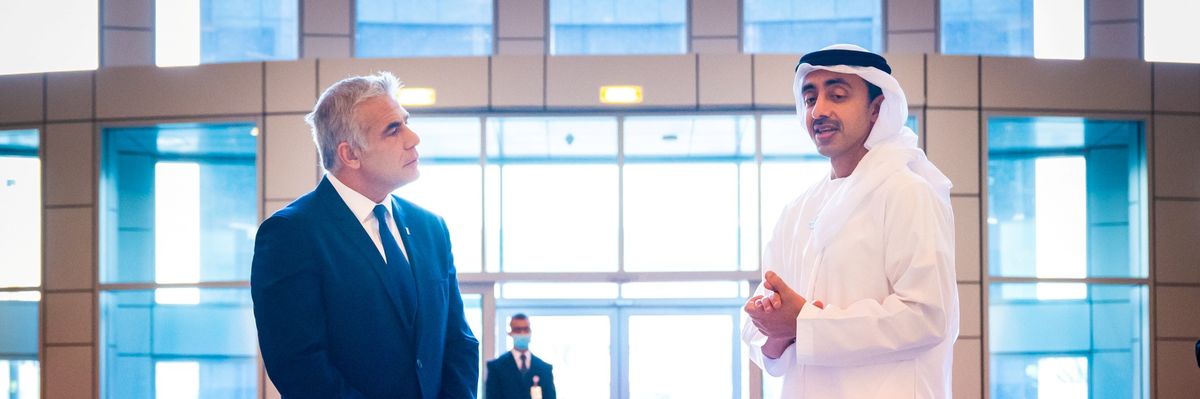
Lat week, Secretary of State Antony Blinken met with his Israeli and Emirati counterparts to discuss regional issues such as Iran’s nuclear program, their joint desire to expand the so-called “Abraham Accords” initiated under the Trump administration, and U.S. foreign policy in the Middle East more generally.
The presence of both the Israeli and Emirati foreign ministers jointly addressing Blinken and a subsequent news conference at the State Department speak to a new reality in Washington: a more formalized united push by Tel Aviv and several Arab states in the region to direct U.S. foreign policy in the Middle East in accordance with their mutual interests.
Israel and other Middle East states lobbying to influence Washington’s regional policies is nothing new. Israel, Saudi Arabia, the United Arab Emirates, Egypt, and others have long sought to sway Washington’s policies in the region in favor of their respective interests. For the Arab countries, their interests have long centered around maintaining absolute authority domestically while repressing the street, upholding the regional geopolitical status quo, and keeping the United States deeply engaged in the Middle East as the security guarantor of the prevailing order from which they benefit. For Israel, in addition to maintaining the regional status quo, it is currently seeking a high-level, top-down “normalization” with Arab states that in part sidelines Arab popular opinion and the plight of the Palestinians. In these normalization agreements, first pursued under the Trump administration and referred to as the Abraham Accords, Israel may also benefit from an evolving security hedge against a common rival: Iran.
No country has been more successful in building a network to influence U.S. foreign policy in the Middle East than Israel. However, as the political interests of elites in Israel and several Arab nations have converged, so too have much of their lobbying efforts. Though their interests are not identical in all matters, several Arab autocrats in the Middle East have increasingly sought to tap various elements of Israel’s influential network in Washington. These endeavors appear to be paying off: over the past several years, various individuals and organizations supporting Israel’s interests have used their influence to shield these governments from human rights criticisms, maintain the flood of arms sales flowing from Washington, and demonize domestic and regional adversaries.
Though the U.S.-sponsored Abraham Accords represent the apex of such efforts, these coordinated efforts to influence American foreign policy predate the wave of “normalizations” between Israel and Bahrain, Morocco, UAE and Sudan. Israel is even trying to woo countries that still do not formally recognize Israel, notably Saudi Arabia.
Examples of these newfound influence campaigns are not difficult to find. The UAE has engaged in outreach and established relationships with well-known organizations and think tanks connected to Israel’s network such as the American Jewish Committee, the Anti-Defamation League, the Conference of Presidents of Major American Jewish Organizations, WINEP, AEI, the Foundation for Defense of Democracies, and others. The UAE’s leadership has been praised by AIPAC and the Conference of Presidents of Major Jewish Organizations for “committing to fight terrorism and extremism in every form” and being “tolerant” and “pluralistic.”
Last August, following the Abraham Accords signing, both AIPAC and then-Israeli Ambassador to the U.S., Ron Dermer, openly expressed their strong support for the UAE acquiring the F-35 fighter jets as the arms deal came under scrutiny in Congress. It was revealed earlier this year that Israel was reportedly planning to lobby President Joe Biden not to pressure the UAE, Saudi Arabia, and Egypt on matters related to human rights. Reportedly in September, they did just that, warning the U.S. not to press Egypt and Saudi Arabia too hard and risk sending them into the arms of Russia and Iran.
Additionally, this past June, the American Jewish Committee (AJC) formally opened an office in Abu Dhabi, and UAE Minister of Foreign Affairs Sheikh Abdullah bin Zayed addressed the 2021 AJC Virtual Global Forum, where he expressed his enthusiasm for the new office.
The UAE, along with Saudi Arabia and Bahrain, have begun cultivating relationships with high-profile Jewish leaders and Christian Evangelicals within the United States. Such efforts are part of a broader project pursued by these governments to promote so-called “moderate Islam” (i.e. state-controlled Islam) to appeal to the West and demonize domestic opposition. In November 2018, Saudi Arabia hosted a delegation of Christian evangelical leaders led by Joel Rosenberg (they had been welcomed to the UAE earlier). A similar delegation that included Rev. Johnnie Moore (then-co-chairman of President Donald Trump’s Evangelical Advisory Board) visited the kingdom once more in September 2019. In January 2020, the secretary-general of the Saudi-financed Muslim World League, Mohammad al-Issa, led a delegation of senior Islamic scholars accompanied by representatives of the American Jewish Committee in an unprecedented visit to the site of the Auschwitz concentration camp in Poland.
Earlier this month, officials from Bahrain traveled to New York City and were hosted by leaders of the local Jewish community and met with the Conference of Presidents of Major American Jewish Organizations. While in the U.S., these officials encouraged Jewish investment and tourism in Bahrain and emphasized their shared concern over the regional threat allegedly posed by Iran.
Elements of Israel’s network also went to great lengths to defend Saudi Crown Prince Mohammed bin Salman following the murder of journalist Jamal Khashoggi. Josh Block, then-CEO of the lobbying group The Israel Project, for example, took to Twitter and called Khashoggi a “radical Islamist terrorist ally who was close to Osama bin Laden, ISIS, Hamas and wanted to overthrow the Saudi ruling royals, who oppose Sunni terrorists, sponsored by Turkey and Qatar, as well as Iran’s Shia terrorist armies and allies.”
Meanwhile, AIPAC sought to protect Egyptian President Abdel Fattah el-Sisi despite his leadership in the 2013 military coup that overthrew the country’s first democratically elected president and the bloody repression that followed. In addition to cautioning against being too critical of Sisi’s human rights record, the organization launched a lobbying blitz to prevent Washington from cutting military aid to Cairo due to the coup.
The two newest members of these lobbying efforts are the states that most recently entered into normalized relations with Tel Aviv: Morocco and Sudan. Morocco’s Foreign Minister Nasser Bourita recently attended an AIPAC conference where he expressed Rabat’s enthusiasm over engaging with Israel and the need to counter Iran’s destabilizing regional activities. Israel is reported to have heavily lobbied the Trump administration to recognize Moroccan sovereignty over the Western Sahara — recognition that Washington had denied since Morocco occupied the former Spanish colony in 1975 — in exchange for normalizing relations with Tel Aviv.
Similarly, Israel was instrumental in persuading the Trump administration to remove Sudan from the state sponsors of terrorism list in return for normalization and lobbied hard for Congress to approve a bill that would have given Sudan immunity from future lawsuits in the U.S. by victims of terrorism.
As these examples demonstrate, Arab autocrats throughout the Middle East have sought to harness the power and influence of Israel’s network in D.C. in order to help ensure their own domestic authority and regional positions. Access to this powerful network is particularly desirable as Washington continues to debate whether to draw down its commanding military presence in the region.