

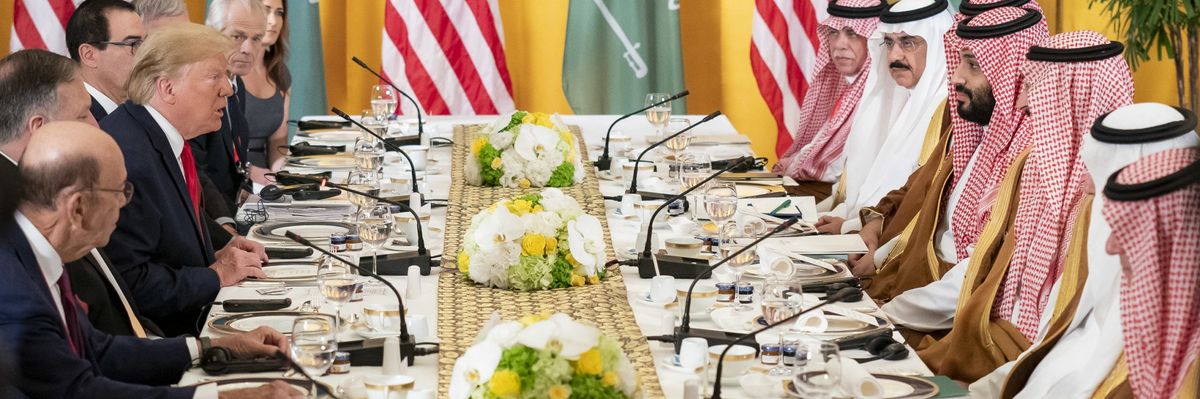
Saudi Arabia’s chairmanship of the Group of Twenty (G20) is proving to be a mixed blessing.
The country and Crown Prince Mohammed bin Salman saw their chairmanship as an opportunity to showcase the kingdom’s leadership and ability to be a visionary global player. But plans to dazzle the grouping and international community with glamorous events in which officials, experts, analysts and faith representatives would develop proposed cutting-edge solutions for global problems at a time of geopolitical rivalry and jockeying for a new world order had to be shelved as a result of the coronavirus pandemic and the worst global economic downturn since World War II.
Lockdowns and other public health safety measures, coupled with the evisceration of air travel, meant that numerous preparatory meetings and brainstorming sessions had to be virtual, replacing glamour, generous hospitality, and organic networking with the sterility of online gatherings. For example, Riyadh had hoped that a high-level interfaith summit in October, a first on Saudi soil, would cement its transition from an austere, inward-looking country that promoted religious ultra-conservatism to one that embraces principles of tolerance, pluralism and freedom of religion. The summit will now have to be held online, although there is a chance that a meeting involving a few prominent non-Muslim religious figures will be held in Saudi Arabia itself.
Prince Mohammed may have seen recognition of Israel following the establishment of diplomatic relations between the Jewish state and the United Arab Emirates and Bahrain as a way of dramatically changing perceptions of the kingdom in the final walk-up to the G-20 summit. However, Saudi Arabia has so far signalled that it favoured normalization but would not do so prior to Israel resolving its differences with the Palestinians on the basis of a two-state solution. That decision likely represents King Salman rather than the crown prince’s inclination but could be overturned if Democratic candidate Joe Biden wins the November 2020 US presidential election. In that case, Saudi Arabia may well see recognition of Israel in advance of the G-20 summit as a way to smooth what otherwise threatens to be a troubled relationship with the incoming administration.
Prince Mohammed’s ambitions were also dampened by other problems, some of which were beyond his control and others that were of his own making. The economic downturn and oil price plunge cast a dark shadow over Vision 2030, his bold plan to transform Saudi society and the economy. Uncertainty on multiple fronts, including the outcome of this year’s US presidential election, to be held three weeks before the G20 summit, subtle Chinese and Russian pressure to reduce tensions between the kingdom and Iran in a bid to rejig the Gulf’s security architecture, and multiple regional rivalries and conflicts complicated the projection of Saudi Arabia as a bright star on the international horizon. So did multiple controversies that raised concerns about its human rights record and its adherence to the rule of law.
The United Arab Emirates’ decision to forge diplomatic relations with Israel threw another spanner in the works. It highlighted contradicting demands: Catering to United States President Donald Trump’s political needs, countering significant criticism of the kingdom in America’s corridors of power and hedging bets on the outcome of next month’s US election on the one hand, and Saudi aspirations for unchallenged leadership of the Muslim world on the other. Following in the UAE’s footsteps would have changed the US landscape from a Saudi perspective, but it would have also exposed it to a wave of criticism from the Muslim world, particularly from its non-Arab constituency.
The absence of an international secretariat offers the rotating chair of the G20 a unique one-year opportunity to shape the global agenda, as well as that of the world’s largest economies. Saudi Arabia’s 2020 chairmanship had the potential to give the kingdom and Prince Mohammed a chance to project themselves as agents of change in a region which, with few exceptions, seemed incapable of liberating itself from the shackles of history, tradition, poor governance, and ingrained animosities and rivalries.
Prince Mohammed initially appeared to have set the stage with his Vision 2030, which envisioned far-reaching social liberalisation and economic diversification: Lifting the ban on women driving; relaxation of gender segregation; the subjugation of the ultra-conservative religious establishment and clipping the wings of the religious police; opening up a modern entertainment industry that featured cinemas, Western-style concerts and other forms of artistic creativity; and the propagation of an undefined moderate interpretation of Islam that promoted tolerance and religious pluralism.
The buzz was reinforced by the prospect of an initial public offering (IPO) of up to 5 per cent of Aramco, the state-owned oil company, privatisation of other assets, including the national airline and utilities, opportunities in multiple other sectors of the economy and liberalisation and deepening of financial markets. Much of that buzz began to fizzle out early on as a result of a valuation of the company at US$2 trillion imposed by Prince Mohammed against the advice of the oil minister, senior Aramco officials, and foreign advisors. The buzz was also dampened by recognition of legal risks involved in a listing on the New York Stock Exchange (NYSE) related to potential 9/11-related legal claims, the NYSE and London Stock Exchange’s transparency requirements, and the kingom’s subsequent decision to list on the Saudi stock exchange.
The repeated postponement of the Aramco IPO as a result of differences over the company’s valuation, queries about corporate governance that would ensure that it would not be required to take on non-core projects at the request of the government, and a reluctance to subject Aramco to submit to transparency and reporting requirements associated with a listing on exchanges in New York, London or Tokyo raised questions in investors’ minds. As a result, the IPO valued the company at US$1.7 trillion, well short of the Crown Prince’s goal of US$2 trillion. Shares were also traded only on the Tadawul, Saudi Arabia’s stock exchange.
The kingdom has also suffered significant reputational damage as a result of the grinding war in Yemen and multiple other issues involving human rights abuse and violations of the rule of law. These included the arrests of powerful members of the ruling Al Saud family and the business community on questionable charges of corruption, creating the perception of a power grab.
Other issues include the detention of dissidents, including activists campaigning for the very reforms implemented by the Crown Prince, the murder of journalist Jamal Khashoggi in the Saudi consulate in Istanbul and the secretive handling of the judicial aftermath, and the insertion of moles in social media companies such as Twitter. Foreign policy fiascos such as the blockade of Qatar and diplomatic spats with Canada and Germany did nothing for the kingdom’s reputation, either.
As a result the chairmanship of the G20 constituted a badly needed opportunity for Saudi Arabia, but it has thus far been a missed opportunity, at least where the West – where it counts most – is concerned.
The Crown Prince’s insistence on pushing ahead with flashy big-ticket projects, including Neom, a US$500 billion futuristic smart city on the Red Sea; Qiddiya, billed as the world’s largest entertainment city; and a massive luxury tourism drive has raised questions about his priorities at a time when the kingdom needs to focus on structural economic and financial reforms and further social changes.
The major issues confronting G20 leaders - containing Covid-19 and tackling its effects, including job loss and stymied economic growth - are magnified in Saudi Arabia, which had an unemployment rate of just under 12 per cent in the first quarter of 2020, before the effects of the pandemic were felt. The G20 chairmanship created a stage for Saudi Arabia to put its leadership in tackling issues and producing solutions on display. Job creation and economic diversification are what will define Prince Mohammed’s regency.
To be fair, few, if any, G20 members will be able to boast of having put the crises behind them by the time the summit is held. The stakes for Prince Mohammed were reflected in a rare credible poll of Saudi public opinion. Asked whether the kingdom’s ban on demonstrations like the ones that toppled leaders across the Arab world over the last decade was a good thing, public opinion was split evenly: 48 per cent agreed and exactly the same percentage did not.
Saudi Arabia had also banked on a negotiated end to the Yemen war to restore some of the gloss to its reputation. Those hopes have so far been dashed by failed attempts to agree on a face-saving solution for all parties. The failure has fuelled calls in Western capitals for restrictions on arms sales.
A failed bid by the kingdom’s sovereign wealth fund, the Public Investment Fund (PIF), for English Premier League team Newcastle United reflected the depths to which its reputation had sunk. The takeover bid was withdrawn after massive pressure was put on the Premier League by human rights groups and others to block the sale.
One significant source of pressure came from the Qatar-owned beIN television network, which is one of the Premier League’s biggest broadcasters. The network has charged for years that the Saudi state was behind a huge effort to pirate its programming It was vindicated by a World Trade Organization (WTO) ruling in June this year. In it, the WTO said Saudi Arabia actively promoted and supported the pirate broadcaster, the curiously-named beoutQ. By doing so, the ruling said, Riyadh had breached its international law obligations on intellectual property rights.
Prince Mohammed had walked away from the 2018 G20 summit in Buenos Aires, months after the Khashoggi murder, confident that he had put the incident behind him. His confidence was based on a high-five from Russian President Vladimir Putin and a business as usual approach by Chinese President Xi Jinping and Indian Prime Minister Narendra Modi. That may have been true for powers like China, Russia and India, but was a premature conclusion with regard to Western powers, with the exception of the White House, an attitude that was not shared by a far more critical US Congress and in much of Europe.
With barely two months to go until the G20 summit in November, Saudi Arabia still has an opportunity to exploit its chairmanship to polish its image and project itself as not only a regional, but global leader in tackling problems with which the world is grappling, chief of which are containing Covid-19 and battling the resulting economic downturn. To do so, it has to quickly adopt a public diplomacy and communications strategy that allows it to put issues that have severely tarnished its image behind it and put its best foot forward.
There are multiple issues that Saudi Arabia could constructively tackle that would significantly improve its image, including a negotiated end to the Yemen war, the release of political prisoners, greater transparency on the Khashoggi case, and formalisation of ties with Israel. But tackling any of these issues entails significant political risk, making it unlikely that the kingdom will successfully do so prior to the G20 summit.
The problem is further that there is little indication that Prince Mohammed has drawn lessons from the fallout of past actions that have significantly damaged his and the kingdom’s image. So far unsuccessful efforts to negotiate a face-saving exit from the Yemen war may be the exception.
Saudi prosecution of alleged perpetrators of Khashoggi’s killing did little to convince the international community that the kingdom honoured due process and the rule of law. Neither did the continued detention of activists, scholars, clerics, businessmen and members of the ruling family on often seemingly trumped up and arbitrary charges nor the continued arrests that seem primarily designed to tighten Prince Mohammed’s grip on power.
Ultimately, the cost-benefit analysis of Saudi Arabia’s G20 chairmanship, once conducted in retrospect, is complicated by factors that it does not fully control. The nature of Saudi Arabia’s relations with the United States three weeks after it hands over the baton of the chairmanship will depend on who wins the US election, who controls Congress and how it approaches a potential Joe Biden administration.
The stakes for Saudi Arabia and Prince Mohammed are high. How it handles the final stretch of its G20 chairmanship is likely to influence its relations with Western powers as well as its leverage in any future talks on rejigging the Gulf’s security architecture, which would involve a more multilateral approach, as well as an easing of tensions with Iran.
This article has been republished with permission from The Turbulent World of Middle East Soccer.