

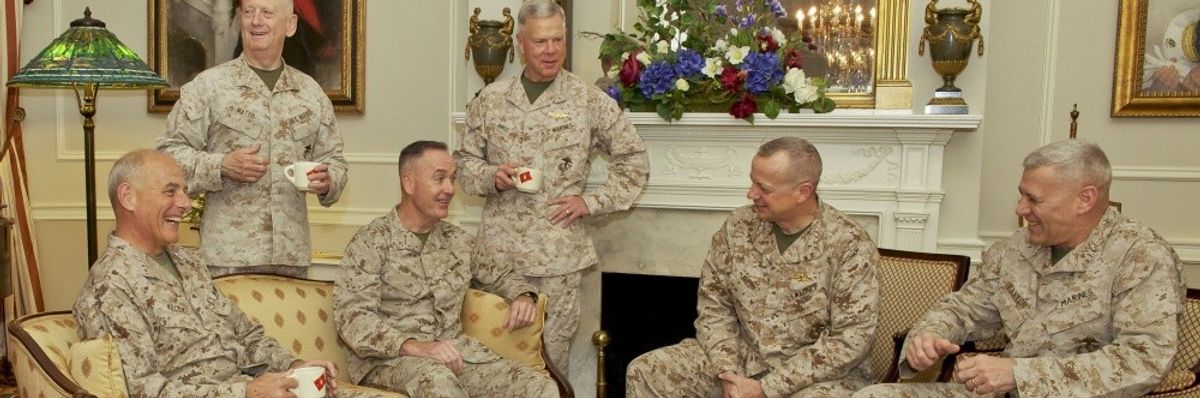
Donald Trump’s political opponents are dizzy with the idea that many of the nation’s four-star generals have been openly questioning the president’s morals and virtue and his fidelity to the Constitution. They have called him a “threat to democracy.”
But it wasn’t too long ago that many of these same critics — particularly Democrats and their progressive allies — were saying the same thing about the generals, as they lied about and promoted wars they did not think we could win, oversaw and defended torture, assassination, and a drone war that put innocent civilians in the crosshairs, and circumvented the Bill of Rights to illegally spy on millions of Americans.
What a difference a few years and a Donald Trump makes.
Suddenly, generals like Stanley McChrystal, James Mattis, Bill McRaven, and Michael Hayden are to be considered paragons of virtue. Colin Powell is no longer a tainted soldier who helped Dick Cheney lie the United States into a unilateral invasion of Iraq. Nor is Barry McCaffrey a zealous Drug War czar who made the violence and corruption worse in Latin America while ignoring alternatives to incarceration back home.
Put aside their own sins for one moment. At a time when the military is still the institution most trusted by the American people, why would these generals (who, retired or not, still represent the military) put that at risk by playing politics? Other retired officers have even suggested that Trump be frogmarched out of the Oval Office when — not if —-he refuses to leave if Biden wins. For nearly half the country that plans to vote for Trump, this may invoke images of military coups that happen elsewhere in the world, not in the United States.
But in a recent article, writer Thomas Colt explained why breaking the long tradition of military a-politicization is so critical in the Trump-era. “The fact that so many top-ranked former Generals and Admirals have gone on record to speak out against Donald Trump underscores the gravity of the threat he represents to our democracy and, ultimately, what it means to be American,” he said.
Colt’s piece, which went on to list several medal-laden generals and direct quotes rebuking the president, was re-tweeted thousands of times largely because of never-Trumper David Frum, a neoconservative who coined the term “axis of evil” for then-President George W. Bush, throwing Iran, Iraq, and North Korea into America’s crosshairs in the wake of the 9/11 attacks and essentially launching what would become the currently ongoing so-called “Global War on Terror.”
This added to critics encouraging generals to do more speaking out, and Biden-friendly media breathlessly showcasing the “break up” of the Pentagon brass with Trump. Establishment-friendly David Ignatius of the Washington Post appears to speak for all of the four-stars when he claims “Trump just isn’t a guy with whom you’d want to share a foxhole.”
Last week, Frum used Colt’s encomium to the generals to mock Trump’s reference to several of them (Mattis, H.R. McMaster, John Kelly) as “disgruntled employees.”
No doubt these generals had their reasons for coming out publicly to say things like “Americans should be frightened — deeply afraid of our future as a nation” (McRaven), or calling the president “immoral” (McChrystal), or referring to Trump’s “assault on our nation’s institutions and values” (Hayden). Likely a mix of personal, political, and ideological is a play here.
But should we not be the ones who are disgruntled over them? One of the reasons why Trump is sitting in the White House right now is due to a well documented, widespread disillusionment of government institutions and the ruling establishment. A fundamental piece of that was the “War on Terror” — the failure of the Iraq and Afghanistan missions to bring resolve much less victory, while human life, precious resources, and our “American Exceptionalism” lay bleeding at the side of the road.
While Americans continue to support troops and the military in annual polling, as members of that exposed establishment, the generals should be on notice with the rest of the elites. Just because it is politically convenient for Trump’s opponents to weaponize them, doesn’t mean we forget what they represent: global instability that cost the American taxpayer more than $6.4 trillion, 8,600 U.S. military dead (not counting contractors), the creation of 37 million refugees and hundreds of thousands of civilians dead in Iraq, Afghanistan and elsewhere since 2002.
So just who are these arbiters of truth? Let’s take a look:
Adm. Bill McRaven. He made his reputation as an Al-Qaeda “manhunter” in Iraq and Afghanistan, assuming control of the controversial Joint Special Operations Command (JSOC) in 2008. Under his command, a JSCOC team killed seven civilians — including two pregnant women and two children in a night raid in Gardez, Afghanistan, in February 2010. The military initially attempted to cover it up and spun it as a Taliban “honor killing.” Later, McRaven reportedly worked with President Obama’s CIA Director John Brennan to coordinate the Obama administration’s “kill lists” for the drone war.
Gen. Stanley McChrystal. Under McChrystal’s command, JSOC was accused of overseeing a secret detention site in Iraq known as “Camp Nama” where detainees were allegedly disappeared and tortured. He was also accused of assisting in the cover up of the death of former NFL star Pat Tillman, who was under his command. McChrystal, in a candid moment, reportedly called the Afghanistan mission “very questionable” though he later went on to push for 40,000 more troops to surge into that country anyway, and was accused of leaking a report that said any fewer would lead to failure.
Gen. Michael Hayden. Hayden was head of the National Security Administration when it initiated illegal wiretaps and massive data collection of Americans in the wake of 9/11. Whistleblowers’ lives were destroyed trying to get that story out. But Hayden not only survived, he thrived. He was subsequently named CIA director in 2006, overseeing its transformation from a spy agency into a counterterror interrogation and drone assassination machine. Later when the Senate was investigating the CIA for torture (before his time), he was accused of lying to the committee repeatedly — downplaying the so-called “enhanced interrorgation techniques” and their affects on prisoners, misrepresenting the actual intelligence they rendered, and giving answers in complete contridiction to the evidence. He denied lying, saying later that “I’m relying on people below me. If they tell you an untruth, you get rid of them.”
Gen. James Mattis. Mattis has revolved in and out of the defense industry and was a key figure in keeping the United States involved in the war in Yemen, supplying the bombs, fueling and tactical assistance to the Saudi-led coalition as it created the largest humanitarian crisis since World War II. When it came time to take a stand in the Trump administration, he resigned his position, not over Yemen, but over Trump’s reported desire at the time to get out of the war in Syria.
Gen. Barry McCaffrey. As Drug Czar during the Clinton years, McCaffrey was the architect of “Plan Colombia,” which poured over $10 billion dollars in American taxpayer dollars into what is now widely considered a failed Drug War effort to cut cocaine production and the black market in Colombia and Latin America, using the U.S. military, Drug Enforcement Agency, and other federal law enforcement tools to “assist.” Violence there today is still raging, and the narco states are thriving. Meanwhile, he led an agency that helped to increase the incarceration of drug offenders (the Clinton administration oversaw the biggest explosion in prison population) and cracked down on patients and doctors who used and prescribed medical marijuana.
Gen. John Allen. The former commander of U.S. forces in Afghanistan was identified by the Washington Post’s Afghanistan Papers series for being one of the many generals knowingly promoting a false narrative that “victory is right around the corner” and that the Afghanistan forces were “better than we think they are” and ready to take on their own security.
Gen. Colin Powell. Though he would live to regret it, as George W. Bush’s secretary of State, Powell most famously decided to roll with evidence he privately did not have full confidence in, and made the case in front of the United Nations that Sadaam Hussein had active weapons of mass destruction in Iraq, a presentation that many say turned the tide of U.S. public opinion toward overwhelmingly favoring the U.S. invasion of Iraq.
***
These generals, now retired, are legally free to say whatever they want about the president. But lecturing the American people on morality and national security threats brings with it a tang of hypocrisy. They might want to consider the long term consequences of wading into this fraught election season, and ask whether they can ever claw their politics back for the sake of the integrity of the military — and nation —they long served.