

The United States has always asked extraordinary things of its service members. But this week, a series of remarkable news stories came out documenting the dire conditions of sailors aboard the USS Abraham Lincoln, a ship that has been at sea so long that those aboard have not stepped foot on land since 2025.
Even families like mine, who have experienced multiple combat deployments, are alarmed by the depictions we read in this news.
We know that behind every sailor and Marine we read about on that ship, there is an entire family unit thousands of miles away wrestling with fear, exhaustion, confusion, anger, and loneliness every day that ship remains in harm’s way. From the spouses who suddenly became the only parent in their home, to the parents waiting anxiously for a phone call, to the children whose birthday parties and baseball games have an empty chair at them this year.
We also know that the sailors and Marines on the Lincoln may be in the spotlight at the moment, but their stories are merely a fraction of the bigger picture. Across the region, thousands of service members and their families are being worn down by new or extended mobilizations right now, with diminishing supplies and without a clear end in sight.
As advocates, we are hearing from those families.
One spouse told us her Marine was supposed to be gone for 60 days. It has now been six months.
A common theme we’re hearing from many deployed families is that communication back home has been abysmal — so much so that it has fundamentally changed how family members feel about the institution their family has entrusted with the life of someone they love.
Another spouse of someone deployed told us: “If my spouse were to be injured or killed, I feel like the military wouldn’t even tell me. I’ve lost all trust.”
That statement stopped me in my tracks. For our military community, communication is not a luxury; it is integral to caring for the families who sacrifice behind the uniform. Trust is not a courtesy; it is literally all we have left when we hug our service member good-bye.
That trust extends to the political leaders making decisions over war and peace, whom we rely on to deliberate somberly and send Americans into war only when absolutely necessary. That trust also includes the military leaders overseeing operations to acknowledge a military family’s sacrifice and incorporate them into communication.
Her statement: “I’ve lost all trust.” Do not mistake that for some petty complaint from a person who simply cannot handle military life. Rather, it is an urgent warning sign for a country that relies on an all-volunteer force.
I am the spouse of a two-time Iraq War combat veteran, and the granddaughter of a Medal of Honor recipient. I have lived this life firsthand.
When my spouse deployed in 2004, and again in 2009 for nearly a year, our family knew that separation was part of military life. We knew there would be uncertainty. We knew there would be fear.
But there was also an acknowledgment that the family was part of the equation.
There were attempts at communication from commanders. I heard from my spouse by satellite phone once or twice, and received a handful of letters. It wasn't perfect, but there was an understanding that those of us waiting at home were carrying a burden, too.
There were also tangible efforts to support us. Our command provided respite care in the form of free childcare at our Child Development Center. The housing office made sure yard work was taken care of, recognizing that the spouse left at home was already carrying more than enough.
Those things may sound small, but they were not. They communicated something profound: We see you. We know this is hard. You are part of this military family, too.
There is often a familiar, infuriating response when military families speak publicly about their concerns: "You knew what you signed up for."
What we signed up for was to serve when service was absolutely necessary. We signed up with the understanding that military force should be wielded with purpose, accountability, and constitutional authority — not for some indefinite excursion of choice.
And we signed up believing that when our loved ones went into harm's way, the institution they served would not forget the people waiting for them to come home.
We did not sign up to surrender our right to ask questions when deployments change dramatically, when communication disappears, or when families are left wondering whether anyone is paying attention.
The same voices telling military families to sit down and stop complaining are often perpetuating the veteran’s version of a “pick yourself up by your own bootstraps” myth. But in doing so, they ignore the reality that more than two decades of post-9/11 war left veterans and their families in such dire need of support that Americans had to create an enormous network of military and nonprofit institutions to scramble and pick up the broken pieces. Families can’t afford to go through that again.
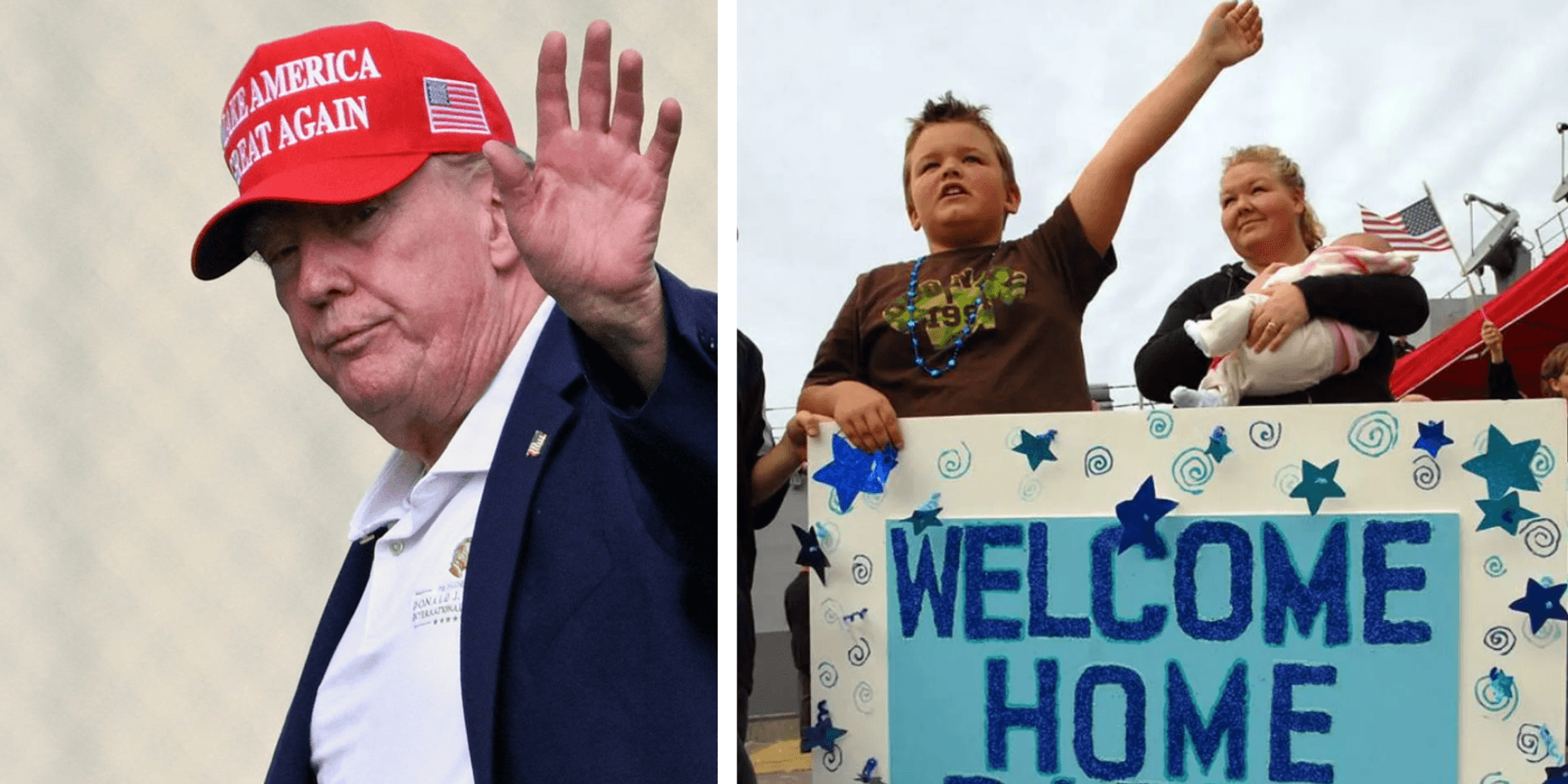
In an interview at Joint Base Lewis-McCord, the president claimed that the families of the USS Abraham Lincoln had no concerns regarding their deployed service members’ wellbeing or mental health. Instead, he crowed that the deployment should last even longer — a position that the Pentagon reversed one day later.
The president ignores military families at our country’s peril. We need to listen to military families, not gaslight them — and not just after the deployment is over, but now.
If we are serious about supporting those who serve, we must stop measuring the cost of war only by what happens on the battlefield. The cost of war is also measured in the families left waiting at home.
The Constitution places the power to declare war with Congress for good reason. It’s the most democratically responsive branch of government and carries the power of the purse.
Earlier this summer, the House and Senate took historic votes opposing this war with Iran, yet the executive branch has proceeded with operations anyway. Military families are being asked to sacrifice months and years of their lives, endure repeated separations, and watch their loved ones enter harm's way — all for a patently unconstitutional conflict.
Sending someone else's husband, wife, mother, father, son, or daughter into harm's way should never be an executive afterthought. It should be a decision made in the light of day, with accountability and transparency.
Military families like ours deserve nothing less.