
Follow us on social

google cta
Trump makes moves to take all  troops out of Iraq and Syria

Trump makes moves to take all  troops out of Iraq and Syria

Source tells RS that complete Baghdad withdrawal will happen by September 2026 and NATO military advisers will also likely leave at the same time.

Reporting | QiOSK
google cta
google cta

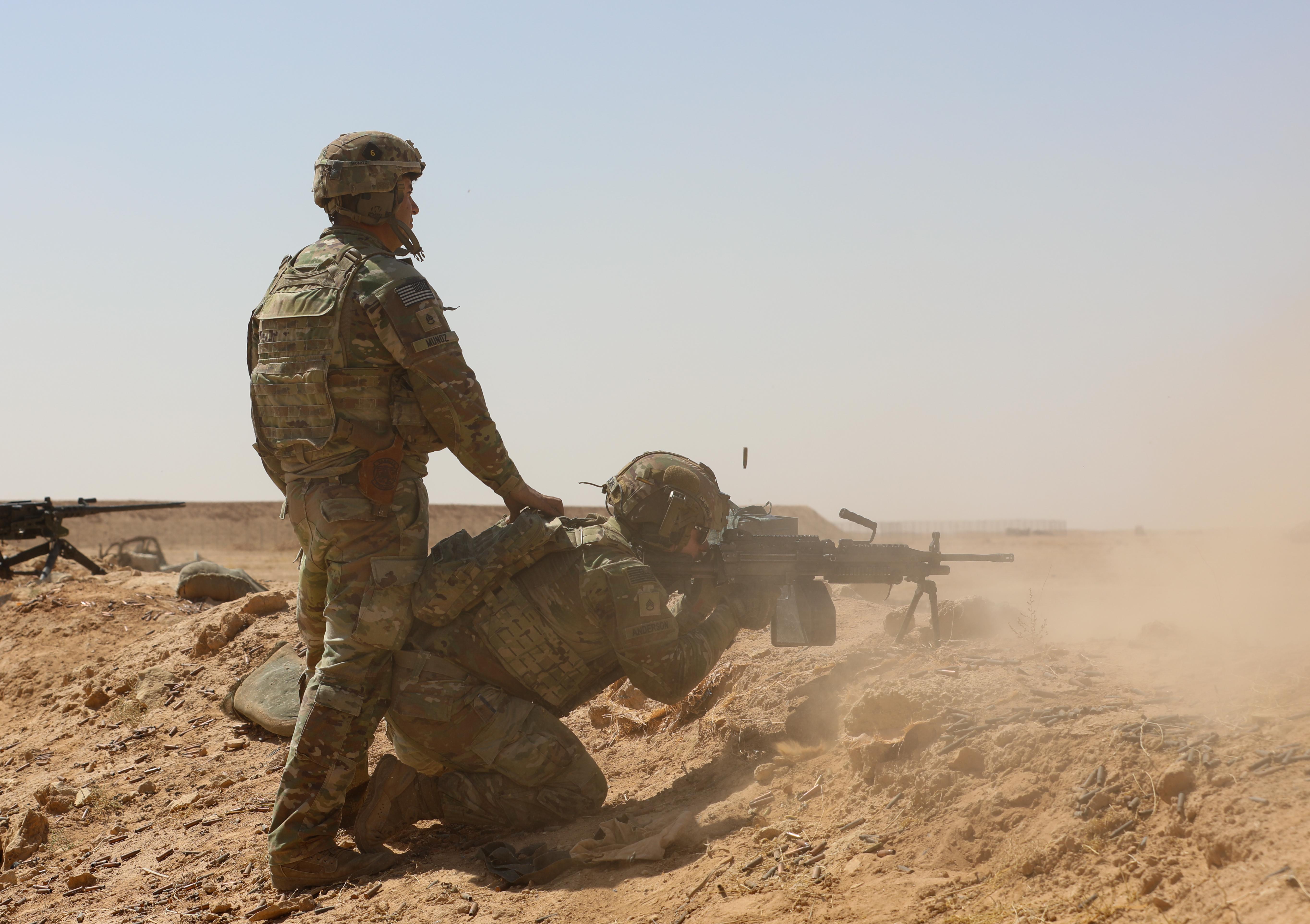
The U.S. plans to complete its military withdrawal from Iraq by September 2026, a U.S. official told RS.

The updated timeline, which the source said will likely coincide with a full withdrawal of NATO military advisers from the country, comes less than a week after Iraqi authorities officially took control of the last American base in federal Iraq. The official, citing operational security concerns, declined to disclose how many U.S. soldiers remain stationed at Harir Air Base in the country’s autonomous Kurdish region.

President Barack Obama had initially withdrawn U.S. combat troops in 2011, eight years after American forces invaded and toppled the government of Saddam Hussein. But Obama sent U.S. combat forces back into Iraq in 2014 under Operation Inherent Resolve, with the goal of helping to beat back ISIS.

With ISIS long defeated as a territorial entity, Iraqi officials have spent years publicly demanding a U.S. withdrawal. In 2024, Washington agreed to pull back its forces by the end of 2026, but it remained unclear whether it would stay committed to that timeline.

The news suggests that President Donald Trump is making progress on his long-standing goal of reducing America’s troop presence in the Middle East, where American soldiers have often served as a target for Iran-aligned militant groups.

Following the collapse of the Kurdish autonomous region in Syria, Trump may also be poised to begin a final withdrawal from Syria, as the Wall Street Journal reported Thursday. Given the increasing central authority of the government in Damascus, U.S. officials now see little reason to maintain their anti-ISIS mission in the country, which now involves roughly 1,000 U.S. soldiers stationed around Syria. Bolstering their desire to leave is the fact that two American soldiers were killed there during a patrol near Palmyra in December.

Plans for a full withdrawal from Iraq and Syria are unpopular among foreign policy hawks, including Sen. Lindsey Graham (R-S.C.), who claimed Thursday that “ISIS would love” it if the U.S. pulled out of Syria. But many of the soldiers who fought in the war on terror will likely see the move as a much-needed end to two decades of open conflict in the Middle East.

As Army veteran Brian Fay told RS in 2024, “there is no such thing as troops being able to stay in a combat zone and not be in some sort of life-threatening danger every single day.”

“After decades of lies, bloodshed and betrayal, I support a full withdrawal from Iraq,” said Army veteran Laura Hartman, adding that it’s now time to “focus on nation-building here at home.”


Top image credit: U.S. Army Soldiers assigned to Task Force Cardinal conduct a live-fire range with M249s, M240s, and M4 carbines at Al Asad Air Base, Iraq, June 18, 2025. The range gave Soldiers the opportunity to refine marksmanship fundamentals, reinforce weapons handling, and maintain combat readiness while deployed in support of Operation Inherent Resolve. (U.S. Army photos by Sgt. Brianna Badder)
google cta
Reporting | QiOSK
G7 Summit
Top photo credit: May 21, 2023, Hiroshima, Hiroshima, Japan: (From R to L) Comoros' President Azali Assoumani, World Trade Organization (WTO) Director-General Ngozi Okonjo-Iweala, Australia's Prime Minister Anthony Albanese and India's Prime Minister Narendra Modi at the G7 summit in Hiroshima, Japan. (Credit Image: © POOL via ZUMA Press Wire)

Middle Powers are setting the table so they won't be 'on the menu'

Asia-Pacific

The global order was already fragmenting before Donald Trump returned to the White House. But the upended “rules” of global economic and foreign policies have now reached a point of no return.

What has changed is not direction, but speed. Canadian Prime Minister Mark Carney’s remarks in Davos last month — “Middle powers must act together, because if we’re not at the table, we’re on the menu” — captured the consequences of not acting quickly. And Carney is not alone in those fears.

keep readingShow less
Vice President JD Vance Azerbaijan Armenia
U.S. Vice President JD Vance gets out of a car before boarding Air Force Two upon departure for Azerbaijan, at Zvartnots International Airport in Yerevan, Armenia, February 10, 2026. REUTERS/Kevin Lamarque/Pool

VP Vance’s timely TRIPP to the South Caucasus

Washington Politics

Vice President JD Vance’s regional tour to Armenia and Azerbaijan this week — the highest level visit by an American official to the South Caucasus since Vice President Joe Biden went to Georgia in 2009 — demonstrates that Washington is not ignoring Yerevan and Baku and is taking an active role in their normalization process.

Vance’s stop in Armenia included an announcement that Yerevan has procured $11 million in U.S. defense systems — a first — in particular Shield AI’s V-BAT, an ISR unmanned aircraft system. It was also announced that the second stage of a groundbreaking AI supercomputer project led by Firebird, a U.S.-based AI cloud and infrastructure company, would commence after having secured American licensing for the sale and delivery of an additional 41,000 NVIDIA GB300 graphics processing units.

keep readingShow less
United Nations
Monitors at the United Nations General Assembly hall display the results of a vote on a resolution condemning the annexation of parts of Ukraine by Russia, amid Russia's invasion of Ukraine, at the United Nations Headquarters in New York City, New York, U.S., October 12, 2022. REUTERS/David 'Dee' Delgado||

We're burying the rules based order. But what's next?

Global Crises

In a Davos speech widely praised for its intellectual rigor and willingness to confront established truths, Canadian Prime Minister Mark Carney finally laid the fiction of the “rules-based international order” to rest.

The “rules-based order” — or RBIO — was never a neutral description of the post-World War II system of international law and multilateral institutions. Rather, it was a discourse born out of insecurity over the West’s decline and unwillingness to share power. Aimed at preserving the power structures of the past by shaping the norms and standards of the future, the RBIO was invariably something that needed to be “defended” against those who were accused of opposing it, rather than an inclusive system that governed relations between all states.

keep readingShow less
google cta
Want more of our stories on Google?
Click here to make us a Preferred Source.

LATEST

QIOSK

Newsletter

Subscribe now to our weekly round-up and don't miss a beat with your favorite RS contributors and reporters, as well as staff analysis, opinion, and news promoting a positive, non-partisan vision of U.S. foreign policy.