

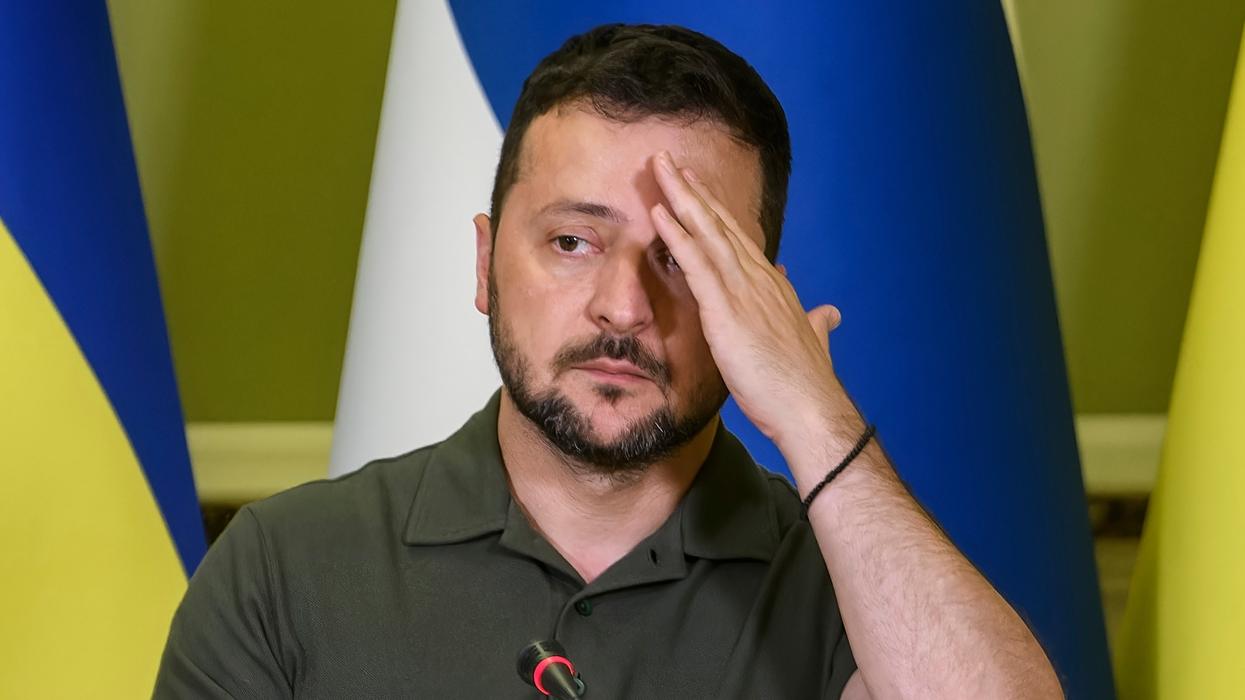
Ukraine's drive to join the European Union is facing increasing frustration. The obstacles are no longer coming from Russia, which has dropped its objection to Ukraine joining the EU: a key concession that grants a core demand of the Maidan protests of 2014. The frustration emerges because the EU cannot dramatically relax its rules of accession to satisfy Ukraine.
Ukrainian President Volodymyr Zelensky has made it clear that he wants any peace plan that ends the Russo-Ukrainian war to include not only a “firm and concrete guarantee” that Ukraine will become a part of the European Union, but also a “precise date.” He recently identified 2027 as the “concrete date,” adding that Kiev is “count[ing] on partners’ support for our position."
Though most European leaders “strongly support Ukraine’s accession to the European Union,” they have resisted pressure to alter substantially the well-established rules of accession to allow Ukraine to join before enacting the legal and administrative requirements for membership.
Recent suggestions of a “membership light” plan, or “reverse enlargement” to fast-track Ukrainian admission to the EU have been dashed. EU President Ursula von der Leyen’s proposal of membership without benefits, including funds and voting rights, was blocked by France and Germany because it is not “realistic.” Officials from Paris and Berlin say the plan lacks support from member states. One EU diplomat says, “I don’t think many of us really ever liked it as a plan.”Getting real
The duration of an accession by any candidate country depends on that country’s adopting legislation and regulations to conform to the so-called acquis, a comprehensive legal and regulatory framework. The 33 chapters of the acquis, negotiated separately, assure the applicant country’s conformity with democratic governance, human rights, the rule of law, and the institutions of a market economy.
Countries that have joined the EU have typically been admitted after seven to nine years of negotiations, and these include countries such as Poland and the Baltics whose institutional, legal and economic reforms were comparatively well advanced before seeking to join. Several countries have made some progress toward accession: Albania, Bosnia-Herzegovina, Montenegro, North Macedonia and Serbia. Ukraine, Moldova and Georgia have more recently become candidates. Turkey’s accession talks have long been stalled but are technically still open.
The EU talks about fast-tracking Ukrainian membership, but it defines “fast” as 2030, and indeed only Finland and Sweden ever have joined on such an accelerated timetable. German Chancellor Friedrich Merz recently stated that accession by 2027 “is out of the question. It's not possible.” He has suggested that it cannot happen until 2035 at the earliest, which would conform to all available precedents.
Zelensky strives to 'reform' the EU: Showdown with Hungary
With the conditions for EU accession becoming clearer, Zelensky has at times shown frustration with Europe, and, in his address to the World Economic Forum in Davos in January, it spilled over. He said that Europe is “a geography” but “not a great power” and called it “just a ‘salad’ of small and middle powers.” He accused Europe of “lov[ing] to discuss the future but avoid[ing] taking action today” and said that “too often in Europe, something else is always more urgent than justice.” Taking aim at Hungary’s Victor Orban, he said, every “Victor” who “lives off European money while trying to sell out Europe deserves a smack upside the head.”
In December, the EU was forced to back away from its plan to use frozen Russian reserves held in Belgium’s Euroclear bank and instead offered a 90 billion euro loan raised by borrowing to bolster Ukraine’s public finances for two more years of war. The pinch for Ukraine’s budget is now looming.
Having agreed in December not to block the EU loan to Ukraine, Orban has now vetoed the implementation of the plan to disburse the funds. This is because Russian oil supplied to Hungary and Slovakia via the Druzhba pipeline has been blocked since late January. Ukraine claims that the pipeline was damaged in a Russian air attack and, therefore, oil cannot flow through it.
After Orbán blocked the disbursement of the loan, Zelensky appeared to threaten his life, saying, "We hope that no one in the European Union will block the €90bn [aid]. Otherwise we will give that person's address to our armed forces so they can call on him and speak to him in their own language.” EU deputy chief spokesperson Olof Gill issued a rebuke of Zelensky, saying, “there must not be threats against EU member states.” European Council President Antonio Costa publicly criticized Zelensky’s remarks.
The EU announced on March 18 that it would send experts to repair the pipeline, but Orban has flatly stated that he will not lift his veto of the loan to Ukraine until the oil deliveries through Druzhba resume.
Orban has accused the European Commission and Zelensky of deliberately interrupting Russian oil delivery to Hungary to promote his defeat in the Hungarian elections to be held on April 12. He has denounced Ukraine, making its “interference” a major campaign theme. In his speech to thousands of supporters on Hungary’s March 15 national day, Orbán called out, “Can you see this, Zelenskyy?... you think that with… the threatening of our leaders, you can scare us?” He then added, “Our sons will not die for Ukraine, but will live for Hungary.”
At a recent rally, Orbán called Zelensky “a minor comedian who imagines himself the arbiter of the fate of a Great Continent” who asks “all of Europe to follow [him]into the abyss” and “dares to mutter threats against Hungary” [translation by Nicolai Petro].
EU membership for Ukraine not easy or quick
Other EU members will also want to ensure their interests are protected by the conditions for Ukraine’s accession to the EU. Ukraine’s former EU ambassador, Olha Stefanishyna, revealed that there is more than one country – not just Hungary –that have concerns about Ukraine joining the EU. Poland’s President Karol Nawrocki, for example, has also expressed reservations.
The accession of Ukraine is a unique and unprecedented case because the country is at war. Nevertheless, the EU’s flexibility is limited by its commitments to strictly apply its membership criteria and without favoritism. In addition to its engagement in an existential conflict with Russia, Ukraine is struggling with corruption, democracy and the protection of cultural, linguistic and religious protection of its ethnic minorities. Many EU states worry that a shortcut Ukrainian admission would harm the credibility of the EU’s membership rules and set a dangerous precedent.
There is no question that the majority of EU members see accession of Ukraine as having special geopolitical significance and would commit to giving priority to Ukraine. But the EU will not be able to set a specific date for concluding accession negotiations, as this removes the leverage the EU has to insist on substantive reforms as a condition of membership.
- Why is Putin OK with Ukraine joining the EU? ›
- They are calling fast-track Ukraine EU bid 'nonsense.' So why dangle it? ›