

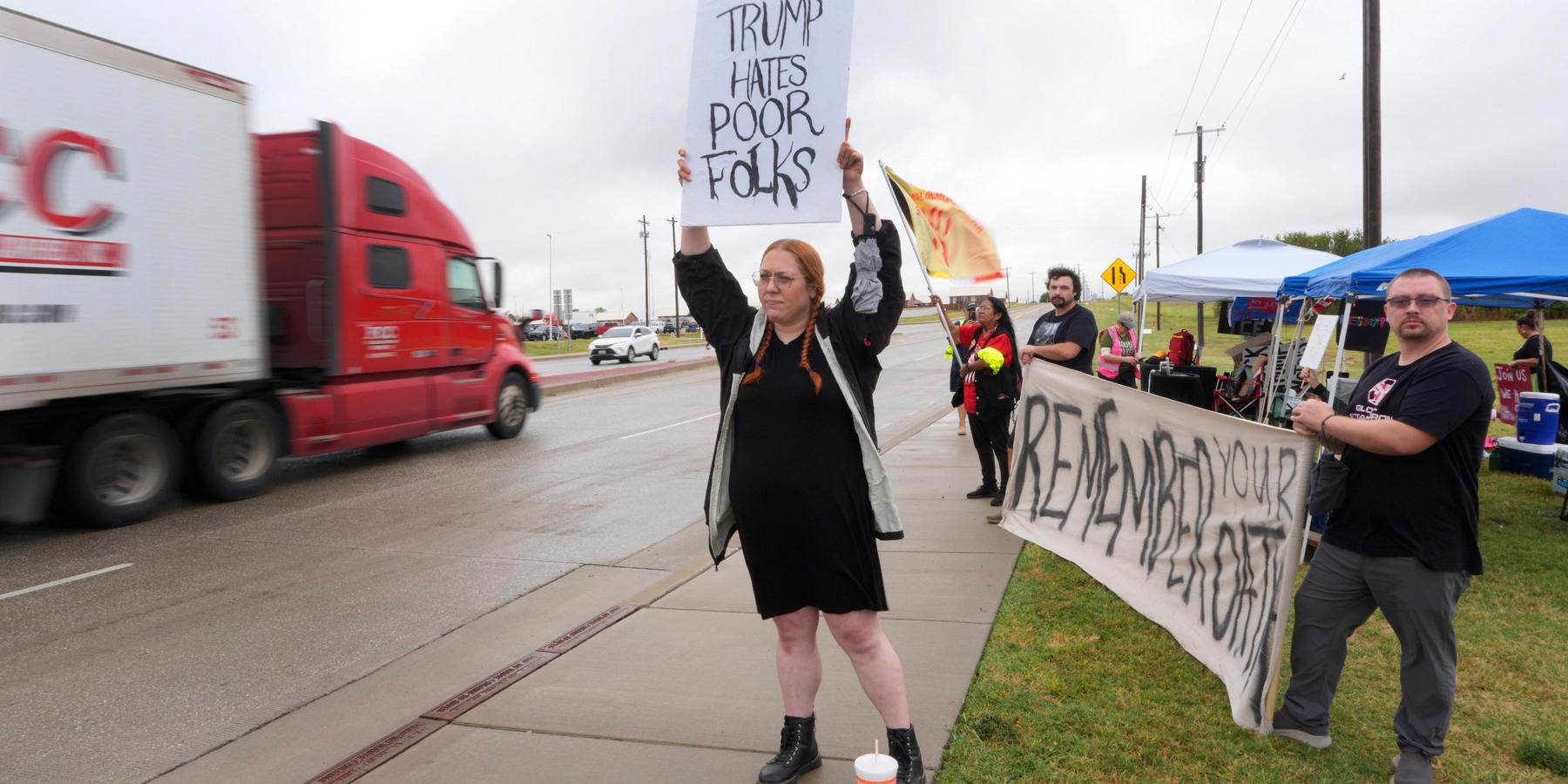
On Monday, as the war with Iran crossed the seven-month mark, Governor Greg Abbott declared a statewide disaster in Texas as a result of a massive increase in diesel prices and a deepening fuel shortage.
Texas is hardly alone. Diesel prices have climbed nationwide since the war began, with the national average now around $6.45 per gallon, up from $3.76 when the war began in late February, according to data from AAA. A number of other states have recently taken steps to try to ease the costs of gas and diesel amid the ongoing war.
As the midterm elections near and the war’s costs hit voters’ wallets, Abbott's declaration is a window into a larger problem for Republicans across the country, including some in deep red states. An increasing number of Republicans are being forced to spend money and political capital defending seats that they carried easily in recent elections.
“The Iran War is proving to be a drag on Republicans, even in solidly Republican states,” Brian Darling, a Republican strategist and former counsel to Sen. Rand Paul (R-Ky.), told Responsible Statecraft in an email, noting that because inflation, caused in part by the war, is driving independent voters toward Democratic candidates.
“These states are exposed to the consequences of the Iran War because the candidates are not distancing themselves, nor providing an off ramp, to President Trump on ending the war,” Darling added.
In Texas, two September polls showed Abbott trailing Democratic state Rep. Gina Hinojosa for the first time in the race. Emerson, the only firm in the New York Times polling tracker to have surveyed voters both before and after the start of the war, showed a five-point swing toward Hinojosa.
Since August, the nonpartisan Cook Political Report has shifted Senate races in five states — Texas, Iowa, Kansas, Georgia, and South Carolina — toward the Democratic party, though some remain likely GOP holds.
Three states that President Donald Trump won by double digits in 2024, namely Texas, Iowa, and Ohio, are currently rated as “toss-ups” in the Cook ratings.
This week, Trump added Nebraska, which he won by more than 20 points, to his midterm speaking tour. Independent polling in the state is sparse, but the race appears to be tightening, and populist independent challenger Dan Osborn has been a vocal critic of the war.
The war itself is broadly unpopular, giving Republicans another reason to worry that its economic costs could become politically damaging. But so far, analysts say, the economic effects appear to be registering more clearly with voters than the conflict itself.
The economic exposure may be especially acute in Republican territory. Much of the GOP coalition rests on rural voters, who tend to drive greater distances, according to Joshua Blank, the research director for the Texas Politics Project at The University of Texas at Austin. These voters' local economies are also more dependent on farming, trucking and other fuel-intensive industries.
That does not mean the war is solely responsible for voters’ economic pain. Political columnist Peter Roff told RS that its effects have been overstated, pointing to lingering inflation and other structural factors that are more to blame for keeping fuel prices elevated. But he acknowledged that such distinctions can be difficult to sell politically when voters see prices rising at the pump.
As Jack Hunter wrote in RS last week, Republicans in tight races around the country are increasingly taking note and trying to distance themselves from the war’s economic fallout, with some beginning to call for the conflict to end.
But that rhetorical opposition has yet to turn into action. When given opportunities to constrain Trump’s war-making authority, most Republican lawmakers have continued to stand behind him.
Only five Republican Senators have voted in favor of any of the 14 legislative efforts to constrain Trump’s ability to wage war without congressional approval. Only one of those five — Susan Collins of Maine — is up for re-election in November. Two will already be leaving the Senate come January.
Luke Nicastro, a senior editor at the American Conservative, argued last week that Republicans (outside of the five senators) who are today talking about affordability are hoping voters don’t pay attention to the fact that they couldn’t muster the courage to actually vote against the war, which is causing the gas and grocery prices to spike in the first place.
Such a strategy can only work if voters can be counted on to actually separate the affordability issue and the ongoing war in their minds as they head to the polls.
“Those Republican candidates are in a jam because they only have a few weeks to engage in intense electoral cognitive therapy to get these voters to compartmentalize their reality,” Charles McElwee, an editor at RealClearPolitics, told RS.
Democrats have certainly noticed the hypocrisy. The party’s Senate campaign arm put out a press release in September listing the past statements and votes of strong support for the war from thirteen GOP nominees, including those in Florida, Iowa, Mississippi, Ohio, South Carolina, and Texas.
“Despite national backlash, nearly every Senate Republican, including those in tight races in key Senate battleground states, just voted to continue the price-hiking war in Iran,” the press release reads, adding that this “comes after GOP Senate candidates shamelessly and desperately scrambled to paper over their extensive records supporting, advocating for, and defending the unpopular war.”
In some cases, the about-face from candidates has been remarkably swift. Rep. Ashley Hinson, the GOP nominee for Senate in Iowa, recently said her constituents “shouldn’t have to foot the bill” for the war in Iran. As recently as last month, she called the same war “out of sight, out of mind for so many Americans” because it is “thousands of miles away.”
Depending on the the district, some Democratic candidates have made explicit the connection between the war and the economy, while others have centered affordability without putting the war itself at the heart of their message. For example, in the fight for the Senate seat vacated by the late Lindsey Graham in ruby red South Carolina, Democrat Annie Andrews is only trailing Graham's sister, Darline Nordone Graham, by 2.5 points in the Real Clear Polling average. She talks more about gas and diesel and has only criticized Graham once for not voting to invoke war powers during her very short time in office.
For Republicans, that leaves little room for error as election day approaches. While experts say that costs for goods like diesel are expected to stay elevated even after any wind-down of the war, Darling says that progress toward a negotiated agreement “would give hope to many that there is a plan to get diesel prices down.”
But the political pressure will only grow if prices continue climbing. “Every gas station in America posts the current price of gas,” Darling added, “and that is a daily advertisement on the progress President Trump is making to resolve the Iran War.”
- Winning? Republicans support a war that's pummeling ‘Main Street’ ›
- Let them eat burritos: Out of touch influencers risk all for Trump war ›
- 'Major wipeout' of 2006 proportions could force a new GOP reckoning | Responsible Statecraft ›
- GOP battleground candidates face tough questions over Iran war ›