

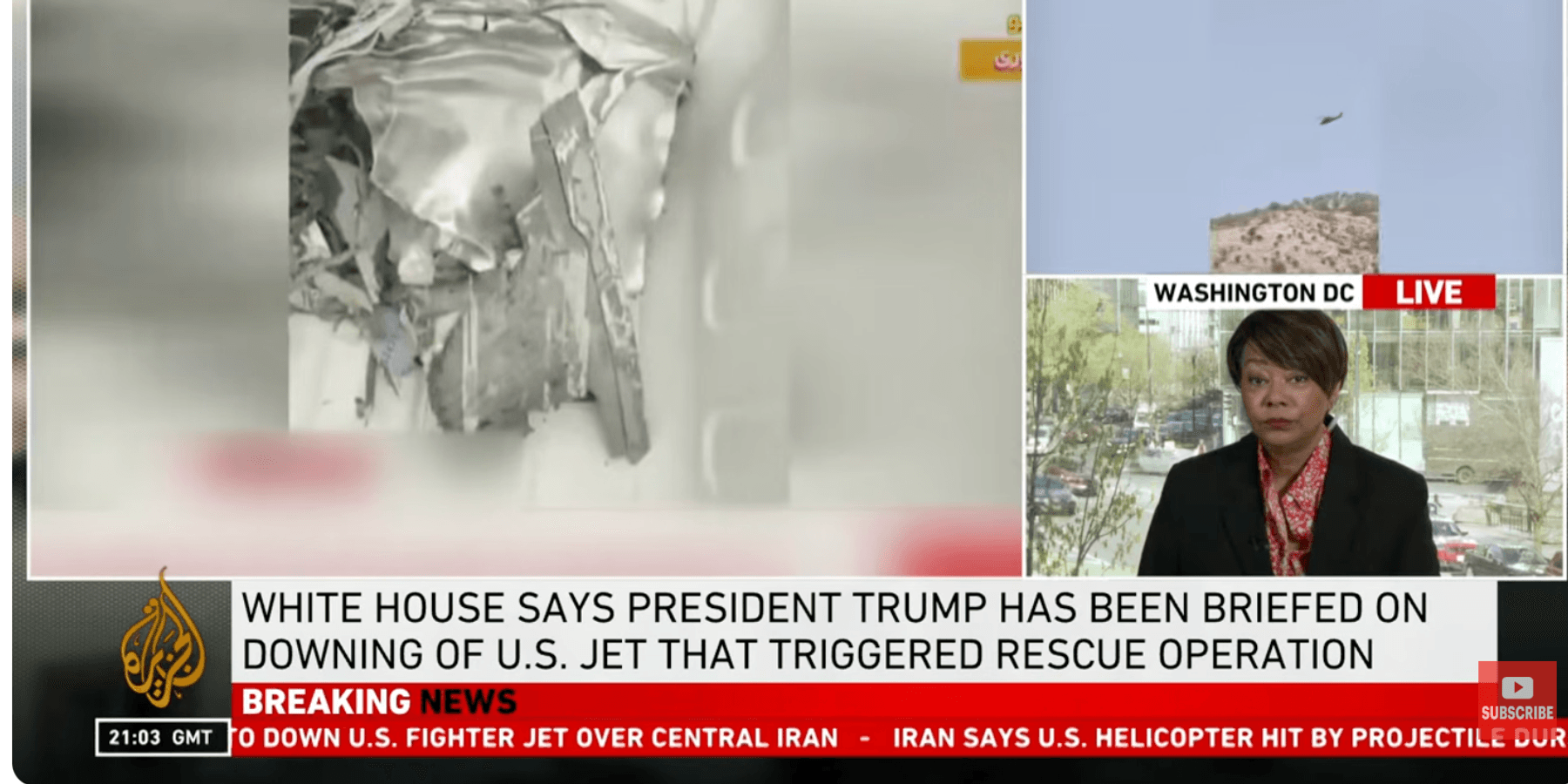
Just 24 hours after President Trump claimed four separate times in a national address that Iran had been “decimated,” a U.S. Air Force F-15E Strike Eagle was shot down over Iranian territory in Khuzestan province, marking one of the most serious direct confrontations of the war to date. The aircraft carried two crew members and one was successfully rescued by Combat Search and Rescue (CSAR), while the second remains missing inside Iran. U.S. search-and-rescue operations are ongoing under hostile conditions, as Iranian forces and local actors have been mobilized to locate the pilot.
The most recent historical parallel occurred during the 1999 Kosovo War, when Serbian air defenses shot down both an F-117 stealth aircraft and an F-16, forcing their pilots to eject into enemy territory and evade capture until they were recovered by U.S. special operations forces. Since 2001, however, the U.S. military has grown accustomed to operating in permissive air environments in Afghanistan, Iraq, and the D-ISIS campaign, where adversaries lacked air defenses capable of contesting U.S. air superiority. This incident therefore represents not just a tactical loss, but the U.S. military’s first true experience with conventional warfare and its associated risks in over a quarter century.
U.S. pilots train extensively for exactly this scenario through Survival, Evasion, Resistance, and Escape (SERE) training, which prepares them to survive behind enemy lines, avoid capture, and resist giving up valuable information if taken prisoner. This includes everything from signaling friendly forces and navigating hostile terrain to withstanding interrogation and delaying enemy propaganda efforts.
Meanwhile the CSAR response has so far included a coordinated package of aircraft, including rescue helicopters and close air support. Conducting such a mission over Iran against a capable air defense network and amid active efforts by the Iranian military to capture the pilot, if he has not already been taken without official acknowledgment, carries significant risk. An A-10 “Warthog,” a single-seat attack aircraft was also hit by Iranian air defenses near the Strait of Hormuz, forcing the pilot to eject outside of Iranian territory. The risk of further U.S. casualties and crashes will increase exponentially as the search continues, and the chance of finding the pilot first diminishes with each hour that passes.
If the missing pilot is alive and has been captured, he is entitled to protections under the law of armed conflict, particularly the Geneva Conventions. As a member of the armed forces, he would qualify as a prisoner of war, meaning he must be treated humanely and provided adequate food, shelter, and medical care. He is only required to provide basic identifying information such as his name, rank, service number, and date of birth, and cannot be coerced into giving intelligence or used for propaganda. The detaining authority is also required to allow access to the International Committee of the Red Cross. In practice, however, these standards are often unevenly applied, and in a rapidly escalating conflict, the pilot could be used as leverage in negotiations. It also represents a significant propaganda victory and morale boost for Iran’s leadership and military, with senior figures like Mohammad Bagher Ghalibaf openly mocking the incident online.
A month ago, the idea that Iran could shoot down a U.S. jet and potentially capture a U.S. service member seemed unthinkable. That it is now possible reflects an increasingly risky and ill-conceived war strategy, or the lack of one. If the pilot falls into Iranian custody, diplomacy to end this war will become exponentially more complicated.
- Putting boots on the ground could kill Trump’s presidency ›
- Seizing Iran’s ‘crown jewel’ would be a suicide mission ›