

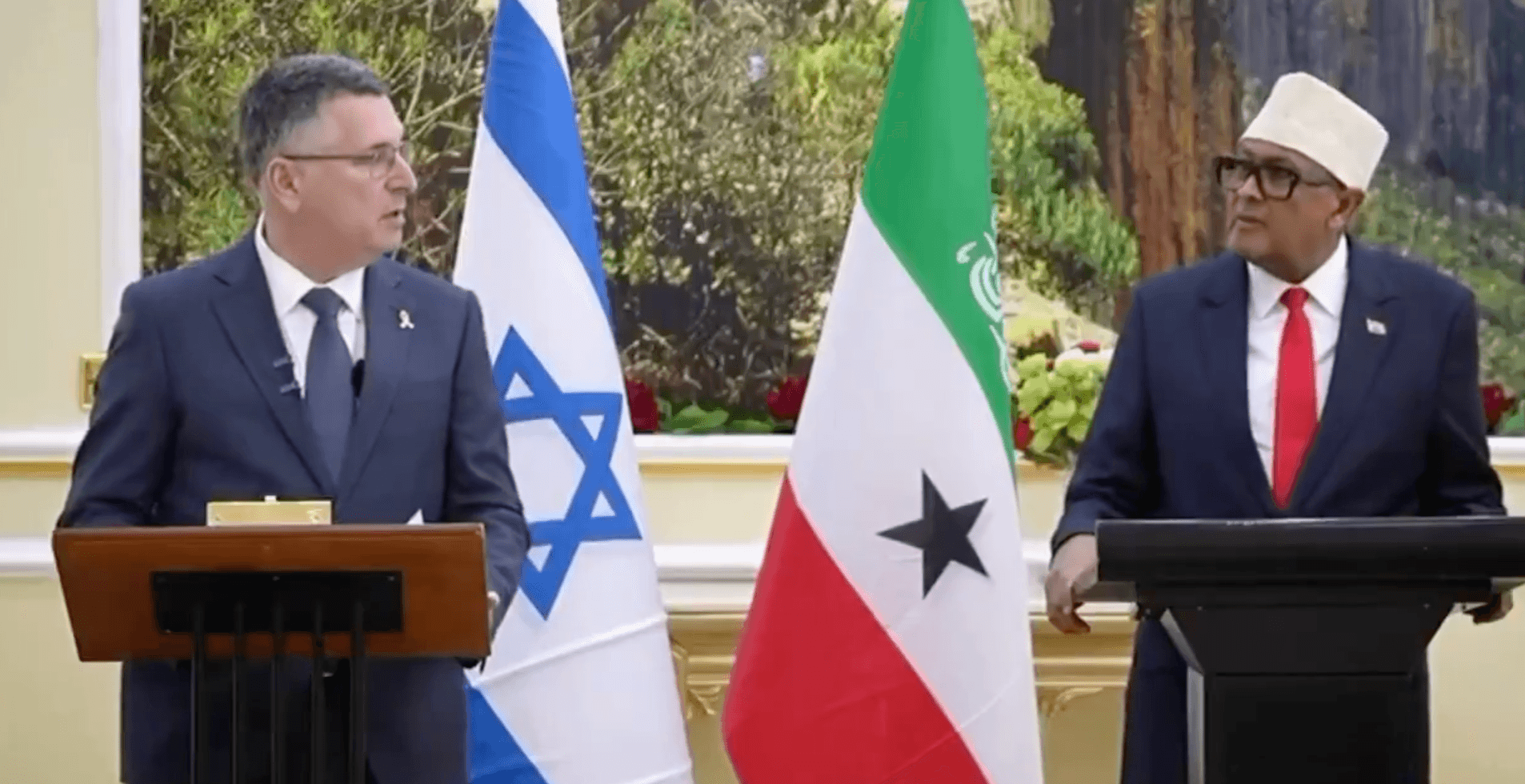
Bloomberg reported Wednesday that Israel is in talks with Somaliland officials to form a strategic security partnership, which might include granting Israel access to a military base or other security installation along the Somaliland coast from which it can launch attacks against Yemen’s Houthi rebels.
With war raging in the Middle East, the Horn of Africa is a particularly important geoeconomic and geopolitical puzzle piece. Its location near the Bab el-Mandeb strait, which connects ships traveling through the Red Sea with the Gulf of Aden and the Indian Ocean, makes it a strategic location from the perspective of global shipping, 10% to 12% of which travels through the strait annually.
For Israel, Somaliland’s strategic importance stems from its close proximity to Yemen. Israeli military officials have long sought to destroy the capability of Houthi rebels to attack Israel as well as its assets in the region. The Houthis’ aggression has grown since the start of the Gaza war in October 2023; the group has conducted nearly 500 attacks against ships and against Israel in the years since.
Although the Houthis have thus far stayed out of the U.S.-Israeli war with Iran, the group’s close relationship with Iran — from which it receives arms, military equipment, and training — keeps it in Israel’s crosshairs.
News of Israeli-Somaliland security talks comes less than three months after Israel became the first country in the world to recognize Somaliland’s independence, which has been contested by Somalia ever since the breakaway region claimed full sovereignty in 1991. Upon Israel’s recognition on December 26, Somalia’s president claimed, without evidence, that the normalization of relations between Israel and Somaliland came with a quid pro quo to open an Israeli military base on Somaliland soil.
In an interview with Bloomberg, Somaliland’s minister of the presidency denied that any negotiations had occurred between his country and Israel on the question of a military base, but didn’t close the door to the possibility of one. “We haven’t discussed with them if [the security partnership] becomes a military base, but definitely there will be an analysis at some point,” said Minister Khadar Hussein Abdi.
An Israeli military base or other security presence on Somaliland would risk significantly expanding the war in the Middle East to the fragile Horn of Africa region, which is already home to plenty of factionalization, armed violence, and proxy conflicts.
Alliances are forming on the question of Somaliland’s independence, with the United Arab Emirates joining Israel in supporting the breakaway state (though the UAE still doesn’t recognize it). Some experts say the UAE — which built and operates the commercial-military Berbera port on the coast of Somaliland — helped facilitate this recognition. Turkey, Qatar, and Saudi Arabia, meanwhile, have thrown their support behind Somalia, including through security arrangements and arms sales. Turkey’s largest base outside its own territory is in the Somali capital of Mogadishu.
Questions now abound over whether the United States might also recognize Somaliland independence, something President Trump has reportedly contemplated, and a policy position being pushed in Washington by a Somaliland lobby, as reported by Drop Site.
Beyond Somalia’s intense disagreement with Somaliland over the latter’s independence, the Somali government is also in a decades-long fight against the al-Qaeda affiliate al-Shabaab, which has made some territorial gains in recent months. Since the presidency of George W. Bush, the United States has engaged in heavy counterterrorism activity in Somalia, and President Trump has conducted more air strikes on the country than his three predecessors combined.
Meanwhile, directly to the west, Ethiopia and Eritrea are preparing for what could be another military confrontation between the two.
Neighboring Sudan, meanwhile, is in the middle of a brutal civil war that has forced the displacement of 14 million people, more than any other current conflict in the world. This civil war has become a major proxy conflict, with different African and Middle Eastern players supporting opposite sides. South Sudan is also at risk of returning to civil war, as violence between the government and opposition forces intensifies; the latest clash in early March left at least 169 people dead.
Extending Israel’s military presence to Somaliland is only likely to exacerbate these already intense regional crises and proxy conflicts, and bring the widening Middle East war to African soil.