
Follow us on social

google cta
Israel brazenly bombs Qatar, U.S. ‘partner’ and host of 10,000 American troops

Israel brazenly bombs Qatar, U.S. ‘partner’ and host of 10,000 American troops

The attack could throw a wrench into U.S. relations with Gulf states, experts say

Reporting | Middle East
google cta
google cta

Editor's note: We are updating this article as this story develops. Last updated at 2:30 pm Eastern Time.

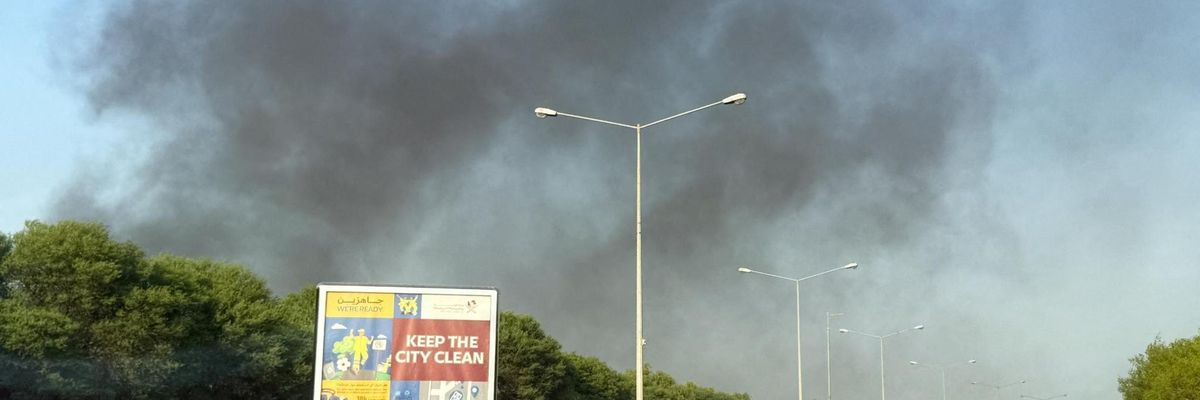
Israel launched airstrikes targeting Hamas leaders in Doha, Qatar, a major non-NATO ally that hosts the largest U.S. military base in the Middle East, which houses at least 10,000 American troops.

The attack appears to be the first ever Israeli airstrike on the territory of an Arab Persian Gulf state. The bombing killed several Hamas staffers, but the group's negotiating team survived, according to Hamas sources. The strike killed at least one member of Qatar's Internal Security Forces and injured others, according to Qatar's Interior Ministry.

Hamas officials have maintained a presence in the Qatari capital since 2011, when the U.S. requested that Qatar set up a back channel with the group. The U.S. embassy in Doha urged American citizens who live and work in the city to shelter in place following the strikes.

A Western diplomat told the Washington Post that American allies in Doha did not receive advance notice about the strike. The Israeli prime minister’s office said the attack was a “wholly independent” operation, adding that Israel takes “full responsibility” for it. But anonymous Israeli officials told the Jerusalem Post that the U.S. knew that the attack was coming.

White House spokesperson Karoline Leavitt condemned Israel's attack, telling reporters that the move "does not advance Israel or America's goals." Leavitt also noted that President Trump spoke with Qatari officials and "assured them that such a thing will not happen again."

If the U.S. approved the strike ahead of time, it would deal a major blow to American credibility in the region, according to Trita Parsi, the executive vice president of the Quincy Institute, which publishes Responsible Statecraft. “What’s the value of having American protection through the presence of an American base if the United States greenlights another country attacking you,” Parsi said, adding that “America shows no willingness to constrain the one country that actually constitutes a threat to” Gulf states.

The attack will likely throw a wrench into talks aimed at securing a ceasefire in Gaza. A Qatari diplomatic source told Responsible Statecraft that Hamas officials were meeting to discuss an American ceasefire proposal at the time of the strike. “As has happened before, the Israelis undermined hopes for peace, further prolonging the war and complicating efforts to bring back the hostages,” the official said.

Since Hamas attacked Israel on Oct. 7, 2023, Israeli forces have targeted the group’s leaders and allies across the Middle East, launching airstrikes in Gaza, Lebanon, Syria, Yemen, Iran, and now Qatar. In July 2024, Israel assassinated Ismail Haniyeh, then Hamas’s lead negotiator in ceasefire negotiations, while he was visiting Iran for a state funeral.

Leaders from across the Arab world moved quickly to condemn Tuesday’s attack, which has sent a shockwave throughout the region. “Striking countries that are mediating the conflict represents a new form of escalation,” argued Dareen Khalifa of the International Crisis Group. “Israel is currently engaged in war in at least six countries; what comes next? It is difficult to entirely dismiss any possibilities.”

Nick Cleveland-Stout contributed reporting.


Top image credit: Smoke rises after several blasts were heard in Doha, Qatar, September 9, 2025. REUTERS/Ibraheem Abu Mustafa
google cta
Reporting | Middle East
NATO
Top photo credit: Keir Starmer (Prime Minister, United Kingdom), Volodymyr Zelenskyy (President, Ukraine), Rutte, Donald Tusk (Prime Minister, Poland) and Friedrich Merz (Chancellor of Germany) in meeting with NATO Secretary, June 25, 2025. (NATO/Flickr)

Euro-elites melt down over NSS, missing — or ignoring — the point

Europe

The release of the latest U.S. National Security Strategy (NSS) has triggered a revealing meltdown within Europe’s political and think-tank class. From Berlin to Brussels to Warsaw, the refrain is consistent: a bewildered lament that America seems to be putting its own interests first, no longer willing to play its assigned role as Europe’s uncomplaining security guarantor.

Examine the responses. German Chancellor Friedrich Merz finds the U.S. strategy “unacceptable” and its portrayal of Europe “misplaced.” Polish Prime Minister Donald Tusk, for his part, found it necessary to remind the U.S. that the two allies "face the same enemies." Coming from a Polish leader, this is an unambiguous allusion to Russia, which creates clear tension with the new NSS's emphasis on deescalating relations with Moscow.

keep readingShow less
Gaza war
Top image credit: Palestinians receive their financial aid as part of $480 million in aid allocated by Qatar, at a post office in Gaza City on May 13, 2019. Photo by Abed Rahim Khatib. Anas-Mohammed via shutterstock.com

Gaza's economy is collapsing. It needs liquidity now.

Middle East

As the world recently marked the International Day of Solidarity with the Palestinian People, and only days after the U.N. Security Council approved the U.S.-backed resolution outlining a new security and governance framework for Gaza, one central issue remains unresolved. Gaza’s economy is collapsing.

Political resolutions may redefine who administers territory or manages security, but they do not pay salaries, keep ATMs functioning, or control hyperinflation. Without Palestinian-led institutions independently allowed to manage money transparently and predictably, a Palestinian state risks becoming purely symbolic.

keep readingShow less
Polymarket ISW
Top image credit: Jarretera and jackpress via shutterstock.com

Think tanker altered Ukraine war map before big Polymarket payout

Washington Politics

On November 15, as Russian forces were advancing on the outskirts of the town of Myrnohrad in eastern Ukraine, retail investors placed risky bets in real time on the battle using Polymarket, a gambling platform that allows users to bet on predictive markets surrounding world events. If Russia took the city by nightfall — an event that seemed exceedingly unlikely to most observers — a handful of retail investors stood to earn a profit of as much as 33,000% on the battle from the comfort of their homes.

When nightfall came, these longshot gamblers miraculously won big, though not because Russia took the town (as of writing, Ukraine is still fighting for Myrnohrad). Instead, it was because of an apparent intervention by a staffer at the Institute for the Study of War (ISW), a D.C.-based think tank that produces daily interactive maps of the conflict in Ukraine that Polymarket often relies on to determine the outcome of bets placed on the war.

keep readingShow less
google cta
Want more of our stories on Google?
Click here to make us a Preferred Source.

LATEST

QIOSK

Newsletter

Subscribe now to our weekly round-up and don't miss a beat with your favorite RS contributors and reporters, as well as staff analysis, opinion, and news promoting a positive, non-partisan vision of U.S. foreign policy.