

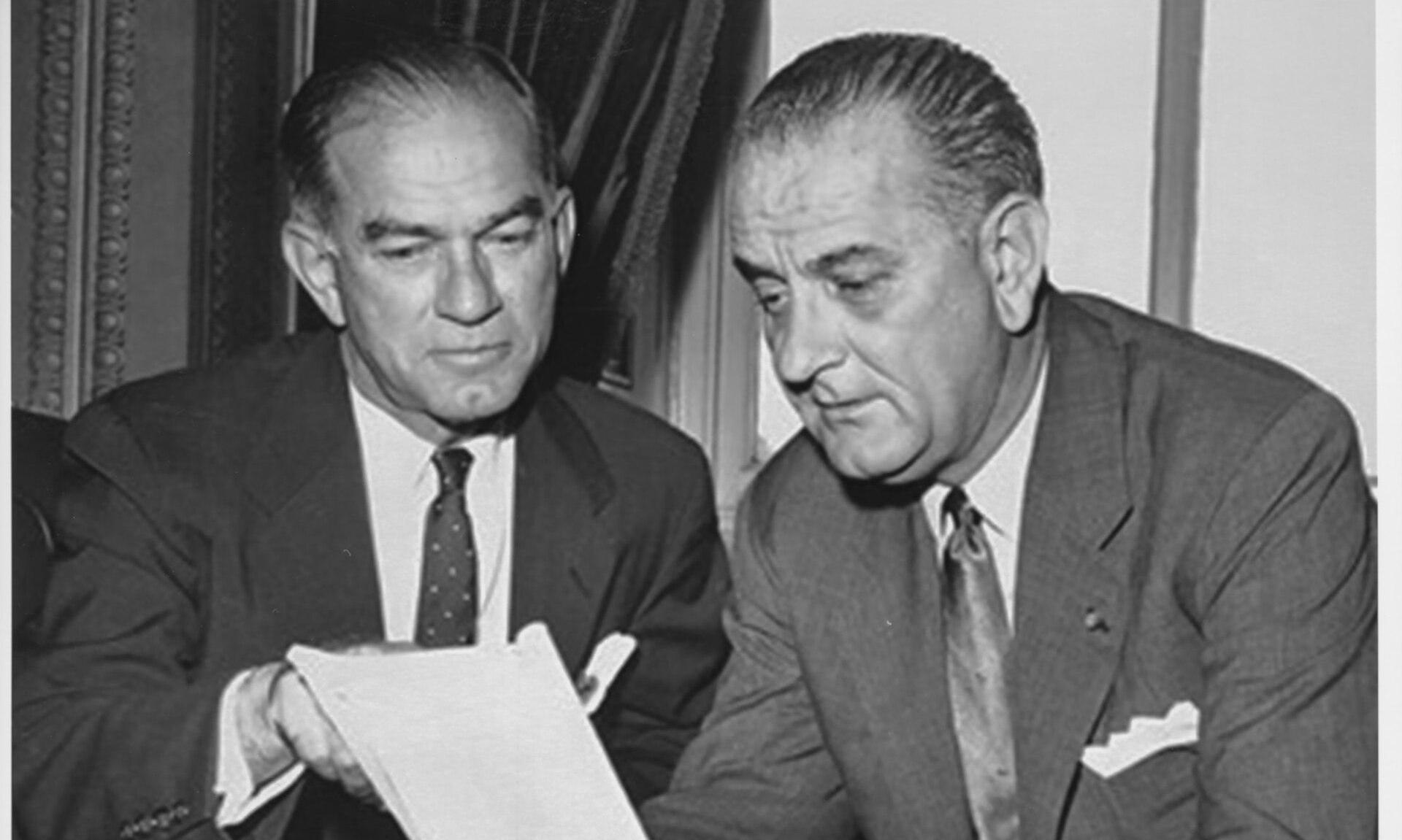
If one listens closely, faint echoes from 60 years past might be discerned in the aftermath of the United States’ latest aggression against the Islamic Republic of Iran. The voice of Senator J. William Fulbright, condemning a Congress for abrogating its power to decide when and how the nation went to war, rings clear given we face a nearly mirror situation today.
It seems worthwhile then to revisit that moment as debate now rages over the merits, morality, and legality of President Trump’s second regime-change war in less than two months. In 1966, Fulbright convened five days of televised “educational” hearings for better comprehending the American war in Vietnam. The Arkansas Democrat, then chairman of the Senate Foreign Relations Committee, followed with a series of lectures that spring at Johns Hopkins University, widening his scope and leveling a sharp critique against U.S. foreign policy.
The denouement came shortly after with the publication of The Arrogance of Power, a meditation on the excesses of an increasingly imperial presidency that merits our attention today.
Two years after the 1964 Gulf of Tonkin Resolution authorized President Lyndon B. Johnson to take “all necessary measures” to repel armed attacks against U.S. forces and “prevent further aggression” in Southeast Asia, Fulbright offered a stark warning about U.S. interventionism. The senator worried that a “lack of self-assurance” tended to “breed an exaggerated sense of power and mission.” Confusing “great power with unlimited power” was dangerous not only to the nation, but to the entire globe.
Given the subjective nature of waging an ideological (and global) campaign against communism, legitimate justifications for war mattered. So too was maintaining American prestige and credibility abroad as Cold War policymakers consistently fretted about the Soviet Union’s “design for world domination.”
Fulbright, however, castigated senior Pentagon officials for conflating pride with achievement. Deploying large numbers of warships and aircraft to Vietnam, for instance, might seem impressive on its face, but were these displays of military muscle truly achieving a lasting peace in war-torn Asia? Unsurprisingly, the senator admonished Secretary of Defense Robert S. McNamara for treating the American “war machine as an end in itself.”
Fulbright went further, denouncing the consequences of a military-industrial complex that had embedded itself into foreign policy decision-making. Rejecting more “constructive pursuits,” Americans had fallen prey to policy elites stirring up a “war fever in the minds of our people.” Worse, in the context of Vietnam, he forewarned that the longer war endured “without prospect of victory or negotiated peace … hopes will give rise to fears, and tolerance and freedom of discussion will give way to a false and strident patriotism.”
Americans’ self-righteous approach to their place in the world accentuated such worries. Fulbright thought it important to make “moral distinctions” between wars, contending that the then commonly used Munich analogy — where appeasing any aggressor would lead to global conflict — did not apply in all instances. Not every belligerent was a would-be Hitler.
To the senator, however, the U.S. policy elite had engaged in a form of fearmongering, leading to armed interventionism unfettered by moral restraint. American exceptionalism left little room for self-reflection when it came to decisions of war. In the process, both civilian and military leaders failed to distinguish much difference, if any, between “virtue” and “omnipotence.”
Notably, the late historian Marilyn Young would reinforce these critiques as she condemned Americans’ penchant for believing their nation’s unique power gave them carte blanche to employ military force, unchecked, across the globe. To Young, the United States wasn’t morally or culturally exceptional, “only exceptionally powerful.”
This eroding moral authority to curb interventionism concerned Fulbright. The former Rhodes scholar, according to biographer Randall B. Woods, pledged “not a determination to export American culture and institutions but rather a commitment to the principle of national self-determination.” As a southern Democrat, Fulbright proved far less circumspect when it came to supporting the civil rights movement at home, maintaining “a perfect anti-integration voting record in Congress from his first election to the House in 1942 until 1970.”
Still, as he argued in 1964, Americans were unsettlingly “predisposed to regard any conflict as a clash between good and evil rather than as simply a clash between conflicting interests.”
Acknowledging these conflicting interests, the Arkansan leaned into his most trenchant critique of contemporary foreign policy debate. Or lack thereof. Fulbright lamented the “intolerance of dissent” to interventionism and believed, in some instances, “dissent [to be] the higher patriotism.” Not until 1968 and the disastrous Tet offensive in Vietnam would more Americans come around to this way of thinking.
In short, Fulbright maintained that dissent was a duty. As was Congress’s obligation to shoulder its constitutional responsibilities regarding war. While the senator had voted for the Tonkin Resolution, by 1966 he was chastising his legislative colleagues for granting the president “such sweeping authority with so little deliberation.”
In the following decades, Fulbright’s convictions would prove prescient. In 1973, as just one example, historian Arthur M. Schlesinger, Jr. enunciated how executive privilege had led to an “imperial presidency,” a challenge obliging “democratic control over American foreign policy.”
Of course, an echo from the past doesn’t necessarily mean that history repeats itself. Context matters. In 1966, a nationwide poll found that 47% of Americans described themselves as “hawks” who wanted to “step up the fighting in Vietnam.” Today, 54% of polled voters “disapprove of Trump’s handling of Iran.” Perhaps “war fevers” can be broken.
Another related distinction centers on what we might call “moral exceptionalism.” In 1966, many Americans still believed in the value of containing communism as a moral imperative, in LBJ’s words, to fulfill their “responsibility for the defense of freedom.” Aside from Mr. Trump’s charge that Iran’s leadership is “evil,” there’s no real sense that most citizens today believe their nation is attacking Iran in pursuit of any greater ideals.
It seems hard to contest the claim that in our current moment President Trump has exploited the power of the presidency with arrogant abandonment. Indeed, he appears to relish that power. From deploying federal paramilitary forces against American citizens to repudiating Supreme Court decisions, this administration sees itself as free from traditional democratic constraints.
Sixty years ago, J. William Fulbright warned his fellow citizens of the dangers in supporting such excesses. Arrogance tended to “confuse power with wisdom” and could lead to “self-appointed missions to police the world … [and] defeat all tyrannies.” The time has come to heed the senator’s call for a bit more humility and a lot less hubris.
- The cost of Trump's Iran war: $5 billion and counting ›
- Trump's war on Iran is already losing the home front ›