

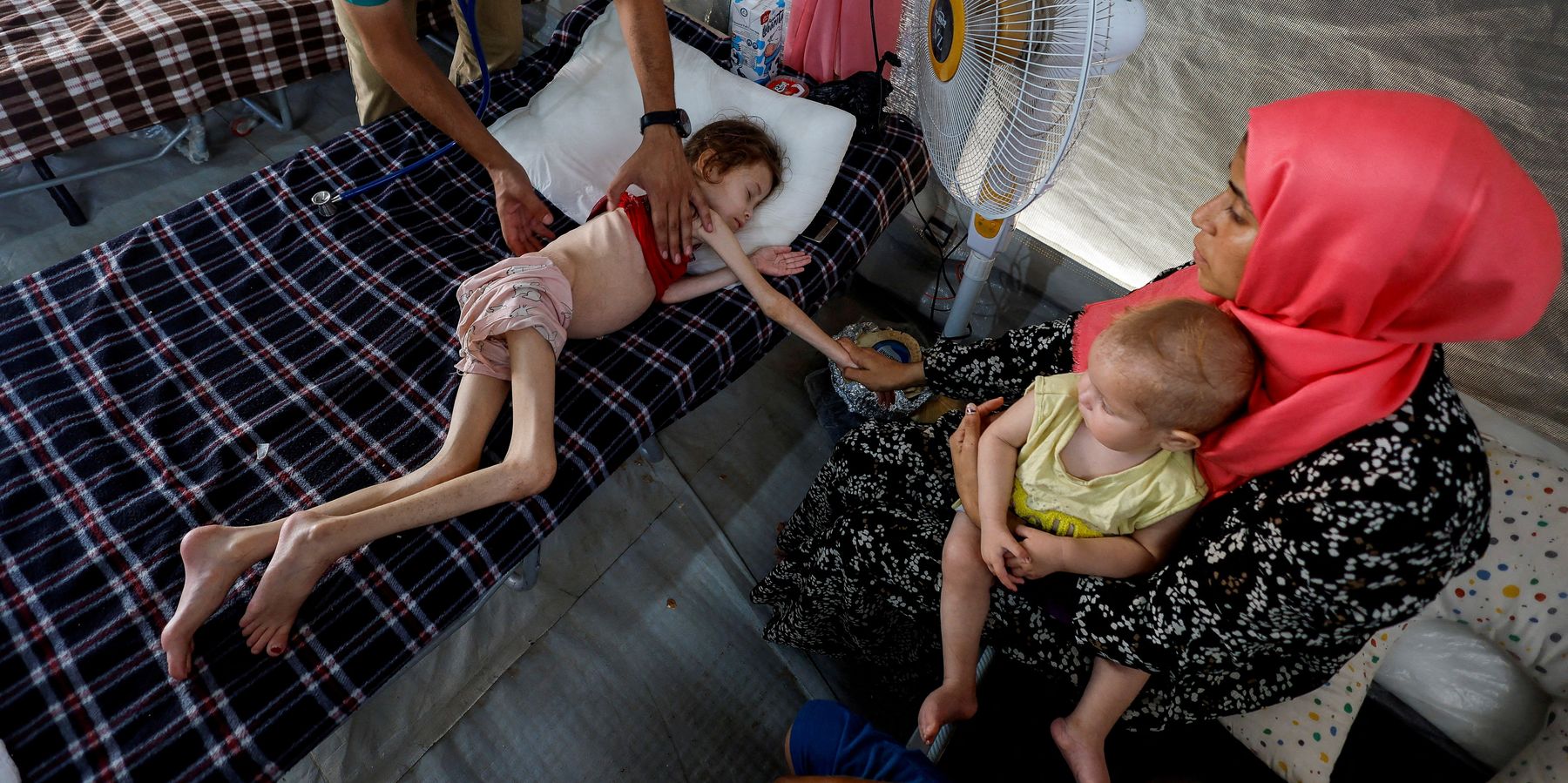
The headlines are increasingly dire.
- “Child Dies of Malnutrition as Starvation in Gaza Grows” (CNN, 7/21/25)
- “More Than 100 Aid Groups Warn of Starvation in Gaza as Israeli Strikes Kill 29, Officials Say” (AP, 7/23/25)
- “No Formula, No Food: Mothers and Babies Starve Together in Gaza” (NBC, 7/25/25)
- “Five-Month-Old Baby Dies in Mother’s Arms in Gaza, a New Victim of Escalating Starvation Crisis” (CNN, 7/26/25)
- “Gaza’s Children Are Looking Through Trash to Avoid Starving” (New York, 7/28/25)
This media coverage is urgent and necessary—and criminally late.
Devastatingly late to care
Since the October 7 attacks, Israel has severely restricted humanitarian aid to the Gaza Strip, using starvation of civilians as a tool of war, a war crime for which Israeli Prime Minister Benjamin Netanyahu and Foreign Minister Yoav Gallant have been charged by the International Criminal Court. Gallant proclaimed a “complete siege” of Gaza on October 9, 2023: “There will be no electricity, no food, no fuel, everything is closed.”
Aid groups warned of famine conditions in parts of Gaza as early as December 2023. By April 2024, USAID administrator Samantha Power (CNN, 4/11/24) found it “likely that parts of Gaza, and particularly northern Gaza, are already experiencing famine.”
A modest increase in food aid was allowed into the Strip during a ceasefire in early 2025. But on March 2, 2025, Netanyahu announced a complete blockade on the occupied territory. Israeli National Security Minister Itamar Ben-Gvir declared that there was “no reason for a gram of food or aid to enter Gaza.”
After more than two months of a total blockade, Israel on May 19 began allowing in a trickle of aid through US/Israeli “Gaza Humanitarian Foundation” (GHF) centers (FAIR.org, 6/6/25)—while targeting with snipers those who came for it—but it is not anywhere near enough, and the population in Gaza is now on the brink of mass death, experts warn. According to UNICEF (7/27/25):
The entire population of over 2 million people in Gaza is severely food insecure. One out of every three people has not eaten for days, and 80% of all reported deaths by starvation are children.
According to the Gaza Health Ministry, at least 147 Gazans have died from malnutrition since the start of Israel’s post–October 7 assault. Most have been in the past few weeks.
Mainstream politicians are finally starting to speak out—even Donald Trump has acknowledged “real starvation” in Gaza—but as critical observers have pointed out, it is devastatingly late to begin to profess concern. Jack Mirkinson’s Discourse Blog (7/28/25) quoted Refugees International president Jeremy Konyndyk:
I fear that starvation in Gaza has now passed the tipping point and we are going to see mass-scale starvation mortality…. Once a famine gathers momentum, the effort required to contain it increases exponentially. It would now take an overwhelmingly large aid operation to reverse the coming wave of mortality, and it would take months.
And there are long-term, permanent health consequences to famine, even when lives are saved (NPR, 7/29/25). Mirkinson lambasted leaders like Cory Booker and Hillary Clinton for failing to speak up before now: “It is too late for them to wash the blood from their hands.”
Barely newsworthy
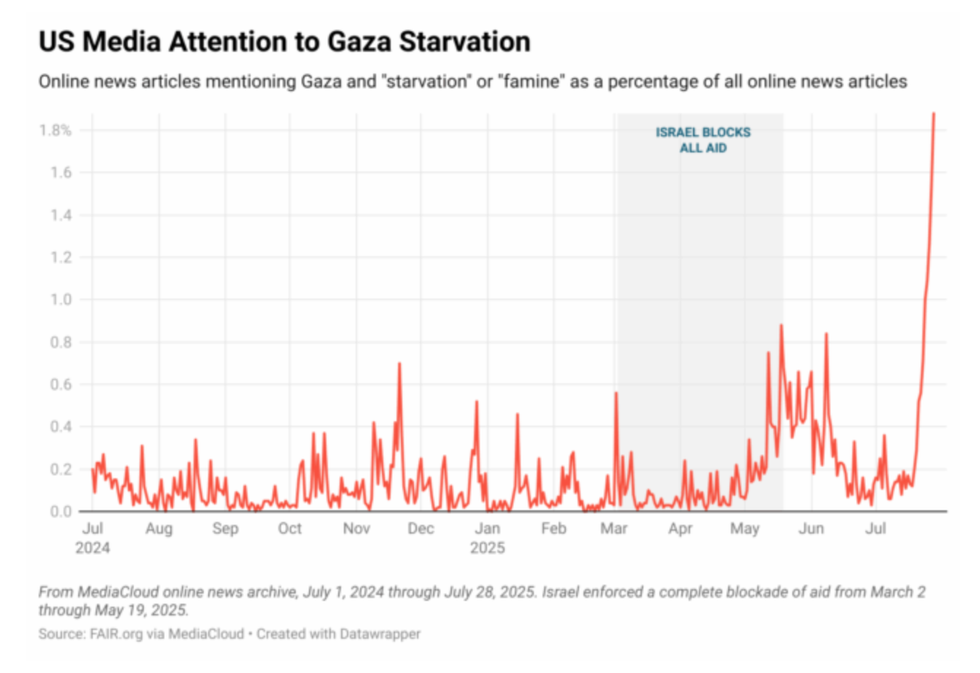
Major US media, likewise, bear a share of responsibility for the hunger-related deaths in Gaza. The conditions of famine have been out in the open for well over a year, and yet it was considered barely newsworthy in US news media.
A MediaCloud search of online US news reports mentioning “Gaza” and either “famine” or “starvation” shows that since Netanyahu’s March 2 announcement of a total blockade—which could only mean rapidly increasing famine conditions—there was a brief blip of media attention, and then even less news coverage than usual for the rest of March and April. Media attention rose modestly in May, at a time when the world body that classifies famines announced in May that one in five people in Gaza were “likely to face starvation between May 11 and September 30″—in other words, that flooding Gaza with aid was of the highest urgency.
But as aid continued to be held up, and Gazans were shot by Israeli snipers when attempting to retrieve the little offered them, that coverage eventually dwindled, until the current spike that began on July 21.
FAIR (e.g., 3/22/24, 4/25/25, 5/16/25, 5/16/25) has repeatedly criticized US media for coverage that largely absolves Israel of responsibility for its policy of forced starvation—what Human Rights Watch (5/15/25) called “a tool of extermination”—implemented with the backing of the US government.
The current headlines reveal that the coverage still largely diverts attention from Israeli (let alone US) responsibility, but it’s a positive development that major US news media are beginning to devote serious coverage to the issue. Imagine how different this all could have looked had they given it the attention it has warranted, and the accountability it has demanded, when alarms were first raised.