

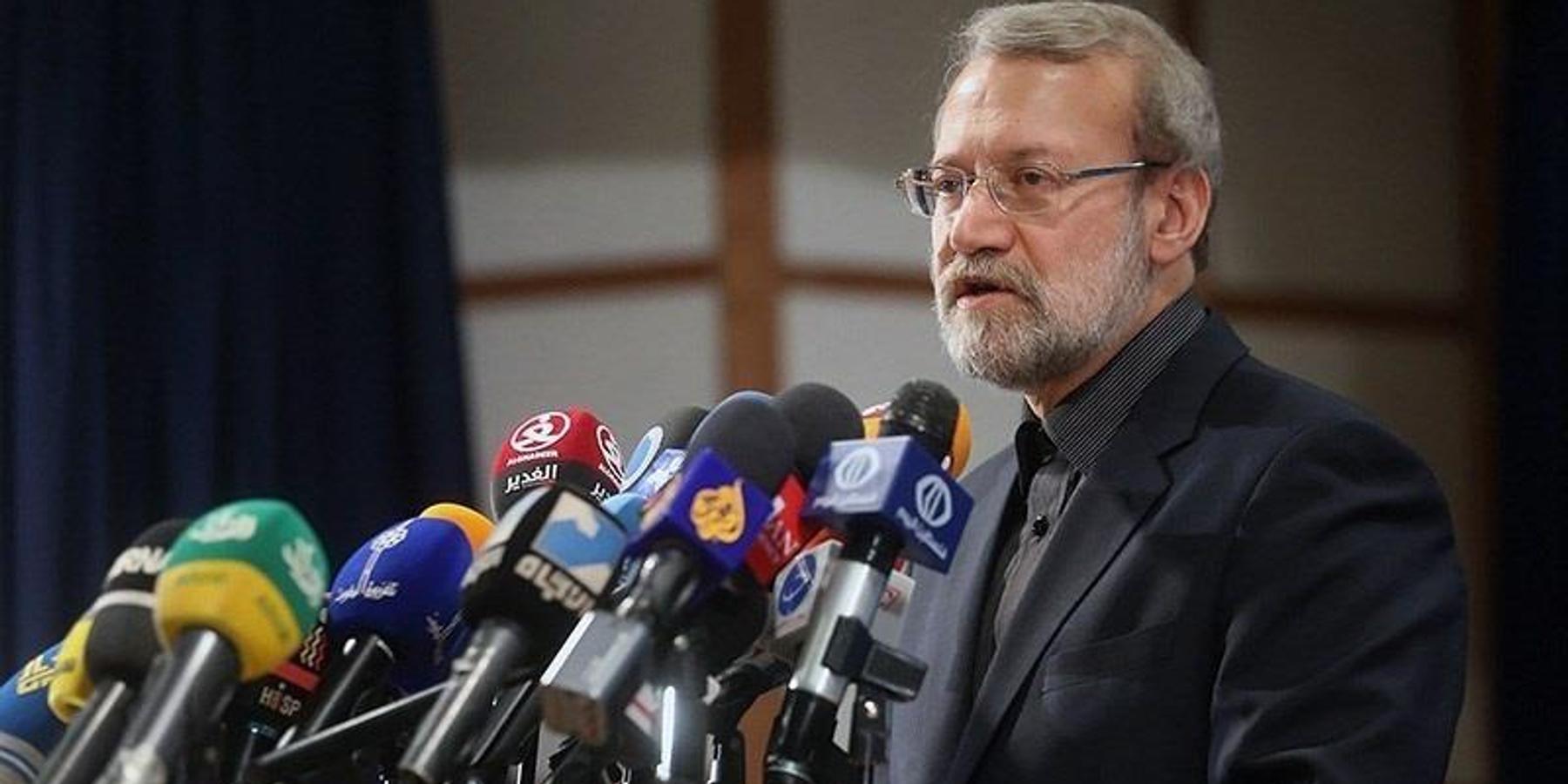
Israel's assassination of Ali Larijani, the powerful secretary of Iran's Supreme National Security Council — now confirmed by Iran — carries far greater political than operational significance.
The Iranian system has demonstrated considerable resilience in replacing political and military leaders killed by the U.S. and Israel. Larijani's removal is unlikely to meaningfully impact the operational level; the system is designed to absorb blows and counterattack, as evidenced by the effective blockade of the Strait of Hormuz.
The far greater significance lies in the political sphere. With Larijani gone, a relatively moderate figure accustomed to dealing with the West — and one who wielded significant influence within the system — is eliminated. This makes any potential off-ramp or diplomatic settlement of the war vastly more difficult.
I met Ali Larijani several times between 2013 and 2018, as part of European Parliament missions to Tehran, during his tenure as speaker of the parliament. The impression he left was that of a staunch Iranian nationalist — not a hardcore Islamist, dogmatic revolutionary, or reformist. A massive map of Iran overlooked his office, which was otherwise adorned in traditional Persian style. He frequently spoke of Iran's millennia-long traditions of statehood, emphasizing the heritage of the Sassanian Empire in particular.
This was not mere rhetoric. It was designed to convey to his interlocutors a vision of Iran as a major historical reality and geopolitical player straddling the Persian Gulf, Iraq, the Middle East, Central Asia, and the South Caucasus. The message, delivered while Western powers and Iran were negotiating the nuclear agreement, was clear: Iran is ready to make a deal, but it will zealously guard what it considers its sovereign rights — such as domestic uranium enrichment and regional security interests. His discourse was notably devoid of references to Islam or the revolution, emphasizing instead Iran's identity as a civilizational state.
One particular anecdote highlights this attitude. In June 2015, a delegation from the European Parliament's Foreign Affairs Committee visited Tehran, encouraged by then-EU foreign policy chief Federica Mogherini as a confidence-building mission, mere weeks before the deadline set by world powers to sign the nuclear agreement later known as the JCPOA.
A member of the delegation, Dutch liberal lawmaker Marietje Schaake, drew scrutiny from hardliners for an outfit they found too "revealing." Outlets affiliated with hard-line religious and IRGC circles lashed out at Larijani for failing to ensure respect for "Islamic values" and for not canceling the meeting over the MEP's attire.
Larijani appeared unperturbed, and the meeting proceeded without issue. However, the media storm — amplified by a New York Times correspondent in Tehran, who found "Schaake-gate" the most compelling story to cover — considerably poisoned the atmosphere. The following day, the delegation's scheduled press conference with international and Iranian media at the Espinas Hotel, agreed with the Iranian authorities, was dispersed by plainclothes security, much to the irritation of the MEPs, who were already under intense pressure from Western hawks for engaging with Tehran.
Of course, Schaake’s outfit was merely a pretext for hardliners to derail the wary, budding rapprochement between the EU and Iran—to portray it as a harbinger of debauchery and indecency that opening to the West would bring. The real target was not the Dutch MEP, but moderates like then-President Hassan Rouhani and Foreign Minister Javad Zarif. Larijani, while never a reformist, was a pragmatic conservative who, from his perch as parliamentary speaker, helped steer the JCPOA through the Iranian legislature after it was signed in 2015.
In subsequent years, Larijani consolidated his role as a pragmatic figure, leveraging his ultimate insider status to reach out to segments of the population growing increasingly frustrated with the rigidities of daily life in the Islamic Republic, such as the compulsory hijab.
But he was never a reformist. Larijani was, first and foremost, a statist for whom the stability and security of the system—as the guarantor of national sovereignty—were paramount. This explains his reportedly pivotal role in suppressing the widespread protests against the Islamic Republic in January 2026 and organizing resistance to the subsequent U.S.-Israel war.
That does not suggest, however, that Larijani's vision excluded reform entirely. But reform could only take place once stability was secured, and in a tightly controlled, top-down fashion. It could potentially combine relative social and cultural liberalization—as the secretary of the Supreme National Security Council, Larijani was among those urging against implementing the drastic "chastity law" adopted by the parliament's hardline majority to enforce the hijab—with economic opening. Larijani and other pragmatic conservatives, like current parliament speaker Mohammad Bagher Qalibaf, were tentatively looking toward to a Pakistani model as a possibility for a post-Khamenei Iran.
Their intra-system opponents, represented by failed hardline presidential candidate Saeid Jalili, would have none of that. While unpopular in society at large, they remain disproportionately influential in the security apparatus—including the IRGC, the judiciary, the parliament, and parts of the bureaucracy (which they filled in large numbers under the presidency of another hardliner, the late Ebrahim Raeisi).
The model favored by this faction, commonly referred to in Iran as Paydaris (the Front of Steadfastness), is not Pakistan or any other autocracy combining tight political control with relative openness, like Egypt or Saudi Arabia under Mohammad Bin Salman, let alone a liberal or Islamic democracy. It is something far closer to North Korea: a thoroughly militarized, isolated, securitized state with a nuclear bomb as the endgame.
This divide was reflected in Larijani’s reported maneuvering — ultimately unsuccessful — to prevent the son of the slain Ayatollah Khamenei, Mojtaba, from becoming the new supreme leader. Mojtaba Khamenei has cultivated his support among the IRGC and is said to be more radical than his late father.
Notably, the IRGC itself is now headed by Ahmad Vahidi, a figure far more hardline than his predecessors Mohammad Pakpour and Hossein Salami, killed by Israel and U.S. As Amwaj Media’s Mohammad Ali Shabani put it succinctly, “the man is brutal. Hardliners waste no time in filling vacancies thanks to Israel”.
By removing figures like Supreme Leader Ayatollah Ali Khamenei — with his stated opposition to the bomb — and pragmatists like Ali Larijani, accustomed to dealing with the world, the U.S. and Israel are paving the way for the most extreme hardline factions to fill the void. A reckless strategy if there ever was one, guaranteeing perpetual conflict in the Middle East.
- Senior US official resigns in protest of Iran war ›
- Larijani's killing will destroy Iran war off-ramps for Trump ›