

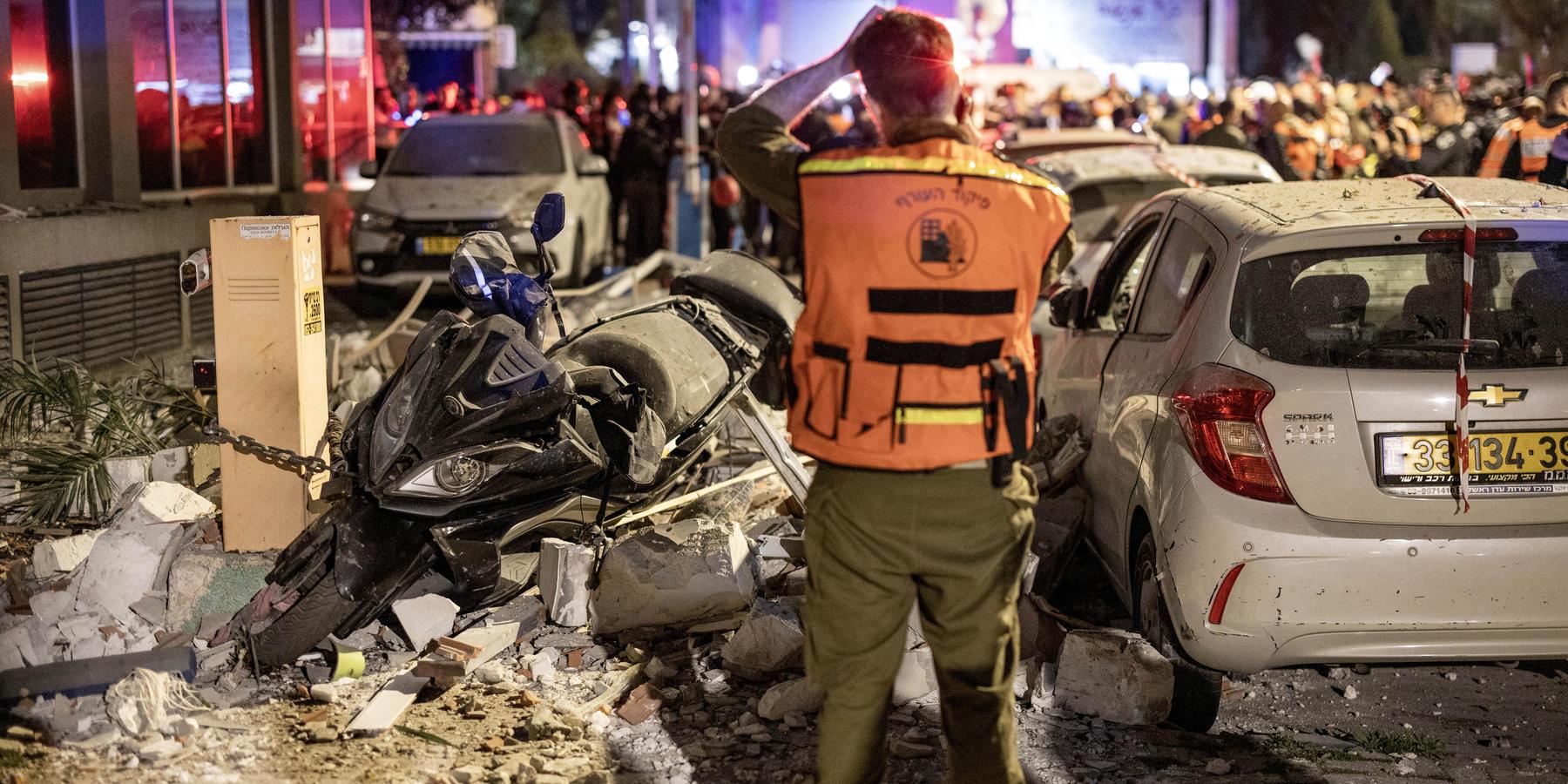
In recent days, Israel and the United States have expressed outrage over the deliberate and indiscriminate targeting of civilians and civilian residences and infrastructure in Israel and the Gulf by Iranian forces.
They have cited the illegality of such attacks, urged global condemnation, and demanded that human rights organizations speak out. Having spent years weakening the laws meant to protect civilians, they are now discovering that those same laws are too fragile to protect their own people.
Israeli and U.S. officials seem unaware that the crimes they now condemn are ones they themselves have long justified as legitimate military actions.
Take cluster munitions. Following Iran’s reported use of these indiscriminate weapons on March 9 around Tel Aviv, Israeli officials condemned their use in populated areas. “The Iranian regime is firing cluster bombs at Israeli civilians. Their deliberate and repeated use against civilians shows that the Iranian terror regime is seeking to maximize civilian deaths and harm,” declared Israel’s foreign ministry, which provided an infographic explaining how the weapon—banned by 124 countries—is inherently indiscriminate. The Pentagon echoed the criticism, with Adm. Brad Cooper, the chief of U.S. Central Command, condemning Iran’s use of “inherently indiscriminate” cluster munitions.
Yet in 2006 Israel fired more than four million cluster munitions into southern Lebanon, turning large swaths of the country into a no-go zone while insisting their use was a military necessity. Unexploded cluster munitions continue to terrorize Lebanese civilians, maiming and killing at least 400 people as they detonated years after the war. Israel reportedly resumed using cluster munitions in Lebanon in 2025 but would neither confirm nor deny doing so.
Israel’s vast use of these weapons in 2006 helped spur the 2010 Convention on Cluster Munitions, banning them as inherently indiscriminate. Yet Israel and the United States — along with Russia and Iran — have refused to ratify the treaty, insisting they may be used legitimately in wartime. In 2023 and 2024, the Biden administration shipped large quantities of cluster munitions to Ukraine despite warnings that unexploded ordnance would endanger civilians for decades to come. The consequences are now clear: having challenged the ban on these weapons, Israel now finds its own civilians under attack from them.
Iranian attacks on Israeli and Gulf civilian infrastructure — from residences to schools to water desalination plants — have drawn similar condemnations as unlawful attacks on civilians, even though such strikes have been preceded or followed by unlawful attacks on Iranian civilians and infrastructure. On March 8, the United Nations Security Council issued a resolution singling out Iranian attacks on civilians for condemnation, even though Israeli and U.S. forces had also struck a girls’ school, civilian residences, and an Iranian water desalination plant, among other civilian sites. Even AIPAC chimed in, bemoaning that Iran was “killing civilians” in Bahrain following a strike that killed a young woman on March 9.
These condemnations ring hollow in the wake of Israel’s vast destruction of residential buildings, schools, universities, and agricultural lands in Gaza, leaving the territory buried under 61 billion tons of rubble and largely uninhabitable, and more than 75,000 people, the majority women and children, dead. For more than three years since its latest war in Gaza, Israel has defended its assault on Palestinian civilians as military necessity, blamed Hamas for “starting” the war, and rejected condemnations as products of bias and antisemitism.
Israeli and U.S. officials have gone further still, at times rejecting very applicability of international law. “I don’t need international law,” asserted President Donald Trump earlier this year; adding “my own morality” is “the only thing that can stop me.”
For its part, Israel rejects the status of Palestine as occupied territory under the Geneva Conventions and the prohibition on the acquisition of territory by force; both U.S. and Israeli officials reject the jurisdiction of the International Court of Justice and the International Criminal Court. “Secretary of War” Pete Hegseth has suggested dispensing with international humanitarian law altogether, declaring that the United States should employ “maximum lethality, not tepid legality” and give “no quarter, no mercy to our enemies” – rhetoric that, when applied in an armed conflict, constitutes a war crime.
Such contempt for international law may seem convenient for states that believe their power shields them from consequences. But in a world where destructive force is widely distributed, weakening the rules meant to protect civilians invites others to do the same. The result is not greater security but a downward spiral in which every side claims necessity while civilians pay the price.
International humanitarian law was never meant to protect only one side’s people. It protects civilians precisely because it binds all parties equally. When powerful states defy those rules, they do more than harm their adversaries; they weaken the only framework that can protect their own civilians in return. If governments truly want to safeguard their people, the answer is not selective outrage but consistent compliance: uphold the law, apply it universally, and defend it even when it constrains your own actions.
- With focus on Iran and Gaza, Israel is quietly annexing the West Bank ›
- New US cluster bombs pose ‘severe, foreseeable dangers’ ›