
Follow us on social

google cta
Most Iranian Americans want diplomacy with Iran: poll

Most Iranian Americans want diplomacy with Iran: poll

A new survey shows that the country's diaspora in the US is deeply divided over the ongoing war

Reporting | QiOSK
google cta
google cta

Recent data released by the National Iranian American Council (NIAC) suggests that a strong majority of Iranian Americans support diplomacy to resolve tensions between the U.S. and Iran — a finding at odds with the dominant conversation online suggesting that most Iranian Americans are in favor of the Iran war.

The data was collected through a survey of 505 Iranian Americans conducted by Zogby Analytics between Feb. 27 and March 5. Among the most notable results were that a clear majority of Iranian Americans — 61.6% — support diplomacy to move toward de-escalation and a negotiated path forward.
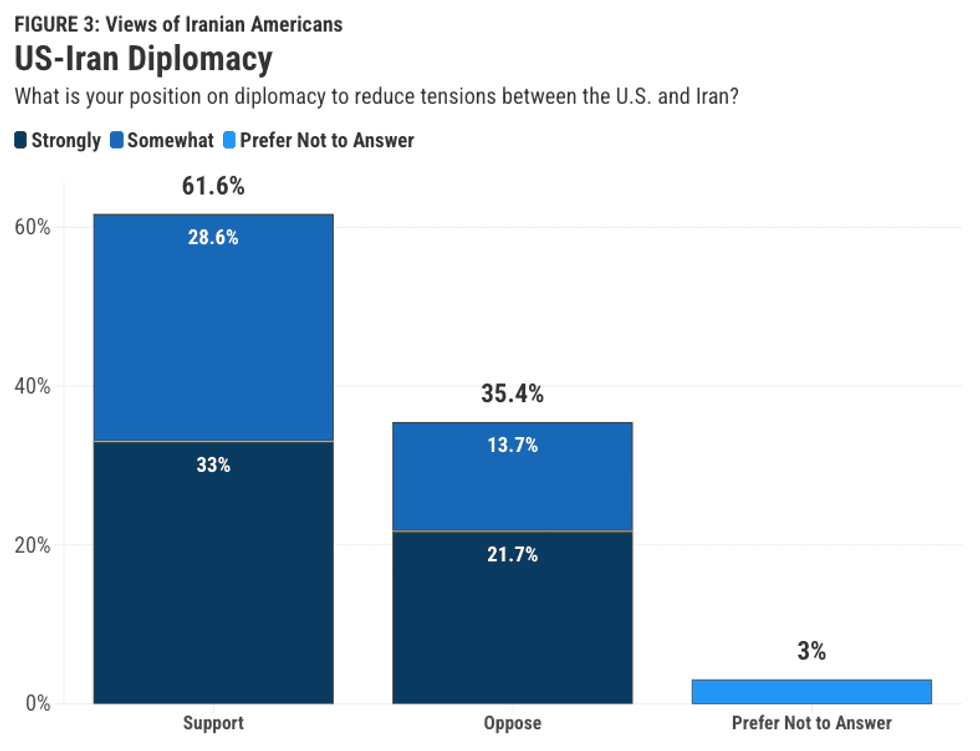
Screengrab via niacouncil.org

“If anything, a lot of people were surprised because they thought Iranian Americans overwhelmingly favored this war,” NIAC president Jamal Abdi said in a Wednesday press briefing. “In fact, it is divided in half. There was really no mandate for the war.”

As Abdi noted, the survey results show that Iranian Americans were nearly evenly divided on whether the U.S. should have initiated war with Iran, with 49.3% opposing the attacks and 48.9% supporting them.

Those who oppose the war are primarily concerned with harm inflicted on innocent civilians and the potential for further destabilization of the country, while those in support hope the war will make regime change more likely and reduce threats imposed by Iran’s nuclear program, according to the poll.
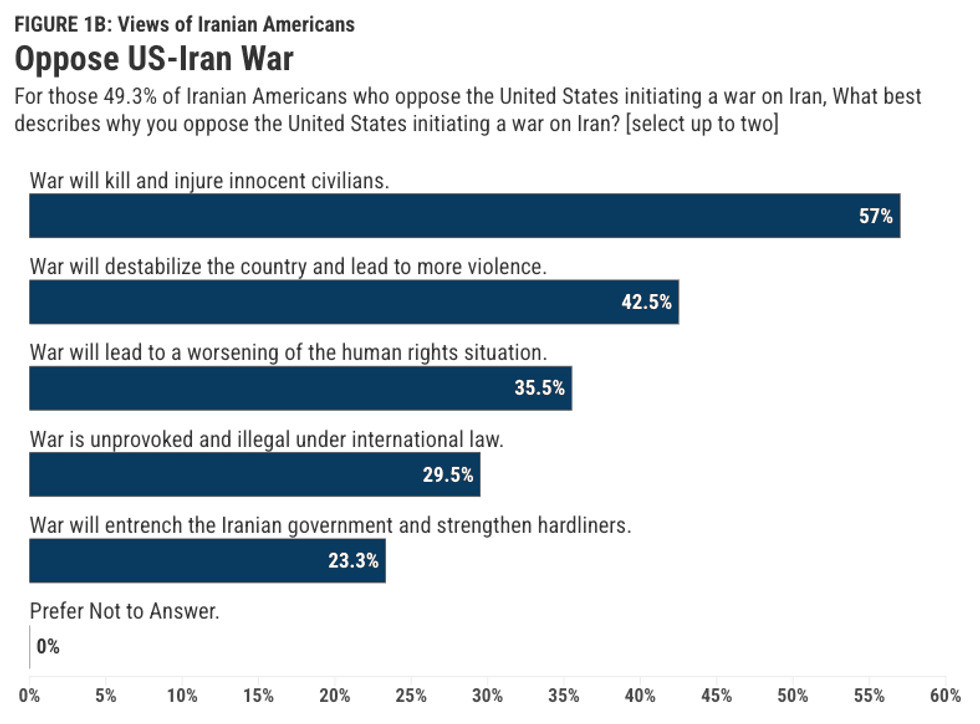
Screengrab via niacouncil.org

During the press briefing, Abdi also said that prominent Iranian Americans have attempted to “shape public perceptions about this war” by “proclaiming that war is the only path that anybody who disagrees is an Iran regime lobbyist.”

The reality is much more nuanced. This newly released data attempts to dispel some of the misinformation surrounding the opinions of the Iranian American community — a community that has faced trauma and division, Abdi said.

“This trauma has been preyed upon by outside interests who want war,” Abdi said during the press briefing. “We think it's really important to end this predatory relationship and expose to the public where our community actually stands, and encourage members of our community to stand up and be vocal and feel that they can be a full participant in U.S. democracy without fear of political violence or online cancellation or death threats and attacks.”


Iranian-Americans in the age of Trump, the Travel Ban, and the Threat of War
google cta
Reporting | QiOSK
Oil disruption from Iran war won’t end any time soon
REUTERS/Essam al-Sudani/File Photo

People walk near farmland by the Zubair oil field as gas flares rise in the distance, in Zubair Mishrif, Basra, Iraq, amid regional tensions following the recent disruption to shipping in the Strait of Hormuz and the U.S.-Israeli conflict with Iran, March 9, 2026.

Oil disruption from Iran war won’t end any time soon

QiOSK

The US-Israel-Iran war has led to extraordinary volatility in global energy markets this week, and there is little reason to think that it will abate any time soon.

Benchmark Brent crude, which traded below $60 per barrel early this year, jumped to $80 last Thursday. It then bounced to $120 in thin weekend markets and, as of this writing, has settled in around $92. In other words, the range of the recent oil price has been 50% of where it was a mere five days ago.

keep readingShow less
Iran school attack
Top Image Credit: March 3, 2026, Minab, Hormozgan, Iran: Iran holds a funeral ceremony for students and staff members of the Shajareh Tayyebeh girls' elementary school who were killed in a strike on the school in Minab, Hormozgan, southern Iran. On February 28, 2026, 'Operation Epic Fury,' a joint Israeli-U.S. military operation, targeted multiple locations across Iran, including a girls' school in Minab near an IRGC base. The school was hit by three missile attacks, resulting in at least 201 deaths and 747 injuries, according to the Iranian Red Crescent, though the toll remains unverified due to restricted media access in Iran. While Iran blamed the U.S. and Israel, the U.S. Central Command is investigating the incident, and Israel stated it was unaware of any operations in the area. The attacks intensified after the air strike that killed Iran's Supreme Leader Khamenei and several senior commanders. (Credit Image: © Ircs via ZUMA Press Wire) Reuters Connect

Why did mainstream media slow-walk coverage of school attack?

QiOSK

As the U.S. war with Iran rages, mainstream media’s slow response to a probable U.S. attack on an Iranian school suggests it is hesitant to report on the conflict’s growing human toll.

The attack occurred on February 28 in Minab, Iran, and killed at least 165 people — mostly school-aged children. Although the U.S. stresses it would not deliberately attack a school, subsequent investigation by American military investigators points the finger at Washington, as do remnants of a U.S.-made Tomahawk missile recovered from the site. (Only the U.S., the UK, and Australia have Tomahawk missiles.) CBS news reported that the strike on the school might have been an accident, perhaps sprung from outdated intelligence wrongly identifying it as still part of a nearby Iranian base.

keep readingShow less
Dan Caine
Top photo credit: Secretary of War Pete Hegseth and Chairman of the Joint Chiefs of Staff U.S. Air Force Gen. Dan Caine conduct a press briefing on Operation Epic Fury at the Pentagon, Washington, D.C., March 4, 2026. (DoW photo by U.S. Navy Petty Officer 1st Class Alexander Kubitza)

Did Caine just announce the Morgenthau option for Iran?

QiOSK

Gen. Dan Caine’s formulation of American war aims in Iran is remarkable not because it is bellicose, but because it is strategically incoherent.

In a press conference Tuesday morning, the chairman of the Joint Chiefs of Staff did not describe a limited campaign to suppress missile fire, blunt Iran’s naval threat, or even impose a severe but bounded setback on Tehran’s coercive instruments. He described a campaign against Iran’s “military and industrial base” designed to prevent the regime from attacking Americans, U.S. interests, and regional partners “for years to come.” In an earlier briefing he put the objective similarly: to prevent Iran from projecting power outside its borders. Rather than the language of a discrete coercive operation, this describes a war against a state’s capacity to regenerate power.

keep readingShow less
google cta
Want more of our stories on Google?
Click here to make us a Preferred Source.

LATEST

QIOSK

Newsletter

Subscribe now to our weekly round-up and don't miss a beat with your favorite RS contributors and reporters, as well as staff analysis, opinion, and news promoting a positive, non-partisan vision of U.S. foreign policy.