

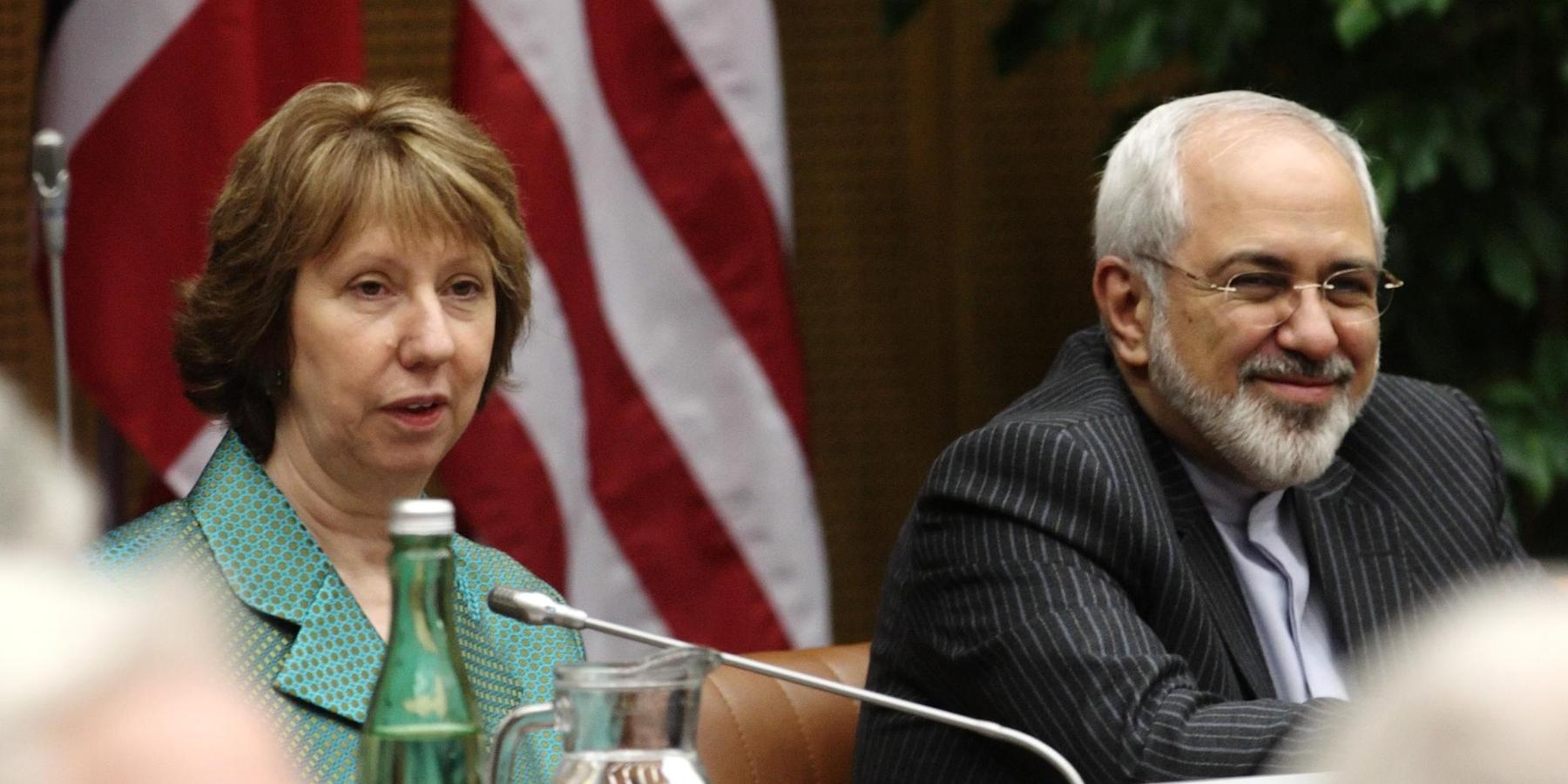
There was a time when Europe was serious about diplomacy — diplomacy as the patient, often frustrating business of engaging adversaries, rather than merely issuing condemnations and imposing sanctions.
Ten years ago, on October 25, 2016, the European Parliament adopted a report on relations with Iran that embodied precisely this understanding of statecraft. Drafted under the leadership of British MEP Richard Howitt, it offered a forward-looking strategy for engaging Tehran following the conclusion of the 2015 nuclear agreement, the Joint Comprehensive Plan of Action (JCPOA) – a diplomatic achievement in which the European Union and its member states the United Kingdom, France and Germany played a leading role.
As a foreign policy adviser in the European Parliament, I had the privilege of working closely with Howitt throughout the report’s preparation, negotiations, and eventual adoption, including a fact-finding mission to Tehran. The report was adopted by an overwhelming majority of 456 votes to 174, with 67 abstentions.
But its significance extended well beyond parliamentary numbers: it represented a moment when Europe appeared capable of acting with strategic foresight. The engagement with Iran was a pragmatic instrument for advancing European security and economic interests; fostering moderation in Iran; and stabilizing the Middle East.
Ten years later, EU-Iran relations are in tatters. Europe has lost much of its economic leverage, its diplomatic influence has diminished dramatically, and its role in addressing the region’s security crises has become marginal.
To understand the scale of this decline, one needs to look back at how pragmatic and ambitious Europe’s approach once was.
The Howitt report proposed developing relations in key areas, including political dialogue, trade,academic exchanges, human rights, and regional security. It offered European expertise to assist Iran in fulfilling the Financial Action Task Force (FATF) criteria – a key step toward economic reform.
The report departed from the mantra promoted for years by hawkish circles in the U.S., Israel and some Arab capitals, which had depicted Iran as the sole source of regional turmoil. Instead, it recognized Iran as an indispensable actor in addressing conflicts in Syria, Iraq, and Yemen. It called for European diplomacy to encourage rapprochement between Tehran and Riyadh – an appeal acted upon years later, by Beijing, not Brussels.
Crucially, the report did not remain a simple exercise in parliamentary rhetoric. Just a few weeks after its adoption, the EU Foreign Affairs Council endorsed the parliamentary approach for engagement with Tehran. It also supported the establishment of an EU delegation in Tehran. Here was a case where parliamentary diplomacy had contributed to shaping the broader political position of the EU.
Reactions to the report were revealing. The National Iranian American Council (NIAC), a Washington-based pro-diplomacy group, welcomed it enthusiastically. Its founder and then-president, Trita Parsi, now executive vice president of the Quincy Institute, praised the strategy of expanded relations while warning against renewed isolation and military threats.
Perhaps the best evidence of the report’s impact was its hostile reception by forces committed to confrontation. Pro-Israeli groups, such as the AJC Transatlantic Institute (TAI), the Brussels office of the American Jewish Committee, denounced the text for allegedly failing to confront Iran’s threats against Israel; its support for Hezbollah in Lebanon and the Assad regime in Syria; and its human rights abuses.
The false choice between defending human rights and engaging with Tehran was peddled relentlessly by the report’s critics. However, the report contained substantial criticism of Iran’s record in that area, including input from Human Rights Watch.
We proposed to anchor discussions on human rights in a broader framework of dialogue rather than simply issuing condemnations. As Howitt said during the parliamentary debate, addressing his critics, “they knowingly imperil the leverage that we do have with Iran and make the improvements in human rights less, not more, likely”.
Reactions from Tehran were equally instructive. The Foreign Ministry’s spokesman acknowledged that “a number of promising points exist in the document which can help open new horizons in and expand relations between the EU and Iran.”
Yet spoilers existed on the Iranian side, too. Mohammad Javad Larijani, then secretary-general of the Iranian judiciary’s High Council for Human Rights, objected to the establishment of an EU delegation in Tehran, suggesting it could interfere in Iran’s internal affairs.
The allegation was ludicrous: 22 of the EU’s then-28 member states, including the United Kingdom, already maintained embassies in Tehran, while the EU had delegations in numerous countries whose governments had profound disagreements with Brussels.
Larijani’s objection reflected a suspicion within parts of Iran’s political establishment that closer relations with the West would invite political subversion. This strengthened precisely those European voices that portrayed engagement with Tehran as futile or even dangerous.
In 2015 and 2016, however, the spoilers on both sides seemed unlikely to derail the positive trajectory. There was reason to believe that the JCPOA, in the view of the then-EU foreign policy chief, Federica Mogherini, was indeed only the floor, not the ceiling, for EU-Iran relations.
That optimism proved tragically short-lived.
When President Donald Trump unilaterally withdrew the U.S. from the JCPOA in 2018, despite international verification of Iran’s compliance at the time, the EU formally opposed Washington’s decision. But the gap between the EU’s declarations and its capacity to act to preserve the agreement soon became painfully obvious.
European companies withdrew from Iran under the threat of secondary U.S. sanctions. Banks refused transactions. The EU attempted to preserve trade through mechanisms such as INSTEX, but these proved woefully inadequate. The promised economic benefits for Iran of the agreement never materialized.
Meanwhile, in a misguided attempt to appease Trump, the E3 (the U.K., France, Germany) themselves adopted an increasingly hawkish line on Iran, accusing it of destabilizing the region and developing ballistic missiles. The latter charge caused particular indignation in Tehran as these same European countries were increasing the supply of sophisticated arms to Iran’s regional rivals. From Tehran’s perspective, its missiles were vital to national defense.
The lesson for Tehran was unmistakable: Europe might disagree with Washington but it was incapable of protecting the nuclear deal. That inability was arguably a major factor in Tehran’s subsequent pivot to Moscow, which led to it supporting Russia’s illegal invasion of Ukraine, in exchange for military-technical cooperation — and which, in turn, made EU-Iran relations more adversarial.
The consequences of this failure have become stark during the 2025 and 2026 U.S.-Israeli wars against Iran. Rather than acting as an independent diplomatic bridge capable of mediating between Washington and Tehran, Europe has struggled to define a meaningful role.
German Chancellor Friedrich Merz wholeheartedly supported the Israeli aggression, notoriously hailing it as Israel doing “the dirty work” for Europeans. The only major European leader who unequivocally opposed the aggression was Spanish Prime Minister Pedro Sanchez, who banned the use of Spanish military bases for the war despite Trump’s attempts to bully Madrid into submission.
Where Europe once led diplomacy with Iran, it is now reduced to issuing bland and toothless statements while Pakistan, Turkey and the Persian Gulf states stepped in as more consequential diplomatic actors.
The contrast with the approach of 2016 is staggering. The question, then, is not merely how Europe traded its leverage over Iran for moral grandstanding and diplomatic irrelevance, but whether it can recover the understanding of statecraft that once made that leverage possible.
- Is the Iran War breaking NATO forever? ›
- Evidence of a Russian 'hybrid war' in Europe is vanishingly thin ›