

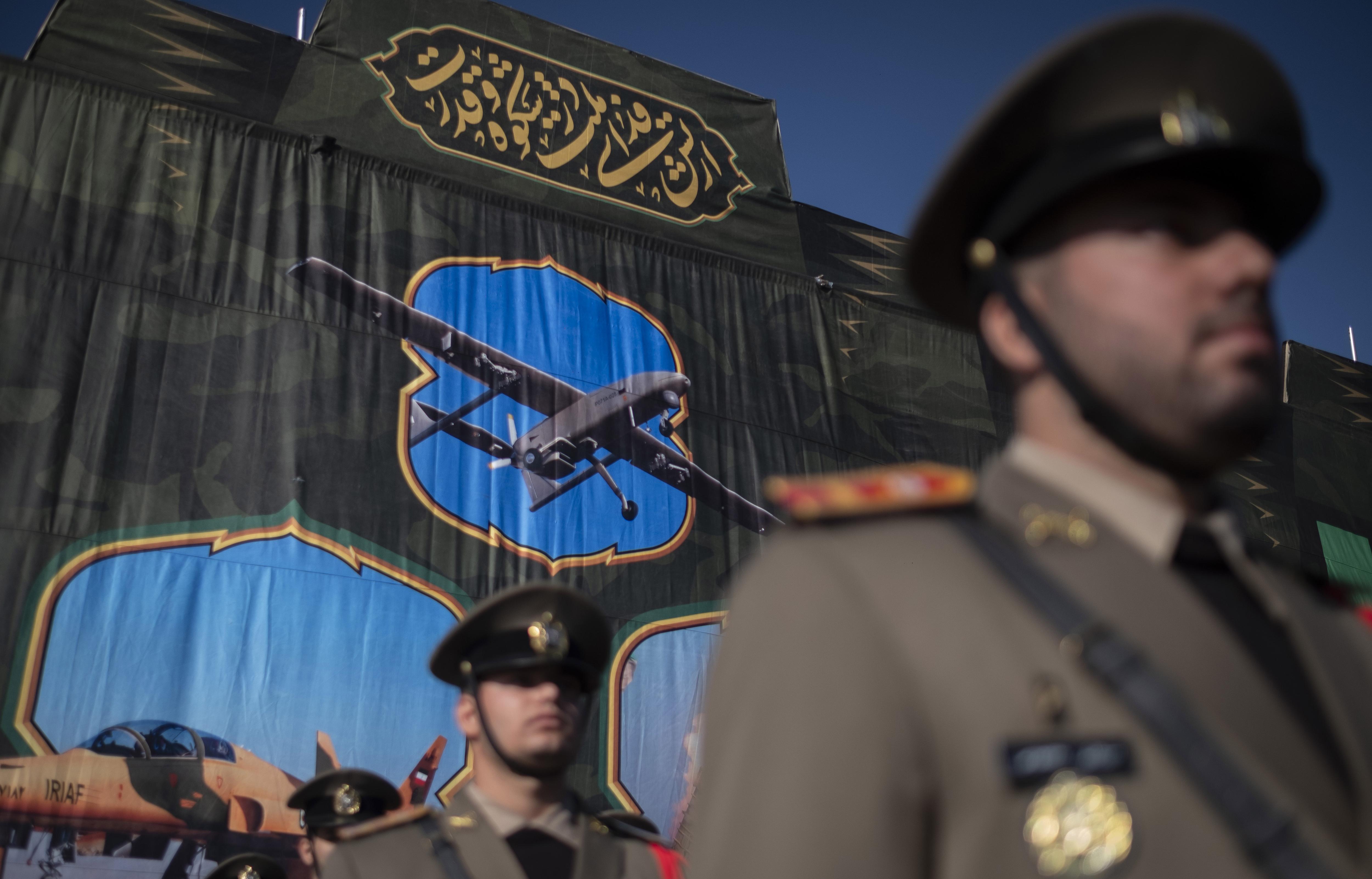
A provocative calculus by Anusar Farrouqui (“policytensor”) has been circulating on X and in more exhaustive form on the author’s Substack. It purports to demonstrate a sobering reality: in a high-intensity U.S.-Iran conflict, the United States may be unable to suppress Iranian drone production quickly enough to prevent a strategically consequential period of regional devastation.
The argument is framed through a quantitative lens, carrying the seductive appeal of mathematical precision. It arranges variables—such as U.S. sortie rates and degradation efficiency against Iranian repair cycles and rebuild speeds—to suggest a "sustainable firing rate." The implication is that Iran could maintain a persistent strike capability long enough to exhaust American political patience, forcing Washington toward a premature declaration of success or an unfavorable ceasefire.
There are, of course, valid reasons to approach this analysis with a healthy grain of salt. The model is structurally narrow, its empirical foundations regarding Iranian industrial recovery are speculative, and its strategic conclusions often leap further than the raw numbers can strictly justify. However, focusing solely on the mathematical flaws misses the broader point.
The most significant takeaway is that the analysis may be directionally accurate, even if specific data points are off-target. Its core assessment suggests that Iran may have time on its side. This is a serious proposition—one that deserves closer attention than the dismissive reactions of traditional defense circles would suggest.
The primary claim is straightforward: if the United States cannot achieve a "rapid collapse" of the Iranian drone infrastructure, Tehran can sustain a campaign of attrition against global shipping lanes, Gulf energy facilities, regional U.S. bases, and American partners. At some point, the cumulative economic and political costs of Iranian persistence become so visible that the domestic pressure in Washington to exit the conflict outweighs the strategic desire to stay.
In its most distilled form, the model reduces the entire contest to a mathematical relationship between two opposing forces: the rate of U.S. suppression and the rate of Iranian reconstitution. If the "regeneration constant"—the speed at which Iran can repair a bombed workshop or move assembly to a new basement—remains high relative to the "attrition constant" imposed by U.S. strikes, a functional portion of the production base survives. This surviving base acts as a floor for continued attacks. From this mechanical premise, the author moves to a political conclusion: continued attacks lead to prolonged disruption, which eventually results in a politically unfavorable outcome for the United States.
As a stylized exercise, this is far more useful than it might initially appear to those who prefer traditional "order of battle" analysis. It identifies a critical variable often obscured in grand strategy: the industrial contest. A war of this nature would not be decided solely by tactical successes. It would be a trial of industrial resilience. If Iranian one-way attack drones can be manufactured through a network of relatively simple, dispersed, and easily repairable facilities, then the standard assumption that Western airpower can "solve" the problem in a matter of days is dangerously optimistic. The model performs a service by directing our gaze away from slogans of "overwhelming force" and toward the slower mechanics of suppression, reconstitution, and sustained coercion.
The shift in emphasis toward industrial resilience is backed by recent history. The experience of the Russia-Ukraine war has fundamentally altered our understanding of Shahed-type systems. They are not "boutique" weapons requiring delicate, high-tech cleanrooms. Instead, they belong to a new category of "attritable" systems that can be produced in massive quantities and expanded rapidly under wartime duress.
Their strategic significance lies precisely in their lack of sophistication. They do not need the performance of a fifth-generation fighter to create a strategic crisis; they only need to be available in sufficient volume to saturate defenses and keep the global energy market in a state of perpetual anxiety. For decades, the U.S. military has thought in terms of "target sets": identify the factory, hit it hard, and watch the enemy’s capability collapse. This logic fails against a modular, dispersed, and industrially "flat" production ecosystem. If Iranian drone production is indeed an adaptive, decentralized network, the suppression problem becomes less like knocking out a building and more like trying to keep a biological organism below a certain threshold of activity. This is a repetitive, costly, and time-consuming endeavor.
This is where the analysis pulls its true weight. The real insight is not the exact ratio of drones produced per week, but the warning that even a "successful" military campaign might take longer than Washington’s political timetable allows. We can illustrate this with a medium-case scenario. Iran does not need to sustain a maximal, high-intensity attack indefinitely. It only needs to demonstrate that, for a period measured in months rather than days, it can keep the conflict "active" and "costly."
If Tehran can do this, it creates a classic asymmetry: long-term U.S. military superiority does not guarantee short-term, politically usable success. This distinction is vital. Iran cannot defeat the U.S. military in a head-to-head clash, but it can likely keep the conflict inside the "American political pain window." A four-month delay in achieving total suppression might seem like a minor tactical hiccup to a general, but to a politician, four months of rising oil prices, skyrocketing shipping insurance, and daily headlines about "failed" strikes is a catastrophe.
The issue is as much about perception as it is about material damage. U.S. administrations must make decisions amid the noise of market volatility, allied franticness, and domestic congressional fallout. In such a pressure cooker, Iran doesn’t need to "win" the war; it only needs to ensure the war feels "unresolved." Time, in this context, is the primary commodity being consumed by both sides.
Tehran’s goal is to ensure that Washington experiences the conflict as a corrosive drain before the U.S. military can produce a "stable and publicly legible result." This is a sophisticated strategy for a weaker power, exploiting the massive delta between a battlefield timeline and a political election or budget cycle. Even if the U.S. implements mitigation strategies—like escorting tankers or tapping into the Strategic Petroleum Reserve—these measures have a lag time. Iran’s opportunity exists in the gap between the initial shock and the eventual adaptation.
The real value of these calculations is that they force the U.S. to confront a specific category of failure: the possibility that the United States, while remaining the stronger party, may find itself under immense pressure to stop before its superiority has been translated into a real result. The risk is not that we cannot win, but that we may be politically disinclined to wait for the win to mature. Susie Wiles, for one, seems to be on the case.
The model might not be the most sophisticated, and it may oversimplify the complexities of military manufacturing, but its central intuition is inescapable. We are entering an era where the industrial simplicity of the adversary’s weapons allows them to compete not on the level of technology, but on the level of persistence. The looming question for U.S. policymakers is not "Can we hit the targets?" but "Can we produce a victory faster than the enemy can produce chaos?" That is a much harder question to answer, and it is the only one that truly matters in the end.