

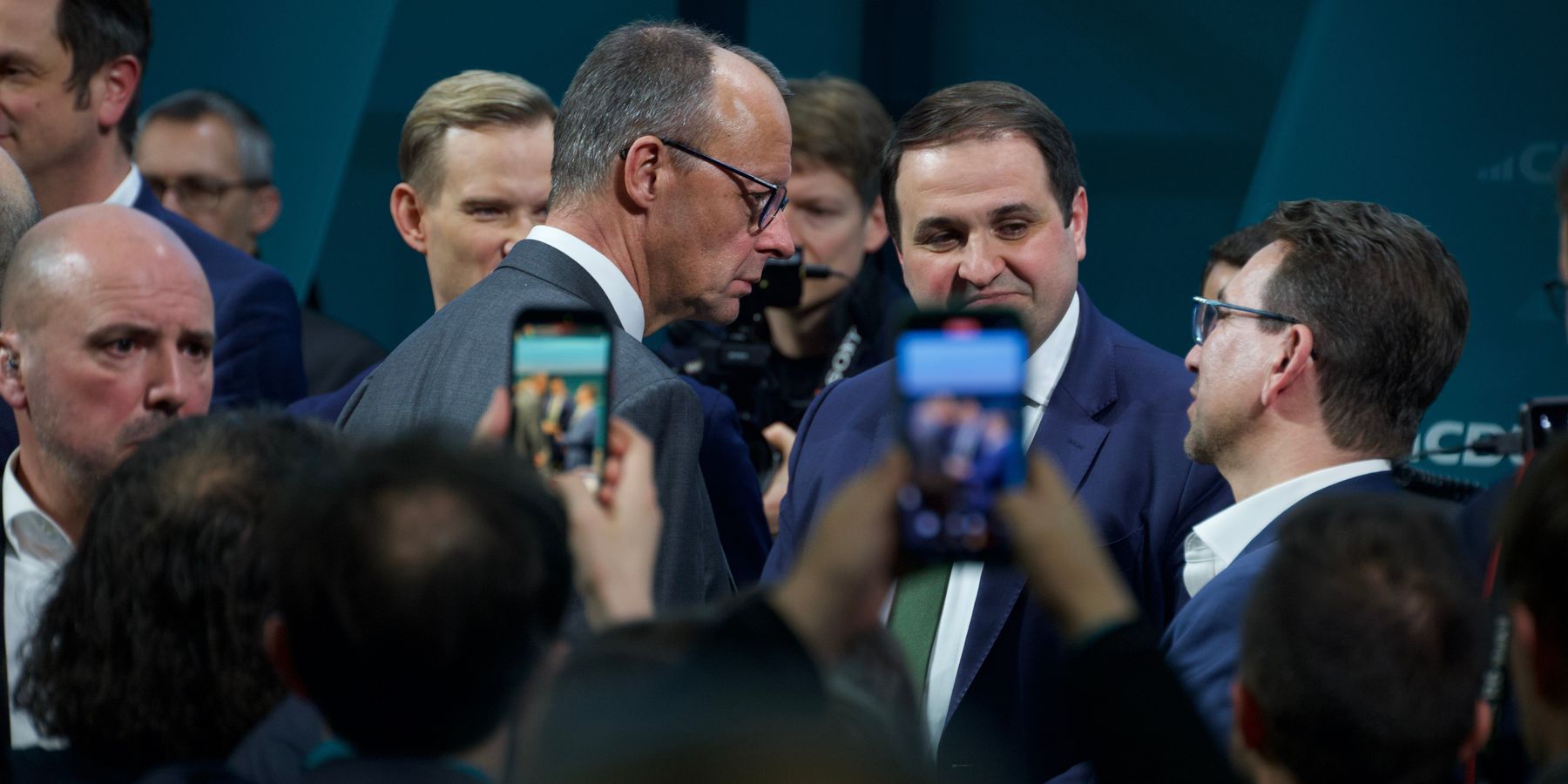
The German election set for February 23 has been coasting toward a predictable outcome since the collapse of Chancellor Olaf Scholz’s three-party coalition in December.
Friedrich Merz, the center-right leader of the opposition Christian Democrat CDU-CSU, remains comfortably ahead of his nearest rival, the populist nationalist Alternative for Germany (AfD). In order to become chancellor, Merz will have to form a coalition with either the center-left SPD or the Greens, or possibly both.
This outcome risks producing a new iteration of the unpopular, fractious three-party coalition led by Olaf Scholz.
The major novelty of the race is the unprecedented level of support (about 20%) for AfD. Three mass killings in the last three months — in Magdeburg’s Christmas market, in Aschaffenburg and most recently in Munich — have cast a long shadow over the election campaign. All three perpetrators were of Middle Eastern origin and, in two of the three cases, had applied unsuccessfully for asylum.
These events have boosted the fortunes of the AfD in its second-place position behind the CDU-CSU. The CDU-CSU lead over AfD was 15% as recently as mid-November; it may now be as low as 8 percentage points. The first televised debate of the campaign, held February 9, featured only Merz and Scholz, whose SPD is now polling at about 16%.
As the margin between CDU-CSU and AfD narrowed, Merz sponsored a resolution in the Bundestag calling for tougher measures against irregular migration and prompt deportation of failed asylum seekers. On January 29, this resolution passed with support from the AfD. Merz, in the minds of his many critics, had broken the “firewall” taboo — the pledge of all mainstream parties not to cooperate with the AfD. His move was met by very large protest marches in Berlin and other cities. Merz now insists that CDU-CSU will never violate its pledge not to cooperate with AfD.
Over the course of the campaign, neither Scholz’s Social Democrats (SPD) nor the Greens led by Economy Minister Robert Habeck has gained much momentum, as both bear responsibility for the weak economy. Three smaller parties remain near the 5% threshold for winning seats. They are the antiwar populist left party (BSW) led by Sahra Wagenknecht, Die Linke (the Left) headed by Gregor Gysi, and the business-friendly Free Democrats under Christian Lindner.
Shock therapy for Europe
Last week’s diplomatic blitz by Defense Secretary Pete Hegseth at the Ukraine Defense Contact group, followed by Vice President J.D. Vance’s speech at the Munich Security Conference, brought a shocking new focus on the viability of staying the course on Ukraine and on U.S. commitments to European security, raising the stakes in Germany’s election.
Vance’s critique of Germany’s “firewall” was taken as an attempt to boost support for the AfD. Both Scholz and SPD Defense Minister Pistorius reacted viscerally in Munich, while Foreign Minister Baerbock contended that the U.S. could yet be persuaded to revise its positions on a Ukraine settlement, in particular on territorial concessions to Russia and NATO membership for Ukraine.
Conference organizers had revoked invitations to both AfD and BSW because their delegations had walked out of the speech by Ukraine president Zelensky at last year’s event. Vance pointedly made time to meet with Alice Weidel while in Munich. For good measure, Presidential envoy Keith Kellogg made clear at Munich that Europeans would not participate in the initial phase of U.S. Russia talks on a settlement. The opening of talks by the Americans and Russia in Riyadh on February 17 followed with what, for Europe, was dizzying and disorienting speed.
A German diplomat told Politico that Europe had received repeated wake up calls (about the imperative to increase military capabilities) but had “kept hitting the snooze button.” It is hard to understand how European analysts could have failed to prepare any contingency for the kind of dramatic reorientation of American policy on Ukraine that had been forecast clearly before and during Trump’s election campaign.
Merz has recently come over toward the SPD’s position on relaxing the so-called debt brake that has stood in the way of any substantial rise in defense spending in Germany. This may be a small indication that the wake-up call has at last been heard.
The final televised debate of the campaign on Feb. 16, included all four of the leading candidates — Merz, Scholz, Robert Habeck (Greens) and AfD’s Alice Weidel. Merz restated his support for sending German long-range Taurus missiles to Ukraine, and Scholz continued to oppose this. Neither man noted that this long-rehearsed question will be moot if the U.S. succeeds in its attempt to reach a ceasefire or otherwise make progress toward a negotiated settlement.
Merz told Weidel that her “neutral” position on the Ukraine war would, in his mind, disqualify AfD from ever being in government. Scholz harshly mocked AfD’s proposals for reviving the economy. Nevertheless, this debate, planned long before Vance’s challenge about the firewall, implicitly conferred a degree of respectability to the AfD’s standing in the race.
While clearly angry at Vance’s remarks, Scholz nevertheless has restated Germany’s abiding imperative to avoid any breach between the U.S. and NATO’s European members. Germany — traditionally more reliant on American defensive guarantees than nuclear armed Britain or France — seems likely to reconcile itself to a proposed negotiated settlement so long as the outcome for Ukraine can be depicted as representing a foundation for its national survival and recovery.
Germany will accept burden shifting toward Europe in NATO, in the interest of averting any open breach between the U.S. and Europe. In keeping with the German center-right’s Atlanticist tradition, Merz has been comparatively circumspect about the implications of the abrupt Washington policy shift on Ukraine. The antiwar AfD and the BSW have both welcomed the pursuit of negotiations.
Getting real vs. magical thinking
Although the Paris summit convened on Feb 16 by Macron produced no consensus among Europeans on next steps, the focus given to whether and when to deploy peacekeepers indicates that the US has managed to shift the conversation toward accepting the fait accompli of the U.S. about-turn on Ukraine-Russia.
On balance, despite the intense anxiety around the fate of Ukraine and reaction to the shift in American policy, Germany’s election is unlikely to bring any unsettling surprise.
- Populist surge in Germany driven in part by war, economic backlash ›
- Anti-war sentiment has Germany's major parties on the run ›
- German elections reflect dramatic shift from postwar political order | Responsible Statecraft ›
- Why Ukraine should hold elections | Responsible Statecraft ›