

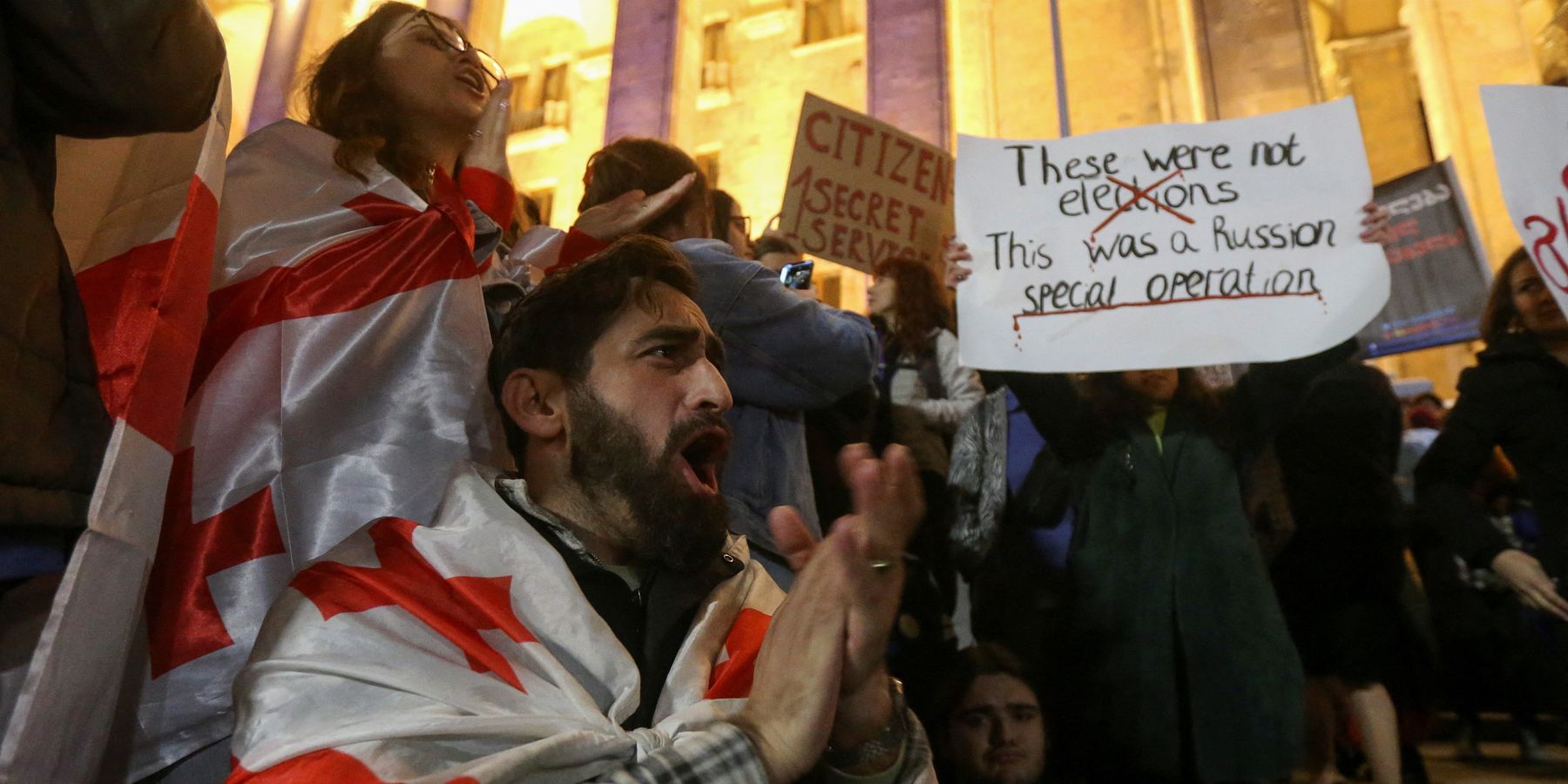
One did not have to be an Elijah or an Amos to predict the aftermath of the Georgian elections, but all the same, the Quincy Institute and Responsible Statecraft can claim a modest prize for prophecy. The domestic and international background to the elections and the ensuing crisis are analyzed in a QI policy brief published earlier this month; and as I wrote for RS back in July:
“Parliamentary elections are due in Georgia on October 26, and the universal opinion among Georgians with whom I have spoken is that if the government wins, the opposition, backed by pro-Western NGOs, will allege that the results were falsified, and will launch a mass protest movement in an effort to topple the Georgian Dream government. Judging by recent statements, most Western establishments will automatically take the side of the opposition. This narrative is already well underway, with lines like 'Government vs. the People in Georgia' and 'a crisis that has pitted the government against its people.' This suggests that Georgia is a dictatorship in which 'the people' have no say except through street protests.”
This is exactly what has happened. According to the results issued by the National Election Commission, the governing Georgian Dream Party won 53 percent of the vote to 38 percent for the different opposition parties. The opposition, however, immediately alleged fraud, and declared that its MPs would boycott the new parliament, thereby depriving it of a quorum.
The pro-opposition President, Salome Zourabichvili, stated that Georgians were “victims of what can only be described as a Russian special operation – a new form of hybrid warfare waged against our people and our country.” However, when asked by Western journalists to substantiate this, she could only say that the government had used “Russian methodology.”
She mixed accusations of electoral falsification with an appeal for “the firm support of our European and American partners to the part of Georgia that is European, that is the Georgian population.” This is a quite different argument. It implies that whatever the results of the elections, the only real “Georgian population” is the part that identifies with the West. Only their voice is truly legitimate, and a government that does not unconditionally follow the “European Path” is inherently illegitimate, elections or no elections.
Much of the Western media immediately responded with headlines like “Georgians join mass rally” and “Georgians protest contested election results,” suggesting (without directly asserting) that this is indeed a case of “the people” against a government, as if the government has no real support at all - despite the fact that even if the government’s election victory is contested, there can be no doubt at all that a very large proportion of the Georgian population voted for them.
The Biden administration and other Western governments and institutions have not even waited for detailed reports from their own observers to call the election results into question. Moreover, it must be stated with regret that many of these observers can hardly be called objective.
President Biden, absurdly, “cited international and local observers’ assessments that elections in Georgia were not free, nor fair;” absurdly, because the local observers are overwhelmingly from NGOs closely linked to the Georgian opposition. As to monitors from the West, in many cases their parent institutions have spent months denouncing the Georgian government as undemocratic and under Moscow’s sway.
The most reliable monitoring historically has come from the OSCE’s Office for Democratic Institutions and Human Rights (ODIHR). Its preliminary comments on the elections:
“Imbalances in financial resources, a divisive campaign atmosphere, and recent legislative amendments were of significant concern throughout this election process… Yet the engagement shown on election day—from the active voter participation, robust presence of citizen and party observers, and rich diversity of voices—gives the sign of a system that is still growing and evolving, with a democratic vitality under construction.”
Though far from a ringing endorsement, this does not allege that the elections were rigged. Moreover, the government’s use of its financial and administrative resources to tilt the result have been true of every Georgian election since independence (as well as some in the West). As to the “divisive campaign atmosphere,” responsibility for this is obviously shared between government and opposition. The Georgian Election Commission has called a recount in a small number of constituencies, which should be closely and independently observed.
All Western institutions and commentators should therefore wait for the final OSCE/ODIHR report before drawing firm conclusions. However, two early assessments seem plausible: First, that there were most probably a good many cases where the government bought votes, intimidated voters, and engaged in other acts of electoral manipulation. Second, however, to legitimately endorse the reversal of a 53% to 38% government victory will require proof of rigging on a very large scale. Maybe that can indeed be provided. Let us wait and see.
Aspects of the Western response have troubling implications that extend far beyond Georgia. Much media “reporting” from Georgia has been closer to opinion articles based on interviews with the Georgian opposition. Interviews with voters who favor the government, with explanations of their reasons for doing so, have been rare indeed. Many Western journalists also seem to feel — if only unconsciously — that the only Georgians (and others in the world) who truly deserve a voice are those who identify with the West and the opinions of the journalists asking the questions.
This is also reflected in an amusing headline from the U.S. government-funded Radio Free Europe/Radio Liberty — “How the World Sees the Disputed Georgian Elections” (accompanied by a large photograph of Secretary of State Antony Blinken). Who is “the world” as quoted by RFE/RL?
One U.S. official, five EU officials, two Western NGOs, and — no doubt to give an impression of “balance” — one Hungarian and one Russian. The views of people in Asia, Africa, the Middle East, Latin America? They belong in RFE/RL’s “world” to the same degree that they take part in the World Series.
I often observed this tendency when I was a foreign correspondent myself, but especially since the Ukraine war and in any question touching on Russia, it has become a dominant and stifling pattern, enforced by editors, and encouraged by Western governments and lobbies. Journalists should ask themselves whether this really corresponds to their self-image as free, independent, and honest reporters from democracies that value honest and open debate.
The Georgian government has undoubtedly greatly exaggerated the degree to which the West and the opposition desire to push Georgia into a new war with Russia — though probably not the degree to which they would break economic relations with Russia, thereby damaging the Georgian economy and impoverishing many Georgians.
There is, however, something deeply unpleasant about well-paid Western commentators sitting safely in Washington, London, or Berlin, and dismissing as innately illegitimate and stupid the concerns of citizens of a small and poor country about relations with a very large and dangerous neighbor.
For if one factor in the Georgian government’s continued support among many Georgians has been fear of confrontation with Russia, another has been resentment at arrogant dictation from the West, and especially the EU, often without any regard to Georgian national interests or national traditions.
This of course is a feeling that is shared by a great many people who are citizens of the EU. It helped to explain Brexit, and the rise of “Euroskeptic” populist movements in many European countries. If you want people to support you, it is probably not a good idea to begin your appeal to them by implying that their views don’t count in any case because they are ignorant, illiterate Russian puppets who do not really deserve a vote anyway.
- Stop treating Georgia as a creature of the US and the West ›
- Georgia: Election was just as much about the economy ›