

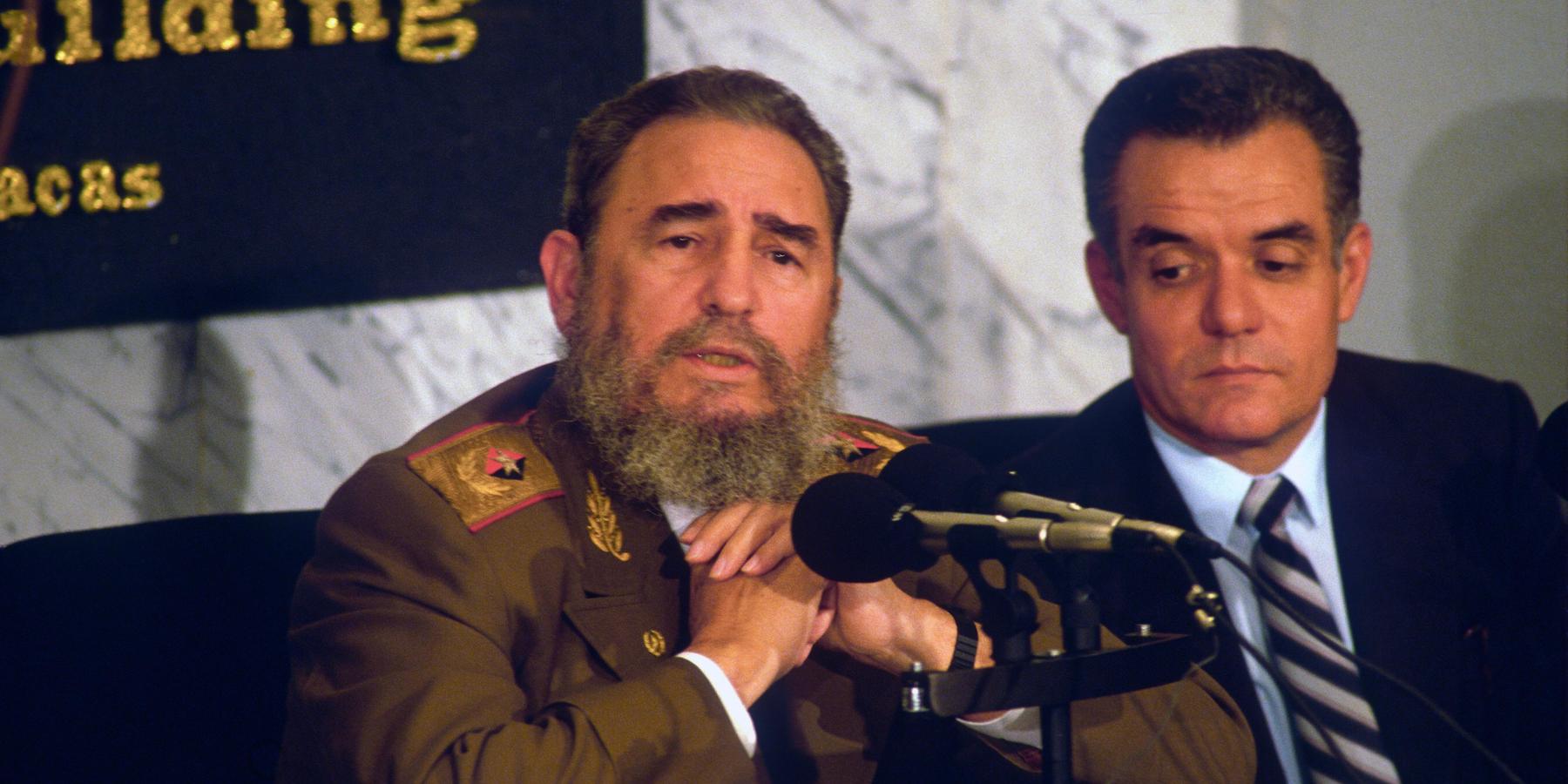
When Fidel Castro came to power in 1959, Cuba was legally sovereign but in an extraordinarily asymmetric relationship with the United States.
As Earl E. T. Smith, U.S. ambassador prior to the revolution, told Congress in 1960, “the American ambassador was the second most important man in Cuba; sometimes even more important than the (Cuban) president.”
Castro’s revolution changed that relationship. This is an essential part of his legacy — one worth exploring as Cuban authorities celebrate the centenary of the long-time leader’s birth. Under Castro, Cuba went from a country whose foreign policy was deeply constrained by Washington to one capable of challenging the United States for decades and pursuing an independent foreign policy far beyond what its size and material resources would have suggested.
Fidel turned Cuban nationalism into the first principle of Cuba’s foreign policy. Revolutionary Cuba learned to say “no.” That is where the paradox begins.
Several Cold Wars
In 1962, Washington managed to expel Castro’s regime from the Organization of American States under the pretext that the island was at the service of the China-Soviet Union axis. Ironically, by 1962, there was no such axis, and Fidel was playing the conflict the two Communist great powers off each other to achieve better terms from each of them.
Fidel Castro was much more than a Soviet ally. The relationship with Moscow was indispensable to the revolution’s economic and military survival, but Fidel never accepted that dependence should negate Havana’s political autonomy. Yuri Pavlov, the last Soviet and the first Russian ambassador in Havana, wrote about the Katushev doctrine, in reference to a prominent Soviet bureaucrat and previous ambassador in Havana: “Never corner Fidel; he will go very far to challenge us, just to prove his independence.”
Angola was the most extraordinary example. As Piero Gleijeses has shown, Cuba’s successful campaign beginning in 1975 to drive back invading South African forces in newly independent Angola cannot be understood as a Soviet operation carried out by Havana. Fidel pursued his own objectives and was willing to assume enormous risks to achieve them.
Cuba’s intervention contributed decisively to the defeat of apartheid forces in southern Africa, paved the way for Namibia’s independence, and gave the island an international influence wildly disproportionate to its resources. Nelson Mandela called Cuba “the most selfless of our friends.” Barack Obama later acknowledged that, in the struggle against apartheid, Cuba had been on the right side of history.
Cuba’s external autonomy coexisted with extraordinary concentrations of power at home. Fidel fiercely defended Havana’s independence from Moscow while sharply restricting the political autonomy of those who disagreed with him. This became one of the central contradictions of Fidel’s legacy: a revolution that defended national sovereignty and ideological pluralism with determination in global affairs, while leaving little room for political autonomy within Cuba itself.
Missed opportunities
When the Soviet Union disappeared, that rigidity was exposed. The economy survived, but at enormous cost. Reforms came too late and too slowly to prevent an economic crisis from becoming a crisis of legitimacy.
There is another, less explored, dimension of Fidel’s legacy: Cuba missed important opportunities in managing its relationship with the United States because of Castro’s revolutionary idealism. The relationship between the two countries is a classic case of asymmetry.
Washington has always possessed overwhelming material superiority and, most of the time, has practiced an imperial policy towards Havana, which is the main obstacle to a normal diplomatic relationship.
But, as political scientist Brantly Womack has argued, asymmetric relationships are not a single relationship between the strong and the weak. The smaller country cannot eliminate the power gap. It can, however, learn to manage it and even flourish despite it. After all, a small power like Cuba can focus the vast majority of its foreign policy attention on dealing with a superpower like the U.S., while Washington must navigate innumerable issues that divide its attention at any given moment.
Womack’s approach allows us to offer a different perspective on the presidency of Jimmy Carter. In 1977, a presidential directive opened the possibility that the United States and Cuba could find a modus vivendi without resolving their fundamental political differences. The goal was modest: turning permanent confrontation into peaceful competition. Cuba didn’t have to withdraw from Angola; an accommodating relationship was on the table if Cuba moderated its revolutionary foreign policy and softened the alliance with Moscow. The asymmetry was not going to disappear. What could change was the way it was managed.
Fidel did not always understand this distinction. After Angola, his perception that the international balance of power was shifting in favor of the communist bloc strengthened a revolutionary foreign policy that did not always coincide with Cuba’s national interest. Cuba gained influence in Africa and the Global South. Revolutionary internationalism was a source of prestige and influence. But this was not always the best strategy for a small state located 90 miles from the world’s most powerful country. In the end, Cuba missed significant opportunities for diplomatic and economic normalization with Washington.
The February 1996 shootdown of the Brothers to the Rescue (BTR) aircraft offers another example. Under the clear tolerance of U.S. authorities, BTR planes conducted incursions into Cuban airspace, in gross violations of international law that endangered air traffic. Havana had legitimate reasons to regard these provocations as a security threat.
But the shootdown strengthened those in Washington who favored economic war on Cuba. It helped create the political conditions for passage of the Helms-Burton Act, which codified much of the sanctions regime and structurally hardened the bilateral conflict. The episode illustrates one of the limits of Fidel’s strategy: he knew remarkably well how to resist but was less adept at recognizing when a tactical victory could lead to a strategic defeat. Resistance had won a battle. But Castro undermined President Bill Clinton’s interest in détente with Cuba.
Is Cuba's crisis Fidel's real legacy?
Castro mastered the art of resistance. Under his leadership, Cuba learned to convert limited resources into international influence. But Fidel struggled to adapt his own revolution to new circumstances.
As Robert Pastor demonstrated in comparing Panama under Omar Torrijos with Cuba under Fidel Castro, asymmetry does not necessarily force a small country to choose between capitulation and permanent confrontation. There is a third possibility: negotiation, through which a weaker state can turn a structural disadvantage into a more favorable political arrangement.
Fidel found that transition much more difficult. After the fall of the Soviet Union, the instruments that had protected the revolution needed to become institutions for a post-Cold War Cuba, but Fidel was not ready to change. He and the same cohort of politicians governed Cuba for more than 60 years. He and his brother, Raul, were at best half-hearted in their support for necessary economic reforms, generational renewal, and greater political flexibility, all factors that could shape a less confrontational relationship with the United States.
Fidel succeeded in making Cuba capable of saying no. But he failed to build a system capable of sustaining that defiance.
To say that he is responsible for Cuba’s current crisis would be simplistic. But to absolve him of responsibility would be equally untenable. The United States has pursued policies toward Cuba for decades that are cruelly coercive and ineffective in promoting human rights and political reform. Recognizing this does not eliminate Cuban leaders’ responsibility for decisions they made when they had opportunities to reduce the country’s vulnerabilities.
The great question left by Fidel’s legacy is not whether Cuba should have resisted the United States. Domination is never an acceptable alternative. There is no freedom in a colony or a protectorate. While saying “no” is necessary, it may not be sufficient. The ultimate challenge is using sovereignty to build prosperity.
Fidel left to his successors the challenge of saying “yes” — to leadership renewal, to economic flexibility, and ultimately to a reconciliation capable of closing the cycle of confrontation.