

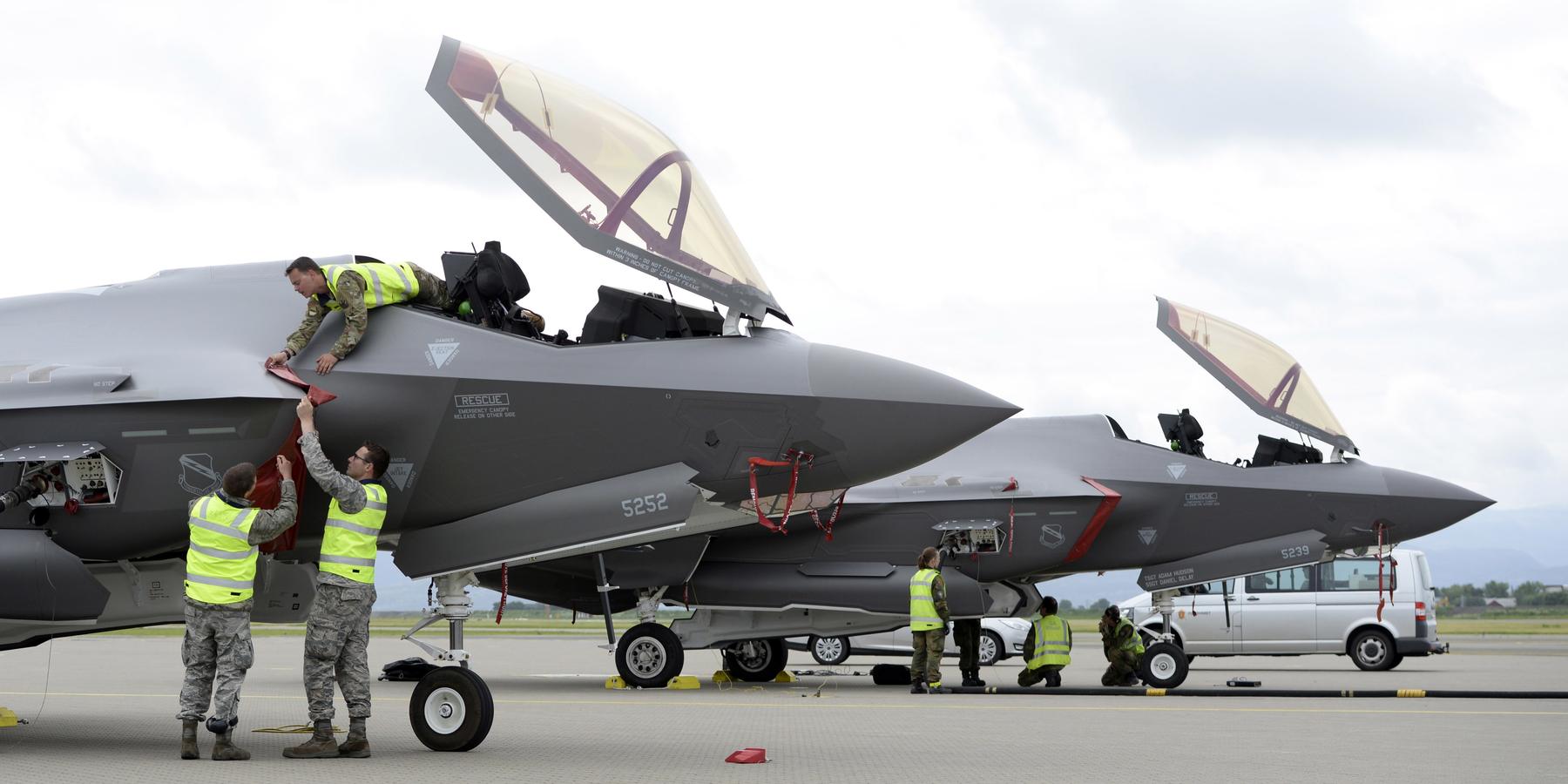
Just when the U.S. military could use reliable machinery for its hot war on Iran, defense contractors plan to send it radarless F-35s that are unfit for combat.
Breaking Defense reported late last week that the military will start accepting F-35s without radars starting this fall. Defense Daily reported last month that some F-35s have already been delivered without them, but the F-35 Joint Program office denied this.
The problem stems from Northrop Grumman’s delays in producing upgraded radars for the F-35 as part of the program’s ongoing modernization effort. The radars are supposed to help the fighter jet detect, track, and target adversarial threats. Not built to host the older radars currently in use, the incoming radarless F-35s can still fly, but will only be used for training purposes until they can be retrofitted with the new radars — effectively sidelining them from combat.
“Right now, [F-35s are] going to be produced with ballasts [instead of the new radars], which…creates an aircraft that’s not going to be combat-coded anytime soon,” Rep. Rob Wittman (R-Va.), chairman of the House Armed Services tactical air and land forces subcommittee, told Breaking Defense earlier this month.
The critical readiness issue the delay creates only stands to compound with time: if Northrop Grumman can deliver the new radars soon, Breaking Defense reports the issue might only affect a “handful” of F-35 deliveries. But if radar production delays persist past next year, more than 100 F-35s could be delivered without radars.
Citing the F-35 program’s history of production delays, Dan Grazier, director of the National Security Reform Program at the Stimson Center, tells RS it is unlikely the new radars will be ready soon.
“Chances are extremely high that the contractor will not be able to deliver a working radar next year. Every time a program official has made such an announcement about a timeline, the promise never materializes,” Grazier told RS. “The only timeline program officials ever stuck with was to declare initial operational capability on time. Those announcements happened a decade ago, and yet the F-35 program is delivering jets without a basic combat system.”
Radar retrofits for the jets, meanwhile, could be expensive and time consuming.
“When you add it all up, retrofits to the F-35 will ultimately cost taxpayers tens-of-billions of dollars. This will only add to that absurd tab,” said Ben Freeman, director of the Democratizing Foreign Policy program at the Quincy Institute, which publishes RS. “It's well past time we cut our losses and stopped buying more of these overpriced and underperforming planes.”
Lockheed Martin, meanwhile, is redesigning the front end of the jet’s internal frame so that newer F-35s can use either the old or new radars; that workaround is not expected to be available until 2027.The F-35's latest flop
The current radar debacle stands to leave the U.S. without critical military equipment amid its potentially long-term war on Iran — which has damaged or destroyed a number of key U.S. military assets, including an F-35, since hostilities began on February 28.
But the impasse is decades in the making, brought about by an F-35 program characterized by underperformance and delays — at the expense of American taxpayers and military readiness alike. Indeed, all F-35s delivered in 2024 were late. Meanwhile, the Government Accountability Office (GAO) deemed the F-35 mission capable little more than half the time in 2023, despite being in service for more than a decade.
Notwithstanding these issues, defense contractors have raked in hundreds of millions in incentive fees — which, ironically, are supposed to encourage contractors to deliver weapons systems on-time — over the lifetime of the F-35 program, which will altogether cost taxpayers an eye-watering $2 trillion.
To expert observers, the radarless F-35 deliveries are just another sign the program has flopped.
The radar problem is “proof positive that the F-35 program is a failure,” Grazier told RS. “This jet has been in development for a quarter century as of this October and the contractor is delivering aircraft to the services that don't have a functional radar. The American people deserve a reimbursement at this point.”
Northrop Grumman and the F-35 Joint Program Office did not respond to requests for comment.
- 'Flop': Proponents of the F-35 can't tell you that it works ›
- F-35 is the biggest money sinkhole ever ›