

In a terminally polarized America, it can sometimes seem like there’s nothing that diehards of both major parties can agree on.
Yet at both the party conventions this year there were signs that Americans are ready for a new U.S. foreign policy — even if they had very different ideas of what that change should be.
Speaking to delegates and attendees at the Republican National Convention (RNC), again and again I heard the sentiment that the United States is too involved overseas, and that the treasure being invested in foreign wars should be reinvested back home.
“America is overstretched. We’re trying to do too much all over the world,” Michigan Trump delegate and sheet-metal union worker Ken Crider told me. His friend, James Hooper, agreed about the folly of foreign intervention. “You can’t predict what will happen when you involve yourself that way,” he said.
Shalira Taylor-Jackson, a disillusioned Barack Obama volunteer and an alternate delegate from Cleveland, complained to me about the massive military aid bill passed earlier this year for Ukraine, Israel, and Taiwan. “You sent $100 billion over there,” she said. “If you just gave some of that to the inner cities.”
It was the same thing I heard from another attendee, a convention volunteer who had also once voted for Obama, who felt too much money was being given away to foreign governments.
“What about our people, our veterans, our health care?” she said.
Attendees consistently expressed favorable opinions about the idea of speaking with adversarial states. “You have to talk,” said Don Hammell from Dallas, whose daughter-in-law is Ukrainian. When I asked him how he felt about Ukraine potentially having to give up territory as part of a peace deal, he said “that’s between them.”
Stopping by the Turning Point USA stage, Rep. Marjorie Taylor-Greene (R-GA) spread baseless conspiracy theories about Trump’s near-assassination, but also expressed skepticism about reports of an Iranian plot on his life. “Is this the next country the Deep State wants to bomb?” she said. “We are not going to accept the weapons of mass destruction explanation fed to us.”
Later in the week, Sen. Ron Johnson (R-WI) stopped by a “Serbs for Trump” event, receiving a good reception for an anti-war, anti-foreign entanglement message, warning against the “demonization” of foreign people, and urging people to read Dwight Eisenhower’s famous farewell address denouncing the growing military-industrial complex. The event’s organizer, Sasha Jovicic, said that such messaging resonated with the Serbian-American crowd because conscription had killed so many men in the old country.
It was not always a coherent anti-interventionist sentiment. Those who expressed caution about foreign entanglements also praised former President Donald Trump’s reckless assassination of Iranian General Qasem Soleimani. There was universal disdain for President Joe Biden’s withdrawal from Afghanistan. Israel’s war in Gaza and U.S. support for it got widespread, enthusiastic support, with Israeli flags rife throughout the convention.
Much of this was reflected in the televised programming, with speeches — like those from Trump and J.D. Vance, or Tucker Carlson and David Sacks — that tended to express skepticism about continuing U.S. involvement in Ukraine and praising Trump as a peacemaker. Others, however, consistently emphasized Trump’s purported toughness, his support for pouring more money into the military, and making hawkish noises about Iran.
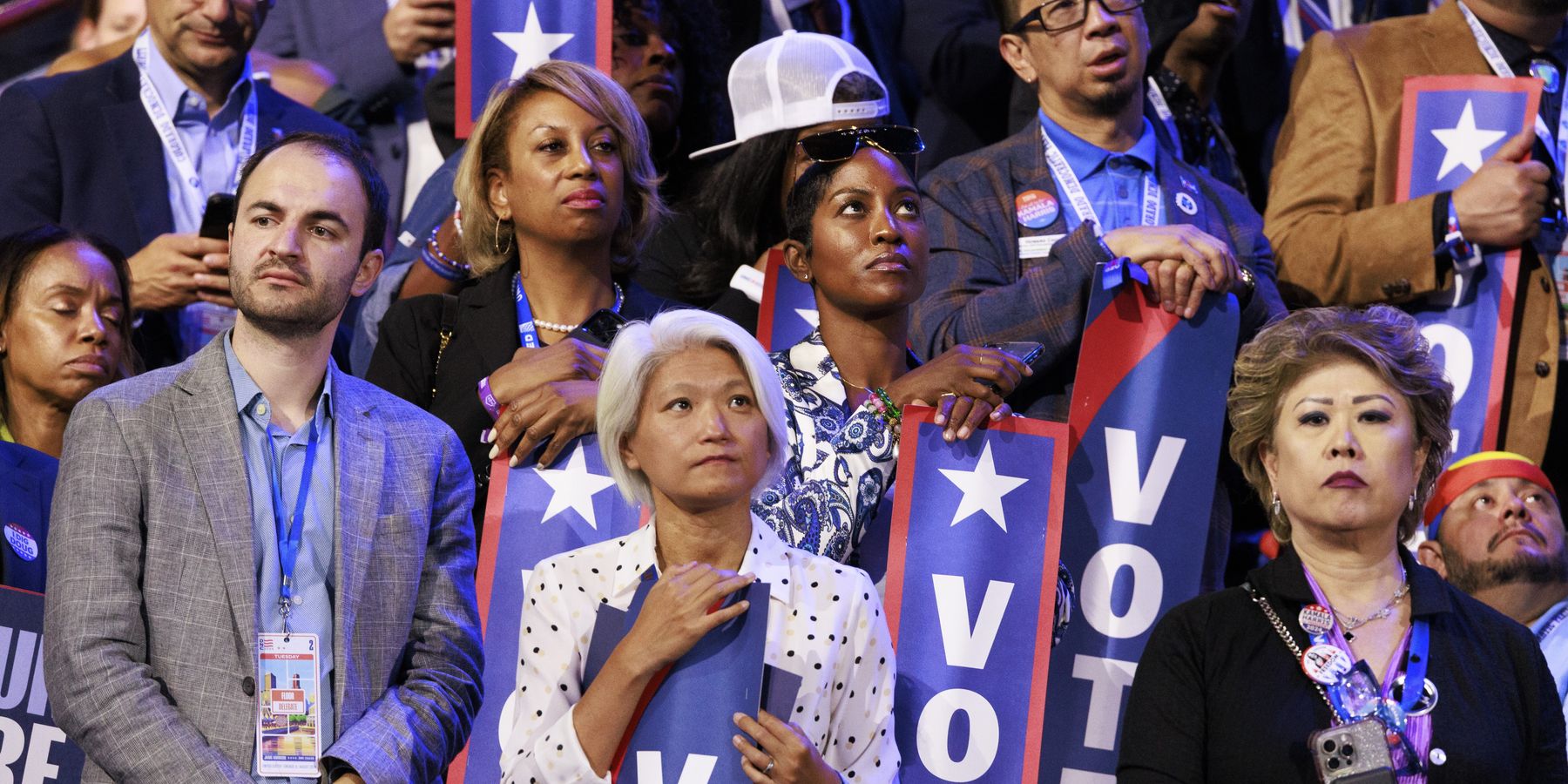
It was a different scene at the Democratic National Convention (DNC) this week, where there was far less enthusiasm for Israel’s war, but commitment to Ukraine was ironclad. The view that Trump was beholden to Russian President Vladimir Putin, and concern that his win would mean handing Ukraine over to Russia, was widespread throughout the convention. Putin was bent on reconstituting the Soviet Union, Michigan delegate Barry Lepler told me, and the world was in a World War II-like moment that couldn’t afford appeasement.
“There’s always been people in rural areas who are more isolationist,” said talk radio host Joel Heitkamp, who had earlier that week appeared on a panel focused on winning back rural Americans. When I asked about the widespread resentment in rural and other parts of the country toward military aid that wasn’t being invested in communities back home, he questioned whether it was a necessarily organic view. People opposed further aid to Ukraine because of Trump, he said, not the other way around.
This was all consistent with the four nights’ speeches, which tended to stress the same themes on foreign policy that Biden had come to lean into the past few years, and which have become familiar Democratic rhetoric now: enthusiasm for NATO, commitment to Ukraine, and a foreign policy based on the idea of defending democracy.
At one point, the packed arena waved flags and sang joyfully along to Bruce Springsteen’s “Born in the USA,” entirely missing the point of the famously bitter anti-war anthem.
This reached its apogee with Vice President Kamala Harris’ acceptance speech closing out the convention, where she vowed to “ensure America always has the strongest, most lethal fighting force in the world,” promised to “take whatever action is necessary” against Iran, assured people she would “stand strong with Ukraine and our NATO allies,” and “always stand up for Israel’s right to defend itself,” while expressing sympathy for the devastation suffered by Gazans as a result of that Israel policy.
Coupled with a party platform that expresses remarkably hawkish views on the Middle East, including attacking Trump for being insufficiently hawkish on Iran, the weeks’ proceedings were, as Responsible Statecraft’s Blaise Malley has pointed out, a major leap backward from the 2020 Biden campaign’s denunciation of “forever wars” and promise to craft a “foreign policy for the middle class.”
But that’s not to say there were no signs of change. The biggest foreign policy story of the DNC was the ongoing rift over the Gaza war, and over the Biden administration’s policy of unconditional support for Israel to carry out what a growing cohort of experts and informed observers are calling a genocide.
But its significance lay not so much in the presence at the convention of 30 “uncommitted” delegates seeking an end to arms transfers to Israel to bring the war to a close, but in the fact that they had widespread support within the party establishment for their goal. Rep. Ro Khanna (D-CA) told me that the movement’s efforts were having an effect inside the party, and said Harris “should pivot [on the war] like Hubert Humphrey in 1968.”
Uncommitted delegates, pro-Palestinian activists, and even anti-war protesters consistently told me that they received a friendly reception from Harris delegates and other attendees, and often got words of explicit support to keep up the pressure. They succeeded in getting 300 Harris delegates to sign a petition calling for an arms embargo, in what one of the movement’s leaders called “some of the easiest organizing they’ve had to do.”
References to a ceasefire were some of the biggest applause lines of the event, with Harris’ pro-Palestinian statement getting a raucous ovation. All of this should make undeniably clear, to both Democratic politicians and viewers at home, how mainstream a position ending this war is.
“Israel is our partner,” Florida delegate William Aristide told me. But 40,000 people had been killed, he said, many of them children. “What did they do to deserve that?” He asked me what the difference was between Israel’s actions and what Russia was doing in Ukraine. “We need to cut them off,” he concluded.
Both parties’ views on foreign policy continue to exist along a partisan gulf. But there are signs, as halting and contradictory as they are, that each is looking for a major shift from business as usual in its own particular way.
- Neocons are melting down over JD Vance ›
- What Kamala Harris would mean for a Biden administration’s foreign policy ›
- Kamala & Gaza: All words and no deeds make a divided party ›