

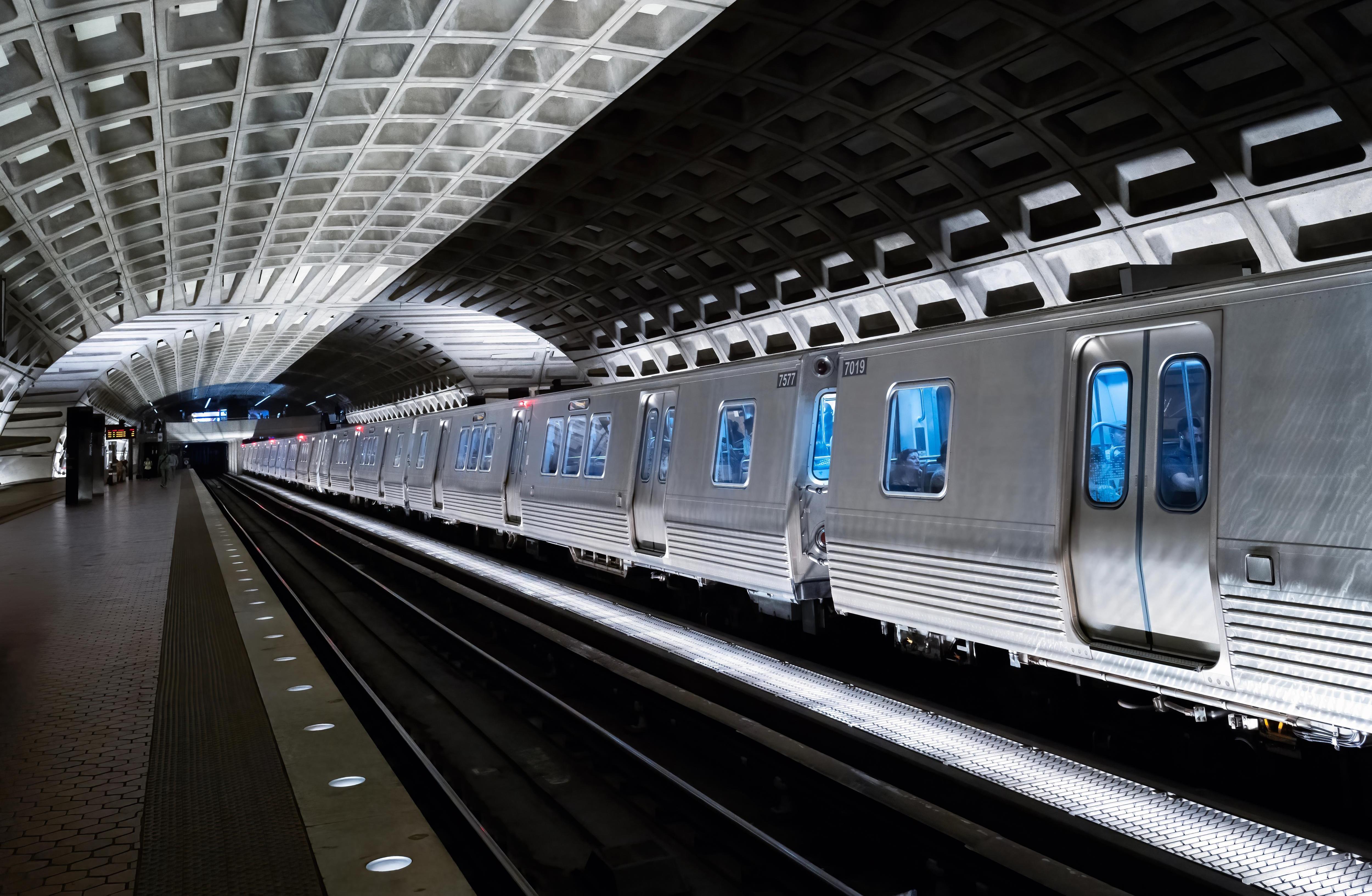
Washington DC’s public transit system, the Washington Metropolitan Area Transit Authority (WMATA), is flooded with advertisements about war. Metro Center station, one of the city’s busiest stops, currently features ads from military contractor Applied Intuition bragging about its software’s ability to execute a “simulated air-to-air combat kill.”
But when an anti-war group sought to place an ad advocating peace, its proposal was denied. Understanding why requires a dive into the ongoing battle over corruption, free speech, and militarism on the buses and trains of our nation’s capital.
In 2022, the same anti-war group, World Beyond War (WBW), received approval to place advertisements on the DC Metro system that read “PEACE ON EARTH.” In December 2025, it approached Outfront Media (the company handling WMATA’s advertizing) with a proposal for an ad that was identical, except for one detail: an asterisk at the bottom that read “*Including in Venezuela.” According to emails provided to Responsible Statecraft by WBW Executive Director David Swanson, Outfront Media replied in early January to say that the ad had been rejected by WMATA: “The ad review panel has determined that the [proposal] is prohibited by Advertising Guidelines 9 and 14.
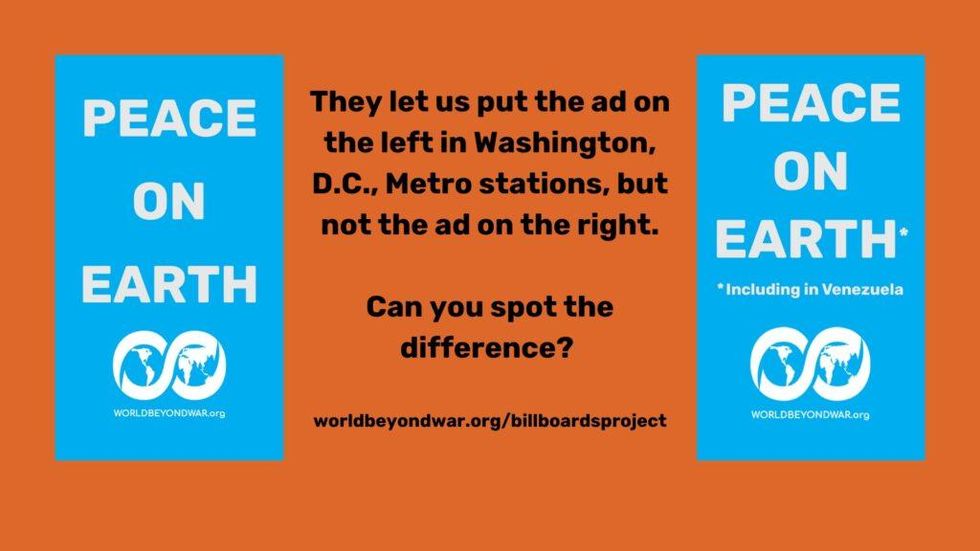
The “advertisement review Panel” is the WMATA board that decides whether ad proposals comply with the Metro’s guidelines. This panel apparently determined that broad calls for peace are permissible, but that any specification — even just naming a country — breaks the rules.
To World Beyond War, this denial is an act of hypocrisy. Pointing to the countless advertisements from military contractors on the Metro, the group’s statement claims that “[a]n exception is being made for peace.” Indeed, in a little-noticed change made in 2024, the transit authority adjusted its rules to provide special treatment to government contractors, including the arms industry
The war over words
The debate over acceptable advertising within the DC transit system has grown into a major controversy over the last decade. One source is the constant presence of military contractors like Lockheed Martin and RTX (formerly Raytheon), which buy ad space in hopes of pushing their products on congressional budget staff and Pentagon procurement officers.
Several years ago, RS conducted a survey of military contractor advertising in the WMATA train system and found not only that contractor ads were common, but that they were also concentrated in the places frequented most by government policymakers: the stations closest to the Pentagon and Congress. At first glance, this arrangement seemed to violate both federal law and WMATA’s own Guideline 14 against ads “intended to influence public policy.” The only reason that contractors have dodged Guideline 14 so far is a bizarre insistence that ads encouraging the government to buy weapons systems with public funds do not count as “political advocacy.”
In the time since that survey was published, military contractors have become even more prominent within the transit system, and WMATA’s marketing guidelines have become even more controversial.
WMATA tried to avoid political controversy altogether in 2015 by temporarily joining the transit systems of cities like Chicago in banning all “issue-oriented” ads. Though successful in stemming paid propaganda, the strict policy also drew criticism from free speech advocates, including a largely unsuccessful 2017 lawsuit by the American Civil Liberties Union (ACLU).
In 2024, the ACLU found some success in another case against WMATA’s advertising restrictions. A DC district court judge ruled that Guideline 9 against ads “intended to influence members of the public regarding an issue on which there are varying opinions” — one of the two guidelines used to reject WBW’s peace ad proposal — “does not provide objective, workable standards,” and that WMATA’s application of the rule “has been far from consistent.”
WMATA sought to address this problem by issuing a new set of “internal procedures” in November 2024, providing detailed guidance about how ads were judged. Though this document was supposedly meant to clarify the rules, it effectively changed the rules by enumerating a number of new restrictions and permissions.
Contractors only
Under the old rules, military contractor ads were in apparent violation of Guideline 14’s straightforward ban on ads “intended to influence public policy.” But under the new rules, government contractors are now exempt from Guideline 14 via a carveout for advertisers that are “offering goods and/or services to the government.” No such exemption was made for peace groups like World Beyond War, who typically take the opposite position of military contractors in debates over Pentagon policy.
WMATA’s new rules gave military contractors other exemptions as well. Guideline 9 — the legally questionable rule that WBW was accused of violating — now explicitly prohibits advertisers from taking a position on any “governmental action or inaction, other than offering goods and/or services to the government” [emphasis added]. In other words, for-profit advertisers with money at stake are now one of the only groups allowed to share their opinions on political issues surrounding military spending and acquisitions.
The ACLU seems to regard WMATA’s “internal procedures” with skepticism, requesting a discovery process into its “development and meaning.” It’s easy to see why: if upheld, these new rules would effectively legalize for-profit advertising in favor of militarism while banning most non-profit advertising critical of militarism.
There is also another reason to be skeptical of the new rules: WMATA does not seriously enforce them. In the year since its “internal procedures” document was released, WMATA has accepted multiple ad campaigns that are in clear violation of Guidelines 9 and 14.
Last month, crypto company Block placed an ad on bus stops arguing that Bitcoin transactions “deserve a… tax exemption.” This month, the Alliance of Nurses for Healthy Environments put up an ad saying that “The EPA’s attack on vehicle emissions standards is an attack on our health.” Both ads break Guideline 9 by “Supporting… a law… or policy” and Guideline 14 by “seek[ing] to influence lawmakers… in the conduct of their duties.” Yet unlike WBW’s relatively tame proposal, both were apparently approved by the ad review board. When WMATA fails to enforce its own rules in accepting ads, each rejection appears all the more suspicious. WMATA did not respond to a request for comment.
While the WMATA guidelines might be an unevenly enforced mess, federal law is still quite clear about military contractor ads. It is explicitly illegal for government contractors to use the public funds they receive for efforts “attempting to influence an officer or employee” of the federal government in an effort to acquire more contracts. It is unclear if WMATA has any process in place to ensure that this law is being followed.
As it stands today, the DC transit system’s advertising rules effectively ban many pro-peace advertisements while bending over backwards to allow ads from the military-industrial complex. Such an absurdity suggests that WMATA’s legal troubles might not be over any time soon. Meanwhile, Swanson says that World Beyond War is “interested in the possibility of a lawsuit!”