
Follow us on social

google cta
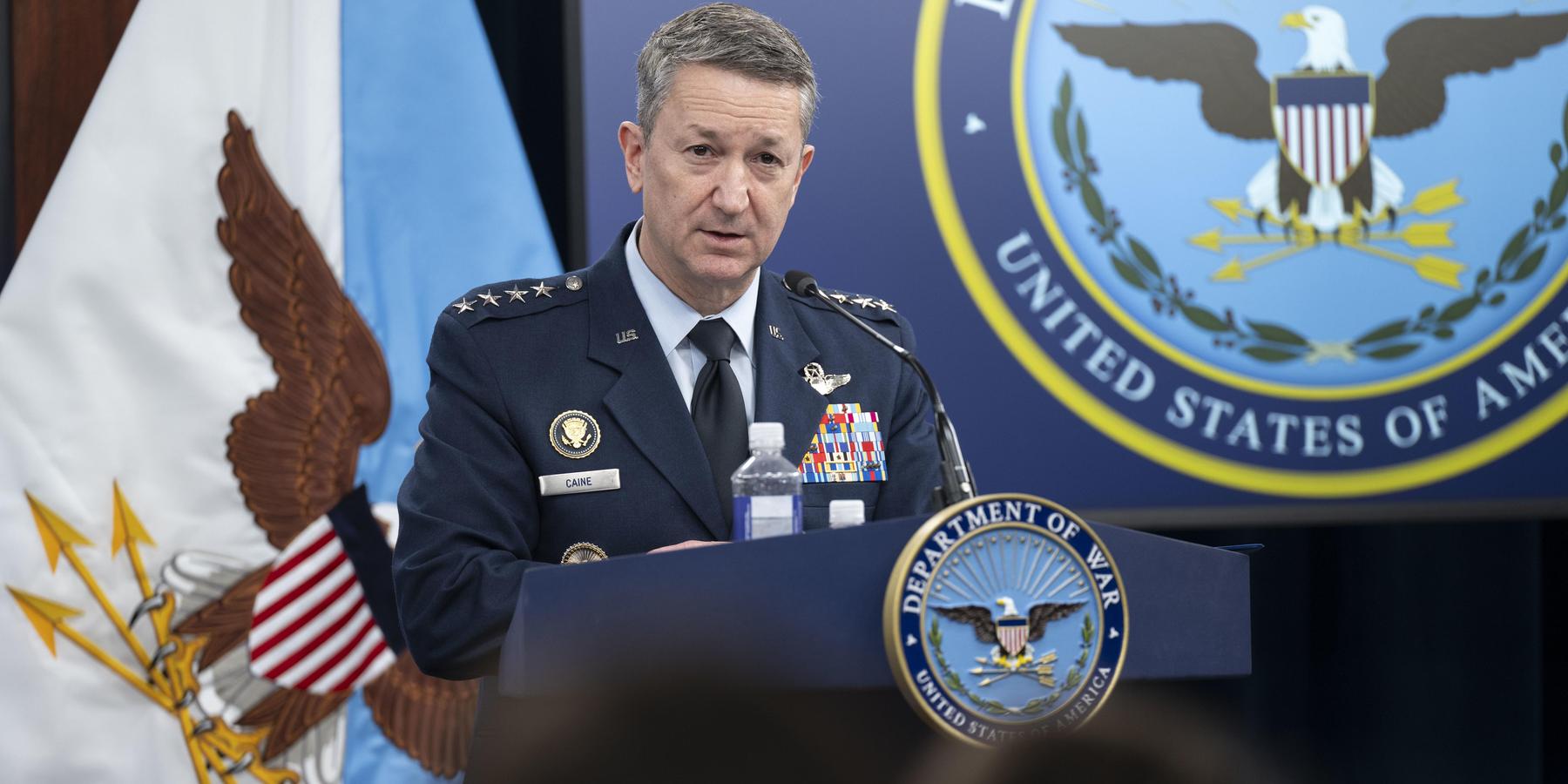
Dan Caine

Did Caine just announce the Morgenthau option for Iran?

Saying the US wants to destroy Tehran's 'military and industrial base' for 'years to come' suggests Germany after WWII and that's strategically incoherent and dangerous

Analysis | QiOSK
google cta
google cta

Gen. Dan Caine’s formulation of American war aims in Iran is remarkable not because it is bellicose, but because it is strategically incoherent.

In a press conference Tuesday morning, the chairman of the Joint Chiefs of Staff did not describe a limited campaign to suppress missile fire, blunt Iran’s naval threat, or even impose a severe but bounded setback on Tehran’s coercive instruments. He described a campaign against Iran’s “military and industrial base” designed to prevent the regime from attacking Americans, U.S. interests, and regional partners “for years to come.” In an earlier briefing he put the objective similarly: to prevent Iran from projecting power outside its borders. Rather than the language of a discrete coercive operation, this describes a war against a state’s capacity to regenerate power.

And once one says “industrial base,” the logic becomes much more radical than administration officials may realize. Destroying missile launchers is one thing. Destroying missile factories is harder but still intelligible. But preventing Iran from threatening anyone “for years to come” means something else again. It means attacking not merely weapons, but the system that produces and reproduces them: electric power, transport, fuels, machine tools, metallurgy, electronics, repair facilities, and perhaps the broader fiscal and industrial foundations of military recovery.

A country whose critical infrastructure remains intact can rebuild military industry. A country that cannot rebuild has, by definition, suffered something much closer to strategic deindustrialization.

That is why Caine’s wording evokes Henry Morgenthau’s wartime vision for Germany. Morgenthau argued that making Germany incapable of renewed aggression required more than smashing its armaments sector. He called for eliminating the metallurgical, electrical, and chemical industries and contemplated a Germany that would become “predominantly agrarian.” Another State Department summary described the plan as looking toward converting Germany into a country “primarily agricultural and pastoral in character.

No, the administration has not formally announced a Morgenthau Plan for Iran. But that is not the point. The point is that Caine’s rhetoric tracks the same underlying logic: if your war aim is not merely to punish or deter, but to keep a state from threatening others for “years to come,” then you are no longer talking about operational suppression. You are talking about systematically crippling the economic foundations of war-making.

That is an extraordinary thing for the chairman of the Joint Chiefs to say. Caine is supposed to be the sober professional in the room, the man who translates political impulse into disciplined military language. If he is now defining American aims in terms that imply the long-term disabling of an entire national military-industrial ecosystem, then one of two things is true.

Either the administration has genuinely lost its strategic bearings. It has wandered from limited war into maximalist fantasy without admitting the scale, duration, and destruction such an aim would require. Or it has sacrificed strategic communication to pure bloviation. It is using inflated language to sound tough while pursuing something much narrower in practice.

Neither possibility is reassuring. If the first is true, Washington is flirting rhetorically with an objective that airpower alone is unlikely to achieve absent a far wider campaign against Iranian infrastructure. If the second is true, American officials are carelessly overstating war aims in ways that make later restraint look like failure. In war, rhetoric matters. Maximalist definitions of success create their own escalatory trap.

That matters especially now, because this is exactly the kind of war Washington may soon want to curtail. If so, Caine’s phrasing was not merely loose. It was damaging. A chairman should clarify ends, align means, and preserve room for termination. He should not borrow, even inadvertently, the logic of Morgenthau while the White House still pretends it is fighting a limited war.


Top photo credit: Secretary of War Pete Hegseth and Chairman of the Joint Chiefs of Staff U.S. Air Force Gen. Dan Caine conduct a press briefing on Operation Epic Fury at the Pentagon, Washington, D.C., March 4, 2026. (DoW photo by U.S. Navy Petty Officer 1st Class Alexander Kubitza)
google cta
Analysis | QiOSK
Mbs-mbz-scaled
UAE President Sheikh Mohammed bin Zayed al-Nahyan receives Saudi Crown Prince Mohammed bin Salman at the Presidential Airport in Abu Dhabi, United Arab Emirates November 27, 2019. WAM/Handout via REUTERS

Is the US goading Arab states to join war against Iran?

QiOSK

On Sunday, U.S. Ambassador to the U.N. Mike Waltz told ABC News that Arab Gulf states may soon step up their involvement in the U.S.-Israeli war on Iran. “I expect that you'll see additional diplomatic and possibly military action from them in the coming days and weeks,” Waltz said.

Then, on Monday morning, Sen. Lindsey Graham (R-S.C.) slammed Saudi Arabia for staying out of the war even as “Americans are dying and the U.S. is spending billions” of dollars to conduct regime change in Iran. “If you are not willing to use your military now, when are you willing to use it?” Graham asked. “Hopefully this changes soon. If not, consequences will follow.”

keep readingShow less
Why Tehran may have time on its side
Top image credit: Iranian army military personnel stand at attention under a banner featuring an image of an Iranian-made unmanned aerial vehicle (UAV) during a military parade commemorating the anniversary of Army Day outside the Shrine of Iran's late leader Ayatollah Ruhollah Khomeini in the south of Tehran, Iran, on April 18, 2025. (Photo by Morteza Nikoubazl/NurPhoto)

Why Tehran may have time on its side

QiOSK

A provocative calculus by Anusar Farrouqui (“policytensor”) has been circulating on X and in more exhaustive form on the author’s Substack. It purports to demonstrate a sobering reality: in a high-intensity U.S.-Iran conflict, the United States may be unable to suppress Iranian drone production quickly enough to prevent a strategically consequential period of regional devastation.

The argument is framed through a quantitative lens, carrying the seductive appeal of mathematical precision. It arranges variables—such as U.S. sortie rates and degradation efficiency against Iranian repair cycles and rebuild speeds—to suggest a "sustainable firing rate." The implication is that Iran could maintain a persistent strike capability long enough to exhaust American political patience, forcing Washington toward a premature declaration of success or an unfavorable ceasefire.

keep readingShow less
J. William Fulbright
Top photo image: Sen. J. William Fulbright and Lyndon B. Johnson in Washington DC, June 21 1960 (US government photo/public domain)

Today's 'Arrogance of Power' meets the ghost of J. William Fulbright

Military Industrial Complex

If one listens closely, faint echoes from 60 years past might be discerned in the aftermath of the United States’ latest aggression against the Islamic Republic of Iran. The voice of Senator J. William Fulbright, condemning a Congress for abrogating its power to decide when and how the nation went to war, rings clear given we face a nearly mirror situation today.

It seems worthwhile then to revisit that moment as debate now rages over the merits, morality, and legality of President Trump’s second regime-change war in less than two months. In 1966, Fulbright convened five days of televised “educational” hearings for better comprehending the American war in Vietnam. The Arkansas Democrat, then chairman of the Senate Foreign Relations Committee, followed with a series of lectures that spring at Johns Hopkins University, widening his scope and leveling a sharp critique against U.S. foreign policy.

keep readingShow less
google cta
Want more of our stories on Google?
Click here to make us a Preferred Source.

LATEST

QIOSK

Newsletter

Subscribe now to our weekly round-up and don't miss a beat with your favorite RS contributors and reporters, as well as staff analysis, opinion, and news promoting a positive, non-partisan vision of U.S. foreign policy.