

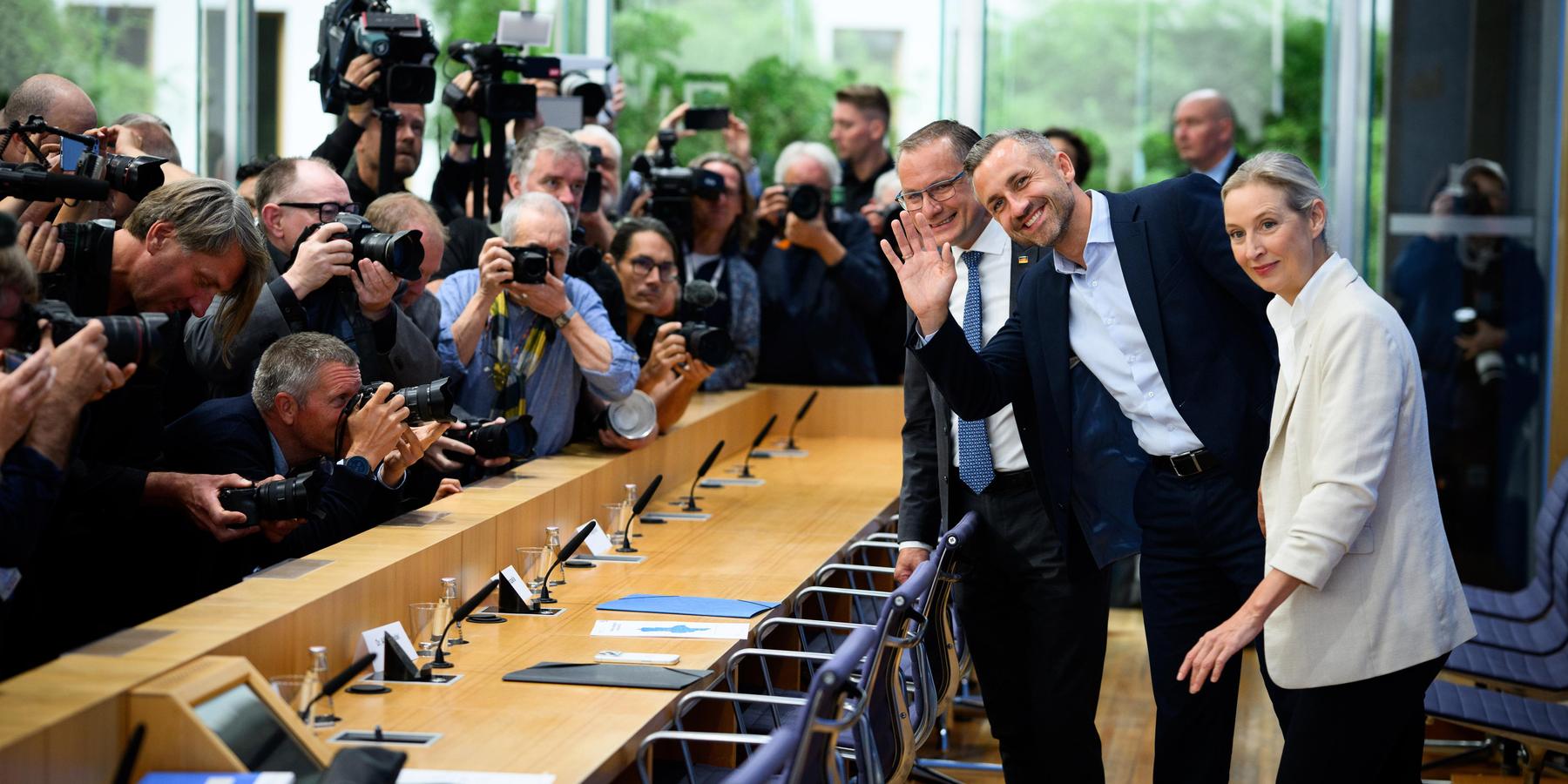
Legislative elections in the eastern German state of Saxony-Anhalt have ended with a huge victory for the nationalist-populist Alternative for Germany (AfD).
The final results have AfD with just under 44% percent of the vote and the incumbent Christian Democrats (CDU) at just over 17%, followed by the Social Democrats (SPD), Greens and the Left (Linke) at about 9% each. The left-populist Sahra Wagenknecht Alliance (BSW) received 5.3% and won five seats. The turnout was above 75%.
Although the population of Saxony-Anhalt is just over two million, this election has been closely watched across Europe, since Germany’s mainstream parties have agreed not to allow right populists ever to have a role in governing at the national or state level. It may be difficult to impose a governing coalition that excludes the AfD after this decisive popular victory.
The AfD will have 39 seats, three seats short of a majority in the 83-seat body, putting the so-called firewall stopping a AfD control under acute pressure. The BSW has offered to cooperate with AfD in Saxony Anhalt, but the terms of any such arrangement would be the subject of negotiation.
In the former East Germany (GDR), the AfD polls strongly, as does the Linke party, which was formed in part from the ruling communist party after Germany’s reunification. Both parties respond to popular grievances in the East about how the region lags behind western Germany on social and economic indicators. There is also a lingering sense of being considered inferior or “other” by western compatriots.
Instead of angry grievance, the AfD leader in Saxony Anhalt, the 35-year-old Ulrich Siegmund, led a campaign with the slogan “Everything in Possible,” projecting a friendly and non-threatening image. In mid-August, the cover of Der Spiegel magazine featured his photo with the caption “Germany’s most dangerous man.” Siegmund cheerfully signed copies of the magazine in good-natured and festive campaign appearances.
Under Germany’s federal system, states have authority over education, cultural matters, and some aspects of economic management and law enforcement. They have virtually no authority in foreign and security policy. Siegmund has stated that schools will follow a more traditional curriculum and will display the national tricolor rather than the rainbow flag. He said the Russian language should be offered in schools and educational exchanges with Russia should be relaunched. Unsuccessful asylum seekers would be detained pending deportation, and his administration would consider limiting the reach of national public broadcasting in the state.
Implications for national politics
Chancellor Friedrich Merz and the CDU-CSU govern in coalition with SPD at the federal level, with Merz’s personal net approval rating at -65% in July, the lowest among European leaders. Throughout the campaign in Saxony-Anhalt, the CDU incumbent minister president Sven Schulze held Merz at arm’s length, because Merz is even less popular in eastern Germany than elsewhere.
The only CDU minister-president (governor) in the former GDR, Michael Kretschmer, who leads Saxony’s administration, urged reconsideration of the firewall. Other CDU leaders attribute the party’s historically low popular support to the necessity of governing in coalition with the center-left SPD, beginning during the governments headed by former Chancellor Angela Merkel. The AfD’s economic and immigration agenda is now not so far removed from that of the CDU. But the AfD is strongly euro-skeptic and opposes continued support for Ukraine.
Merz, unlike the SPD and Greens, does not favor attempting to ban the AfD on the grounds that its political orientation violates the country’s constitution (Grundgesetz). Merz considers the AfD a challenge to CDU’s leading position on the right and therefore seeks to attract voters back to the CDU by, for example, introducing tougher limits on migration and asylum.
There is little evidence that his strategy has succeeded. Since Merz took office, the AfD has become the most popular party in Germany with 28% support, while support for the CDU has declined to 22%. Some analysts suggest that the firewall, by forcing mainstream parties into broad coalitions, has blurred the distinctions among them and vindicated AfD’s claim to present the only available alternative.
Merz has been adamant that the firewall should not be allowed to collapse. To complicate matters further, the CDU also rules out ever going into coalition with the Left party, which they characterize as post-communist, or “hard left.”
What does the breakthrough mean for Ukraine War?
Siegmund and the national AfD leadership have announced openness to cooperation in government with others but seem in no mood to make substantial policy concessions to accomplish this. It is unclear therefore how the AfD will govern alone. The impact on the federal governing coalition, most especially Chancellor Merz’ standing in the CDU, could be significant.
The government of Saxony-Anhalt does not have any direct role in foreign policy. But this election, by opening the novel prospect of admitting the AfD into governing coalitions, including at the federal level, could eventually influence national policy toward AfD’s preferred approach to relations with Russia. The issue was not downplayed by AfD’s leaders during its campaign and will likely play a similar role in the party’s campaign later this month in two other state elections in eastern Germany: Mecklenburg-Vorpommern and Berlin.
- Anti-war sentiment has Germany's major parties on the run ›
- Populist surge in Germany driven in part by war, economic backlash ›