

This year’s anniversary of the Sept. 11, 2001, terrorist attacks should serve as another reminder that the criminal prosecution of the accused plotters remains in limbo.
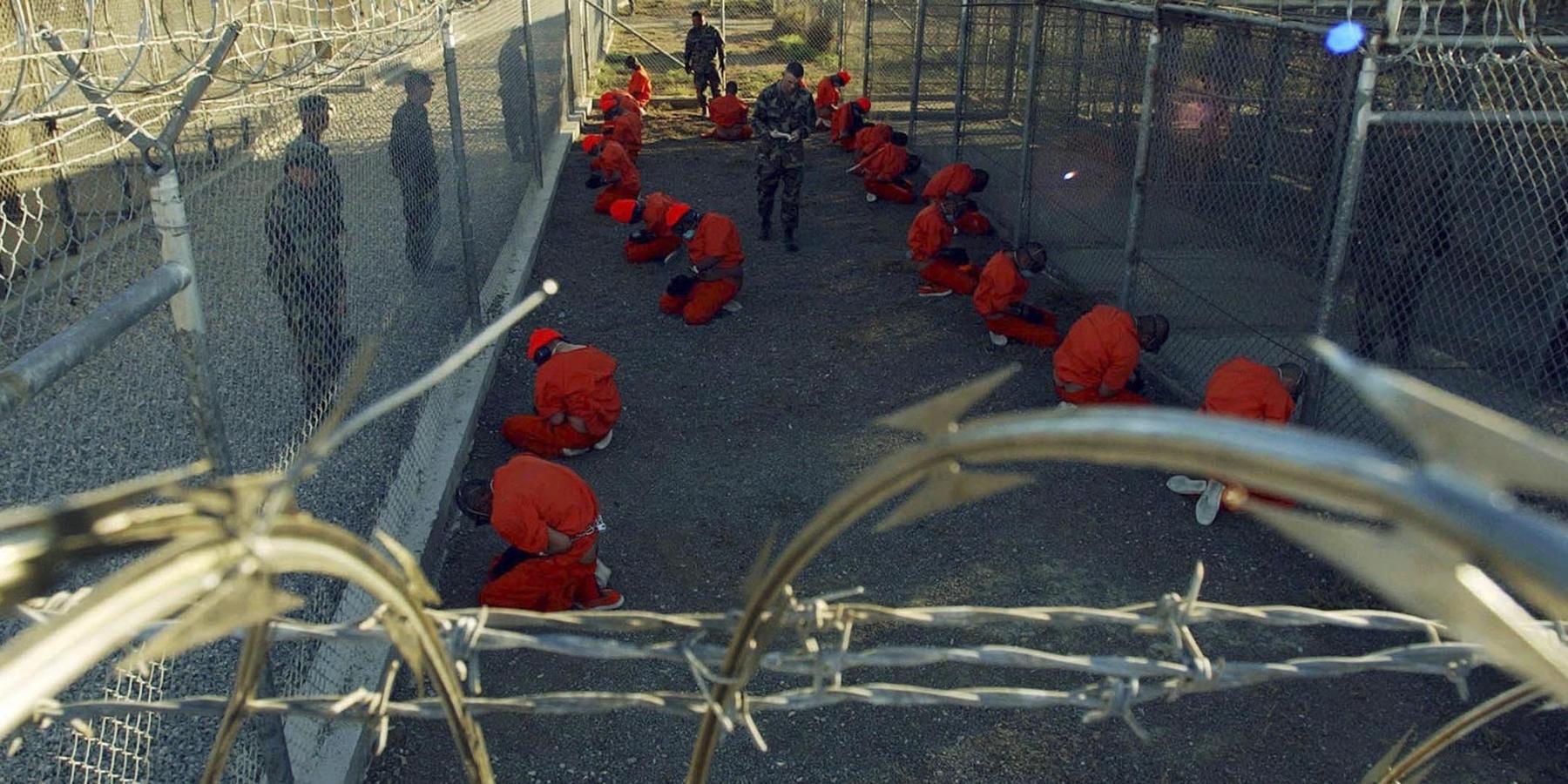
One of the biggest cases in U.S. history, and potentially one of its most consequential, has continued to unfold in something of a vacuum at the U.S. Navy base on Guantanamo Bay, Cuba, against five long-held detainees. Ten additional war-on-terror detainees remain on the base; two of them also have cases in the military commissions, a court system established under President George W. Bush and amended near the start of President Barack Obama’s first term.
Quite often, only two reporters are on the base to cover pretrial proceedings in the prosecution of the alleged plot mastermind, Khalid Sheikh Mohammed, and four co-defendants. The case either dates to 2008 – when the detainees were first charged by the Bush administration – or 2012, when more than 50 reporters from around the world attended their rearraignment at Guantanamo Bay. That second military commission began after a failed attempt by the Obama administration to move the case to federal court in Manhattan. At some point, journalists and other members of the public wait for a trial. This hasn’t happened.
A trial is still not scheduled to begin until at least June 2028, a frustrating reality for family members of the victims, journalists, and other members of the public as the 25th anniversary of the attacks approaches.
To be sure, not all of what’s happened in court over the past decade has been riveting. Holding a five-defendant death-penalty trial for the worst-ever attacks on American soil in a sleepy, remote naval base – and in a new and untested court – was bound to create a time-consuming mix of logistical hassles and legal disputes that have little to do with the defendants or their alleged crimes. For many would-be observers and other stakeholders, this mind-numbing legal mess has come to define the case.
But a closer look reveals an important legal experiment, one that pits the demands of national security against American principles of due process. Perhaps more than any institution, the Guantanamo court continues to reckon with the Bush administration’s decision to rendition terror suspects, including the eventual 9/11 defendants, to CIA black sites, where they were subjected to intense periods of torture and then held in isolation for three to four years.
In the wake of 9/11, the strategic priority was to gather intelligence from the highest-value detainees to prevent future attacks, rather than to prosecute them. Once this process ran its course, the Bush administration transferred the detainees (a total of 14 at the time) in September 2006 from CIA custody to the naval base at Guantanamo Bay. The Senate’s report on the CIA interrogation program stated that the agency maintained “operational control” of the detainees for an unspecified time after their arrival on the base. Nevertheless, the Army commander of the detention camp told the detainees that they were in military custody and entitled to the protections of the Geneva Conventions.
Then the priorities changed. About four months after the transfer, the FBI arrived and reinterrogated the five 9/11 suspects (and other detainees) to elicit ostensibly “clean” confessions that could be introduced as evidence at trial in the new court system. Four administrations later, the case has remained mostly trapped in a perpetual debate over whether these confessions are valid or inadmissible due to the brutality that preceded them at the CIA’s black sites. (One of the five defendants has been severed from the case over a finding of mental incompetency – which his lawyers blame on his CIA torture – though the government still hopes to prosecute him.)
The United States lost credibility around the world both with the creation of the detention facility on Guantanamo Bay – and its unsuccessful attempts to completely block detainees there from access to U.S. civilian courts – and with the many revelations of abuses from the CIA interrogation program. As witnesses in the 9/11 cases have testified, it’s difficult to reestablish the context of the immediate post-attack panic in the U.S. – the fear of an even worse attack and the imperative to stop it.
Still, democracies should be judged on their commitment to the rule of law in times of conflict, when the temptation to skirt international conventions is strongest. The U.S. could have chosen a different path to better balance the demands of intelligence gathering with the need to pursue criminal accountability on behalf of the victims. Instead, the government chose a linear sequence – to first operate outside the law, then to return to the law when doing so suited its shifting priorities.
These decisions have faced significant criticism for apparent hypocrisy. In court, the result has been one of incoherence: The initial steps the U.S. took to capture, torture, and disappear the alleged perpetrators have proved irreconcilable with later efforts to prosecute, convict, and execute. The attempts to make it work, over so many years, have been both fascinating and maddening as the national security state has hovered over the proceedings.
Fights over certain tranches of witnesses and evidence consumed the cases, with the parties engaged in an endless struggle over what can transpire in open court or in classified sessions that are closed to both the public and the defendants. The CIA program, the FBI’s role in that program, the operations of the Guantanamo detention facility – these and other topics contain information the government wants to keep secret.
In 2024, Secretary of Defense Lloyd Austin overruled plea agreements that prosecutors had reached after lengthy negotiations with Mohammed and two co-defendants. The deals would have removed the death penalty as a possible sentence in exchange for full confessions and their participation in a sentencing trial expected to last three months. The defense teams have asked the U.S. Supreme Court to review a decision by the U.S. Court of Appeals for the D.C. Circuit upholding the legality of Austin’s move. If that fails, Austin’s decision may prove to be a lost opportunity at finality for an otherwise unresolvable conflict between the desire for criminal accountability and past national security policies that put that desire on hold.
However the proceedings move forward now, any fair assessment – even the criticisms – should recognize the case’s evolving relationship to America’s credibility and commitment to democratic norms. In one part of the Caribbean, the government has been summarily executing suspected drug traffickers without due process; in another, it continues to provide the accused 9/11 conspirators with stables of military and civilian legal professionals led by experienced capital defense lawyers nearly two decades after they were charged.
So far, three military trial judges – the current judge and his immediate predecessor in the 9/11 case, the other in a separate commission against the accused plotter of the USS Cole bombing – have sided with defense claims that the CIA's past abuse should render subsequent confessions obtained by the FBI inadmissible. It would be a greater risk to America’s credibility to simply terminate these proceedings out of frustration – and to recategorize the 9/11 defendants as detainees who will neither be released or face trial – than to let the experiment play out.
The passage of time cuts both ways. By almost any viewpoint – prosecution, defense, victim family member, taxpayer – the court system has failed for the purpose it was created. But there has been no rush to judgement in court. The American adversarial system has proven resilient in the most unlikely of places.
- Torture killed every single avenue for 9/11 terror prosecution ›
- How years of US policy put Cubans on a path to Gitmo ›