

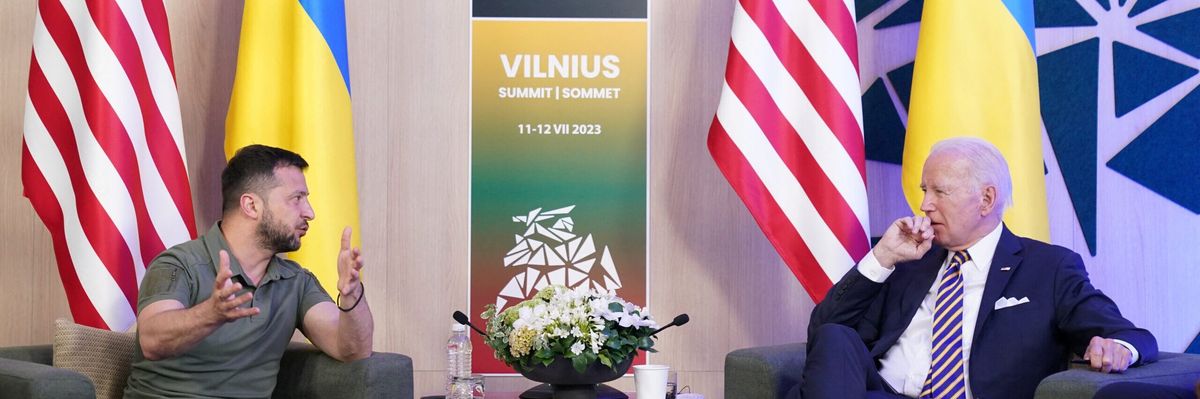
Amid all the talk at the NATO summit this week about alliance unity and support for Ukraine, a bigger issue was ignored: America’s strategy for the alliance is failing.
Ukraine’s long-anticipated counteroffensive — its bid to compel the Kremlin’s capitulation by driving Russian forces from the Donbass and Crimea — is foundering in the face of Russia’s massive defensive fortifications, large numbers of replenished troops, and growing dominance of the skies near the war’s front lines.
Ukraine is fast depleting its supplies of soldiers, artillery shells, and air defense missiles, and the West cannot train enough troops or manufacture enough weapons to change that bleak picture anytime soon. Nor can the United States continue to draw down its existing military stockpiles without compromising its ability to deal with a potential crisis with China. As a result, NATO’s strategy for ending the war, which is premised on the counteroffensive’s success, appears increasingly quixotic.
America’s broader strategy in Europe is also failing. NATO’s original purpose was to prevent the rise of a European hegemon that could threaten America’s own security and economic prosperity. It aimed to reassure U.S. partners that Washington would neither abandon them in the face of Soviet aggression nor leave Germany free to rebuild an independent military and rekindle old aspirations to dominate the continent. In return for protection under America’s military umbrella, Western Europe was able to focus on economic growth that made it less and less susceptible to communist subversion, while buying time for the Soviet system to wither and rot. That old strategy was a resounding success.
With the fall of the Berlin Wall, however, America’s foreign policy elites shifted their sights: rather than block the rise of a rival hegemon that might dominate Europe, the United States has maneuvered to become the continent’s supreme power, aiming to turn all Eastern Europe into an American protectorate. The twin expansion of NATO and the European Union has spread prosperity across the continent, but it has rendered Europe all but incapable of creating an autonomous military capability or pursuing a foreign policy independent of Washington, and it has left Russia outside Europe’s key institutions, increasingly incentivized to undermine rather than support them.
This approach could succeed only if the Russians were to acquiesce. But every Kremlin leader since Gorbachev has rejected the notion of a NATO-centric Europe in which Moscow has little or no voice in key decisions affecting its security. Our chances of force-feeding it to Putin or any likely successor are diminishing by the day as Ukraine’s counteroffensive sputters.
Meanwhile, Europe itself is increasingly divided over the premises of Washington’s strategy. German prosperity — the engine of Europe’s broader growth — has for years been based on low defense spending and access to cheap Russian energy that fueled its export-driven economy. Putin’s invasion of Ukraine effectively ended that access, increasing Germany’s dependence on expensive American energy.
And to deal with the twin dangers posed by Russia and China, Washington is putting increasing pressure on Germany and other parts of “old Europe” both to step up their defense spending and restrict trade and investment in China. The slow pace of German arms deliveries to Ukraine and Chancellor Scholz’s high-profile trade visit to China last fall are signs that “spend more and earn less” is unlikely to be an attractive bargain for Berlin.
Meanwhile, many of the alliance’s newer members, led by Poland and the Baltic states, are putting pressure on the United States to back up security guarantees it has provided but never wanted to enforce. They see Russia’s invasion of Ukraine as both an imminent threat to their own security and an implicit test of Washington’s treaty commitment to come to their defense. They call for massive qualitative and quantitative increases in Western military aid to Ukraine, arguing that Russia is highly unlikely to risk a direct clash with NATO in response, even if its forces were facing defeat.
And they insist on providing Ukraine with NATO membership as soon as possible, claiming that such a security commitment will preclude rather than provoke more Russian aggression.
Washington has attempted to avoid the hard choices these conflicting pressures require. We have ruled out any compromises that might increase the chances of a negotiated peace with Russia, believing we can compel a Russian surrender in Ukraine on the cheap, without risking much deeper NATO involvement in the war and all the dangers that would attend it. We have insisted on greater European burden-sharing and reduced trade with Russia and China, yet still expect Europe to surrender its independence on key foreign policy issues. Washington’s large group of hawks has treated American security guarantees as a magic talisman that will prevent Russia or any other rival from challenging them, relieving the need for enforcement.
A new American strategy is long overdue. Our immediate aim should be to thwart Russia’s ability to reconquer Ukraine, which is achievable without deeper NATO involvement in the war, rather than to drive Russian forces out of the Donbass and Crimea, which is not.
We should couple this defensive support with a diplomatic offensive that incentivizes Moscow to end the fighting, not prolong it to block Ukraine’s reconstruction and preclude its membership in NATO. Rather than continue to expand NATO’s roster and take on new out-of-area missions, we should return NATO to its original defensive purpose, increase Europe’s role in arming and leading the alliance, and support greater European autonomy in the world, which would reduce the risks and burdens for America in dealing with Russia and China.
We did not see such a shift at Vilnius. The abortive rebellion of the Wagner mercenary group last month has raised hopes in Washington that Russia might implode, lose the war in Ukraine, and enable the United States to avoid difficult trade-offs. But hope, as the saying goes, is not a strategy.