

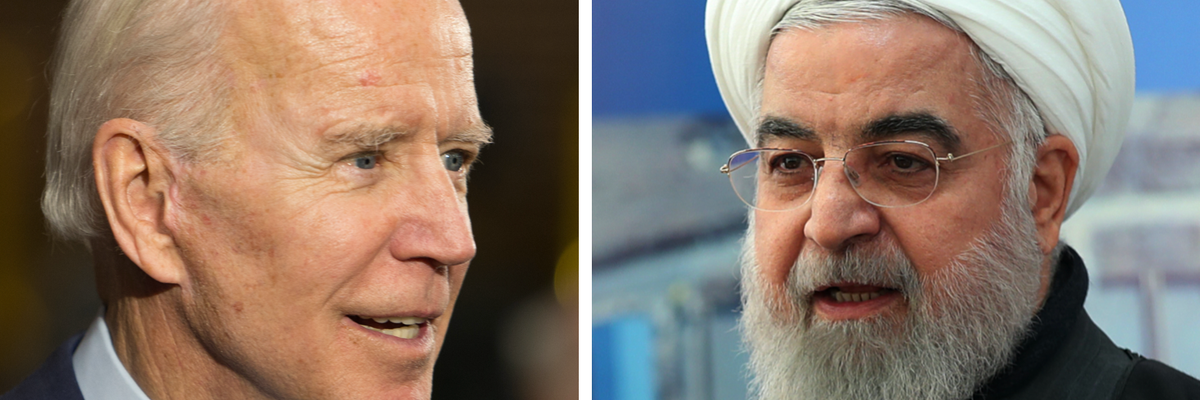
He’s only been president for a bit more than a week, but Joe Biden’s promise to return to the 2015 nuclear deal (the Joint Comprehensive Plan of Action) with Iran has already hit a roadblock. While the United States and Iran both publicly favor returning to the nuclear deal, they both also insist that the other must take the first step. As heated as some of the rhetoric has been between the two sides, the “who goes first” problem has been prevalent throughout diplomacy on Iran’s nuclear program, so there are nonetheless good reasons to remain calm.
Both Washington and Tehran have accepted a mechanism for restoring the JCPOA: compliance for compliance. It is as simple and straightforward as it gets. Both sides simply comply with all of their JCPOA obligations with no preconditions. The Iranians drop their insistence that Washington compensate Tehran for having breached the deal in the first place, and the U.S. side refrains from using Donald Trump’s sanctions as “leverage” to extract concessions from Iran before returning to the deal. Once both are in compliance with the deal, negotiations over disagreements and changes to the deal can begin.
As simple as this formula is, however, it doesn't resolve the question of who should take the first step.
Without providing any particular justification, Biden and Secretary of State Tony Blinken have stated that the United States will go into full compliance once the Iranians have done the same. In other words, the burden is Tehran to take the first step.
The Iranians argue that it was Washington that breached and left the deal —Iran has remained a party to the deal throughout this period, as acknowledged by the other five signatories (the United Kingdom, France, Germany, Russia, and China)— and, as a result, logic dictates that the United States go first.
Diplomacy seems stuck even before it has begun. Or is it?
Arguing about who should go first may well be more posturing than substance. The Biden team is not yet fully staffed; it may not even be in a position to take the first step. But presenting the “delay” as a tough negotiation position may make Biden look strong to domestic audiences.
Not surprisingly, neither side wants to appear too eager to get back into the deal — even though both recognize how much they need the JCPOA. So, as part of the public negotiation, posturing and playing hard to get may be useful to both.
Tehran’s firm public insistence that the United States go first may cause Iran to look overeager. But it also signals to domestic audiences in Iran that the Rouhani government isn’t naive. Due to Trump’s betrayal of the deal, coming across as soft or trustful of Washington won’t help Rouhani or his foreign minister, Javad Zarif.
And even if this public fight is more than posturing, optimism is still warranted. There was plenty of “who goes first” drama in the JCPOA negotiations as well.
Each time, however, the drama was defused thanks to two factors. Both sides possessed enough political will. And they both had enough time to reach creative solutions to problems as they came up.
This time around, the political will exists as well. On the other hand, time is short.
Both countries have the political will because rejoining the deal squarely lies in their respective national interests.
For Washington, the JCPOA not only blocks Iran’s pathways to a bomb, but it is also a necessary step to enable the United States to significantly reduce its military footprint in the Middle East.
Moreover, diplomatic efforts to deescalate regional conflicts — from Syria to Yemen—can’t begin in earnest until the JCPOA is restored and the nuclear dispute is removed as a major point of tension between the United States and Iran.
For Tehran, the JCPOA doesn’t just lift sanctions that have crippled the Iranian economy. It also offers a pathway for Iran’s political and economic rehabilitation regionally and globally. And ending Washington’s 40-year-old campaign to contain and isolate the Islamic Republic.
So there is little reason to believe that either party lacks political will. Time, however, is a different story. Rouhani’s hardline political opponents in the Iranian Majlis have passed a law that requires Iran to begin 20 percent enrichment of uranium if Washington fails to lift sanctions on Iran by the end of next month.
Moreover, the Iranian presidential elections take place in mid-June this year. Thus, the political season will begin in earnest by the Persian new year (Nowruz) in March, after which negotiations to revive the JCPOA will likely become a political football that will make impossible serious negotiations until a new president takes office.
So, while the political will exist, the time to find creative solutions is short.
Ultimately, however, there’s more room for optimism than pessimism for one very simple reason: too much is at stake for both sides to risk losing what may be the last opportunity to revive an agreement that so squarely advances their interests and security.