

The narrow window of opportunity to end the Yemen war that opened in late 2019 may fast be closing. Fighting along key front lines in northern Yemen, along with Huthi rebel missile strikes and the resumption of Saudi-led aerial bombardment, threatens to tilt the conflict toward a major escalation, reversing tentative steps toward dialogue. There is still a chance to break the cycle by expanding newly opened communication channels between Huthi rebels (who call themselves Ansar Allah) and Saudi Arabia to include the internationally recognised Yemeni government and others in order to negotiate a truce on all major fronts. But success will require a coordinated and continuous regional and international effort.
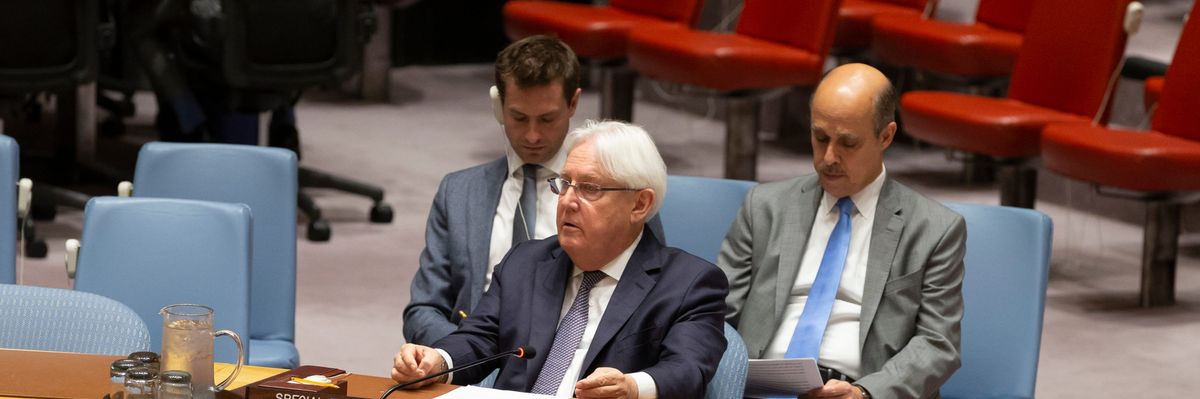
The swing from stalemate and de-escalation to shooting war was sudden. On 18 January, after a month that UN Envoy Martin Griffiths described as one of the conflict’s quietest periods, the government alleges that the Huthis launched missiles at one of its military camps in Marib governorate (the Huthis refuse to confirm responsibility). The strike reportedly killed more than 100 soldiers in one of the war’s deadliest single incidents to date. It came amid intensified combat along previously stalemated front lines in al-Jawf, Nihm and Marib between allies of the Huthis, on one side, and of the government, on the other. These battles became still fiercer after the strike, with both sides suffering heavy losses. The Huthis have since fired several more missiles at military facilities in Marib. Saudi Arabia, in turn, has ramped up its air campaign, launching dozens of raids in what the Huthis argue is a breach of a putative cross-border truce. Saudi officials label the fighting a Huthi attempt to take advantage of border ceasefire negotiations under way since October. For now, neither the Huthis nor the Saudis wish to abandon the talks, but the de-escalation process is under severe strain.
The fighting underscores the limitations of the current piecemeal regional and international approach to ending the war. This approach, in which Saudi Arabia has taken the lead on the key negotiating tracks in the south and on the border, has been as much about firefighting as conflict prevention. The UN is struggling to sustain the year-old Stockholm Agreement to prevent a battle for the Red Sea port of Hodeida. Saudi Arabia, meanwhile, is pressuring the government and the secessionist Southern Transitional Council (STC) to firm up the November 2019 Riyadh Agreement that ended fighting over the southern port city of Aden. Many observers, including Crisis Group, had hoped that the parties could thread these two disparate tracks together with the Saudi-Huthi border de-escalation into a single UN-led process to end the war. Progress in demilitarising Hodeida would, under this view, build confidence among the Yemeni parties; the Riyadh Agreement would prevent a war-within-a-war and lay the groundwork for forming a more inclusive government; and the Saudi-Huthi talks would help remove Yemen from the regional power struggle between the U.S. and its allies, on one hand, and Iran, on the other.
Recent events, however, suggest that the piecemeal approach rests on inherently weak foundations: a series of bilateral agreements designed to halt specific parts of the conflict without tackling their underlying causes, something only national multiparty talks can achieve. Left unaddressed is the fighting between government-aligned forces and the Huthis on fronts in the north and south, making the approach’s success or failure vulnerable to events on the ground. The cause of the sudden escalation in the north is contested, with both the Huthis and the government claiming they are taking defensive measures in response to their rivals’ premeditated aggression. In explaining their expanded military activities, the Huthis cite a series of alleged Saudi airstrikes and ground attacks they say took place before the 18 January missile strike. The government says the Huthis had launched a series of small-scale raids on strategic positions, including highways in government-controlled areas, over the course of January before the Marib strike. What triggered the fighting may in fact have been a local dispute over a checkpoint in al-Jawf governorate early in the month that gradually spiralled out of control.
Regardless, it is clear that both parties had been preparing for renewed hostilities in the north after a long period of stalemate. The Huthis and the government each claimed their rivals were planning major new operations in the weeks and months before the escalation. Huthi fears may have grown in recent weeks as government forces previously based in the south of Yemen were redeployed to Marib as part of the Riyadh Agreement.
The fighting in the north will have a knock-on effect on each of the ongoing negotiation tracks. Saudi-Huthi talks continue but are strained; hawks in both camps have arguably gained traction, and they have come close to scuttling discussions on several occasions. The Riyadh Agreement has also come under stress since the 18 January missile strike, in part because the Huthis’ refusal to claim it encourages speculation about its provenance.
Pro-government news sites and social media have spread an unlikely rumour that either the United Arab Emirates (UAE) or the STC, the secessionist grouping aligned with Abu Dhabi, fired the missiles. A number of government officials note that the UAE removed its Patriot missile defence system from Marib in mid-2019, leaving the area vulnerable to Huthi short-range missile attacks. Pro-government media have also used the fighting in the north as an opportunity to lambast the Stockholm Agreement, which they see as an artificial stalemate imposed from outside. The government has publicly threatened to leave the agreement. The renewed focus on Stockholm is in part motivated by concern that Saudi Arabia and the UN are close to negotiating a truce in the north at a time when the Huthis remain dominant on the ground. But it may also portend renewed hostilities along the Red Sea coast.
At the time of writing, the Huthis appeared to be making the biggest gains on the battlefield, reportedly controlling the important Nihm front north east of Sanaa after several days in which both sides claimed a series of largely symbolic victories while suffering numerous casualties. In a sign of deep frustration and fatigue among ordinary Yemenis, public criticism has turned inward: the Huthis’ tribal allies have criticised the rebels for the high cost of what are likely inconclusive battles, while the government’s supporters have similarly reproached President Abed Rabbo Mansour Hadi for failing to gain ground on the Huthis. Some voices in the anti-Huthi bloc blame Riyadh for providing insufficient support at what they believe was a potential turning point in the war.
The fighting could spark renewed conflict elsewhere in Yemen. Many in the anti-Huthi bloc see it as an opportunity to attend to unfinished business. The widespread narrative in their ranks is that the Stockholm Agreement forestalled a pivotal battle that would have weakened the Huthis and allowed for a national political settlement on more equitable terms. With fighting already raging in the north and in the southern governorate of al-Dhale, many in the anti-Huthi camp believe they could make a renewed push for Hodeida and reignite battles along the border in a rare, coordinated multifront campaign. Many Huthis suspect such a battle was the Riyadh Agreement’s real aim all along. Hawks in the Huthi camp, meanwhile, appear to relish the prospect of a national showdown particularly if, as seemed to be the case at the time of writing, they have come out on top in the latest round of fighting.
An expansion of the conflict would be a devastating blow to current efforts to end the war. Senior Huthi officials have staked their reputations on the de-escalation initiative with the Saudis, and would likely lose considerable capital within the movement if it fails. Saudi as well as Huthi military leaders were already sceptical of the de-escalation effort and may decide that the only option now is outright military victory. In addition, developments in the U.S.-Iran rivalry may well have motivated Riyadh’s decision to negotiate with the Huthis, following a missile attack on vital Saudi Arabian oil production facilities in September 2019 that was claimed by the Huthis, but widely attributed to Iran. Arguably fearful of a regional war in which U.S. support was uncertain, Riyadh may have sought to mitigate the risk along its southern border by de-escalating with the Huthis and seeking to drive a wedge between them and Iran. But Saudi officials might also have reappraised this approach (or at least slowed it down) after unrest in Iran, huge protests in Iraq and Lebanon, and the U.S. killing of Qassem Soleimani, the architect of Iran’s regional asymmetrical war strategy, in early January.
The uptick in violence is extremely worrying, yet actors supporting the political track may still be able to reverse the current trajectory. Crisis Group recommends the following:
• The UN Security Council should echo UN Envoy Griffiths’ call for a de-escalation, and urge a truce on all fronts or, even stronger, steps toward a nationwide ceasefire, reiterating the point that the only solution to the Yemen war is a political one.
• The U.S. in particular should push Saudi Arabia, and the UN, the EU and Oman should press the Huthis, to continue talks, maintain the cross-border truce and implement further bilateral de-escalation measures. In parallel, the U.S. and the UN should encourage Saudi Arabia to bring the Yemeni government and its allies into negotiations with the Huthis.
• The UN should lead the establishment of a national military body, comprising senior military representatives from the government, the Huthi movement, key military officers on major frontlines (as some anti-Huthi commanders like Tariq Saleh on the Red Sea coast do not fall under the direct authority of the government) and Saudi Arabia, overseen by the UN and advised by international ceasefire planning experts. This body would be charged with planning and implementing frontline truces and reopening key roads. It would include political liaisons capable of transmitting proposals directly to their leaders.
• International and regional support as well as coordination for such an initiative would be critical. Crisis Group has advocated in the past for the formation of a contact group of key regional and international stakeholders including Saudi Arabia, the UAE, Kuwait and Oman, as well as the U.S., UK and EU. Such a grouping could meet regularly and divide labour for outreach, pressure and the provision of technical expertise, taking its cues from the UN envoy. A meeting of such a group should take place as soon as possible, making the formation of a military body its immediate task.
The present scenario is wearyingly familiar: modest advances toward a political settlement undone by local fighting that explodes into a national escalation, driven by overconfidence or miscalculation on the part of key protagonists. There still is time to stop this dangerous slide, but it may fast run out.
This article has been republished with permission from the International Crisis Group.