

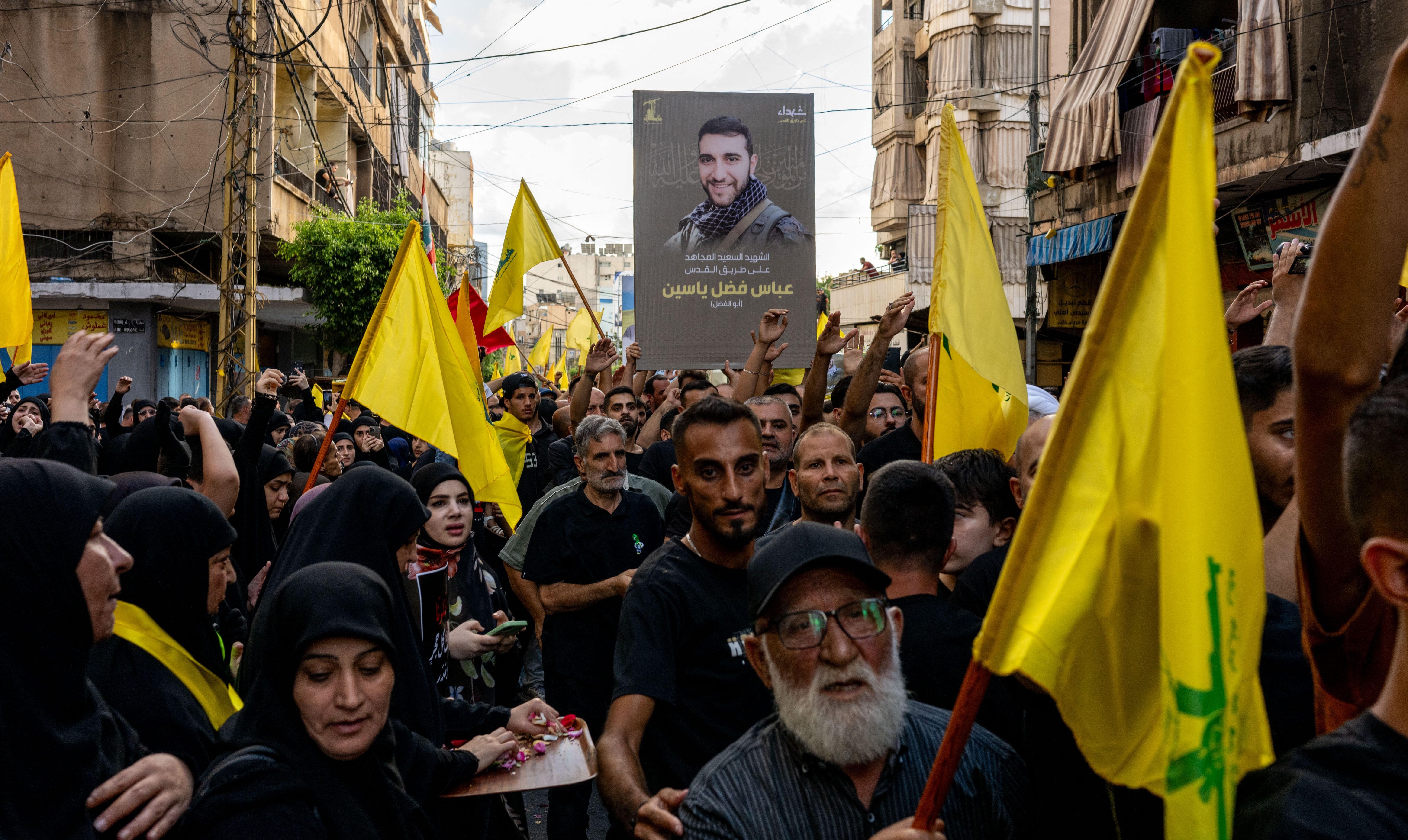
The remotely triggered bombings in Lebanon using rigged pagers and walkie-talkies are a more clandestine version of what Israel has been doing with deadly force for some time and especially during the past year. One feature of Israel’s lethal campaigns is low regard for the lives of innocent civilians. Putting explosives in thousands of innocuous looking communication devices was certain, when detonated, to maim many people throughout Lebanon who never have fought against Israel, including people who are not even members of Hezbollah.
The pager bombings, besides killing a dozen people, overwhelmed health care facilities with 2,800 wounded, many of whom lost eyes or fingers or suffered other grievous wounds. Among the dead were an 8-year-old girl, and 11-year-old boy, and four health care workers. Exploding walkie-talkies the next day killed an additional 20 people and wounded 450.
The indiscriminate nature of the suffering mirrors what Israel has done in the Gaza Strip during the past 11 months, where it so far has killed more than 40,000 residents, including more than 11,000 children, and wounded nearly 100,000 more, in addition to turning into rubble most infrastructure needed for daily living.
Another feature of the Israeli use of deadly force is that it has represented most of the escalation that has occurred between Israel and its adversaries. This obviously has been true in the Gaza Strip, where the death and destruction Israel has inflicted vastly exceed the Hamas attack last October, to which the Israeli assault is ostensibly a response. It has been true of accelerated Israeli military operations in the occupied West Bank, where the casualties Israel has inflicted during the past year, including on children and other innocent civilians, are many times greater than what Palestinians there have done to Israelis.
Along the Israeli-Lebanese frontier that has seen exchanges of fire between Israel and Hezbollah during the past year, Israel has carried out five times as many attacks as Hezbollah has attempted in the other direction, causing 10 times as many casualties, including civilian casualties.
Now the exploding communication devices, given the magnitude and geographic extent of the resulting casualties, represent yet another major Israeli escalation. As if that were not enough, the day after the walkie-talkies exploded, Israel conducted its deadliest airstrike against Beirut since the current round of fighting began last October.
The pager attacks have stimulated a flurry of instant analysis centered on how the attacks fit into Israeli strategy, what the Israelis hoped to accomplish, and specifically the question of “why now.” It is analytically hazardous to try to make sense of the attacks in these terms, because — like much other Israeli use of lethal violence during the past year — they are not driven mainly by careful calculation of what is in Israel’s long-term interests.
One of the main drivers has instead been the personal motivations of Prime Minister Benjamin Netanyahu, who sees continued and even escalated warfare as his only ticket to holding his far-right coalition together, thus staying in power as well as putting off the day he has to confront fully the corruption charges against him.
Another driver is emotional rather than strategic and involves a widespread Israeli hatred of Arabs that was made even more intense and indiscriminate amid the understandable anger over the Hamas attack last October.
The nature of the operation involving explosive-laden communication devices constitutes in effect another driver. An operation this large and sophisticated, involving infiltration of supply lines and probably the creation of shell companies, had to have been planned and begun long ago. It is thus pointless to try to answer the question “why now” by speculating about what was going through the minds of the creators of the operation years earlier.
Once begun, the operation acquired an inexorable momentum of its own. It is the kind of operation that, while entailing much effort and expense, could quickly be rendered useless if compromised. If one of those thousands of pagers had prematurely detonated, or if Hezbollah leaders had otherwise gotten wind of the operation, the devices would all have been promptly discarded.
Perhaps the Israelis were given reason to believe that Hezbollah was close to discovering the operation. It was at least as likely that the mere possibility of compromise made the whole caper a “use it or lose it” affair in which Israeli leaders decided they had to execute the plan soon after the preparations were in place if they were ever to execute it at all.
The situation has shades of the situation involving European powers before World War I, when railroad timetables and their role in mobilizing mass armies had an inexorable momentum of their own. Once begun, a preparation for war made it difficult to stop the slide into war itself.
None of what Israel has been doing to Hezbollah lately, including the operation involving the pagers and walkie-talkies, advances even immediate Israeli security objectives, let alone long-term ones. Currently the principal declared Israeli objective regarding the Lebanese frontier and the confrontation with Hezbollah is to enable Israeli residents who have been evacuated from northern Israel to return to their homes. Ramping up the violence and tensions along the border does not make that objective more obtainable, and further escalation to full-scale war would not either.
The pager and walkie-talkie attacks may have been an effort to strike a significant blow against Hezbollah without resorting to full-scale war, including a ground invasion of Lebanon. Alternatively, it may have been preparation for such an invasion by weakening Hezbollah’s ability to defend itself.
Either way, Hezbollah feels under heavy pressure to respond. It retains the capability to do so despite any weakening from the pager attacks. Hezbollah leader Hassan Nasrallah has publicly vowed to retaliate at times and places of Hezbollah’s choosing. Hezbollah has good reasons to continue to try to avoid all-out war, but the recent Israeli actions are too offensive to go unanswered.
Hezbollah’s ally Iran also wants to avoid wider war in the Middle East and certainly one that would involve Iran itself. The Iranian regime has so far shown remarkable restraint in the face of Israeli escalation, including not responding as yet to Israel’s assassination in July of Hamas political leader Ismail Haniyeh at a government guest house in Tehran. But one must wonder what the limits are to Iranian patience in the face of continued Israeli offenses.
In Washington, a key question is what the limits of U.S. patience are in the face of the same Israeli offences. The techno-terrorism in Lebanon comes on top of repeated Israeli pokes in the eye of the United States, whether it is Netanyahu’s succession of excuses for blocking a ceasefire in Gaza or Israel’s escalation of its conflict with Hezbollah at the very time a U.S. envoy was in the region attempting to de-escalate the conflict.
Besides the broader political and diplomatic costs that the United States suffers from its close association with Israel, the obvious double standards involved weaken U.S. credibility in criticizing the misconduct of other regimes. For example, U.S. criticism of what Russia is doing in Ukraine — including military occupation of someone else’s territory and infliction of many civilian casualties — and of other countries’ material support to the Russian war effort is made less credible by continued U.S. material support to what Israel is doing in Gaza.
Now the episode with the pagers and walkie-talkies draws attention to the glaring double standard in the U.S. approach to terrorism, thus weakening further the credibility of declared U.S. opposition to terrorism. Imagine if, say, Iran — which has considerable capability to harm others through manipulation of electronic devices — were to conduct an operation exactly like the one Israel just did in Lebanon, aimed at the Israeli military and with the same assortment of civilian casualties. There would be, of course, a mighty uproar from the White House and Congress, denouncing this horrific act of terrorism from the “world’s number one state sponsor of terrorism” and calling for some sort of retribution.
In contrast, the Biden administration has not mustered a peep of public criticism of what Israel just did in Lebanon. When forced in press briefings to address the subject, spokespersons for the White House and State Department refused even to say whether what took place was terrorism and whether it represented a legitimate form of warfare. White House press secretary Karine Jean-Pierre only said something about how children and other people being harmed is “not something that we want to see.” State Department spokesperson Matthew Miller said “we do believe it's a legitimate practice for any country to defend itself by fighting terrorist organizations,” apparently confusing who in this instance was the terrorist and who was the target of the terrorism.
The proper U.S. response would be not only to recognize terrorism for what it is and to oppose it no matter who does it, but also to protect its own interests by moving away from close association with what has increasingly become a rogue state. Those with genuine sympathy for Israelis and their security — including self-declared Zionist Joe Biden — should bear in mind that it hurts rather than helps Israelis’ own long-term interests to use technical prowess not to make the desert bloom in cooperation with others who live there but instead to set in motion ever more violence and conflict with the other people in the region.
The same was true of the nations whose leaders set the mobilization trains in motion in 1914.
- Will US troops be drawn into the Israel-Gaza war? ›
- Hezbollah leader ups ante after attack on Iranian consulate ›
- As bombs fly, are Americans in Lebanon on their own? | Responsible Statecraft ›
- Biden is letting Israel trap the US into war with Iran | Responsible Statecraft ›
- Is Biden too weak or unwilling to stop a 'Sarajevo moment'? | Responsible Statecraft ›