

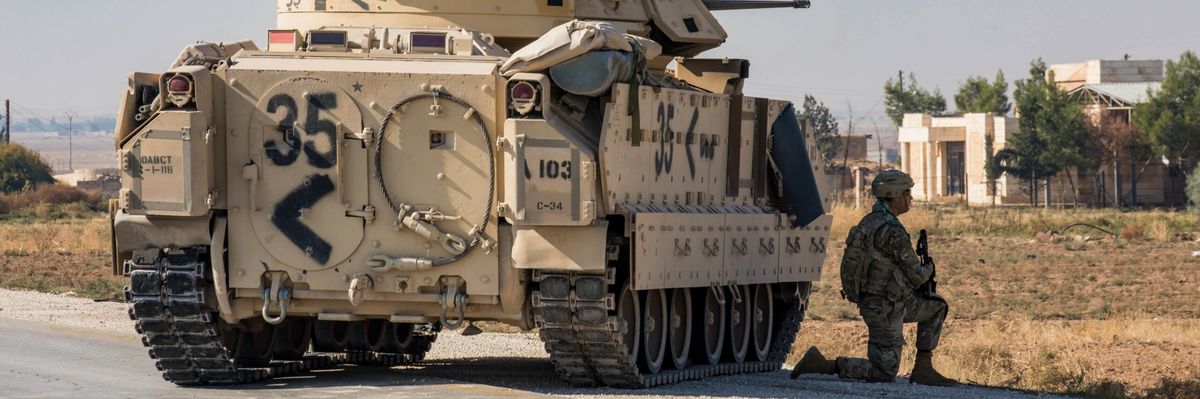
From time to time come reminders that American troops are still in places where they supposedly had stopped participating in the “forever wars.” Usually, the reminder comes in the form of attacks on those troops. Even if the official description of these service members is that they are not engaged in combat, they nonetheless are getting shot at. Such has been the case with a spate of recent attacks on facilities inhabited by the 2,500 U.S. troops in Iraq and the nearly 1,000 in Syria.
Probably most Americans would have a hard time identifying the mission that these troops supposedly are performing. Officially, the stated mission involves preventing any resurgence by the group known as Islamic State or ISIS. But Iran keeps figuring into official thinking as well. The Trump administration’s envoy for Syria said one of the reasons the United States was in Syria was to get Iran out of Syria — without explaining just how the former was supposed to accomplish the latter. And under the current administration, Iran gets frequently mentioned in almost any official comments about Iraq and the U.S. military presence there.
The twin missions of countering ISIS and Iran immediately lead to a contradiction. Those two actors have been on opposite sides of the fiercest conflicts in recent years in both Iraq and Syria. Iran was the most significant source of outside assistance to the Iraqi regime in battling ISIS. It similarly has been one of the two biggest outside supporters (Russia being the other) in aiding the Syrian regime.
The job of countering ISIS is far different from what it was several years ago, when the group had established a de facto ministate in large swaths of territory in western Iraq and northeastern Syria. The “caliphate” of ISIS is no more. From the viewpoint of U.S. interests, the main remaining concern about ISIS should be less one of conventional military operations and more one of resentments the group can exploit in aiming possible terrorist operations against the United States. History has shown that a prime exploitable resentment underlying international terrorism has been the presence of foreign troops that comes to be seen — as the U.S. presence in Iraq especially came to be seen — as a military occupation.
In an early phase of the civil war in Syria, the beleaguered Assad regime welcomed the presence of ISIS as a way of propagandizing to the world that the regime was fighting against international terrorists. That situation also has changed greatly, with the regime having come back from its previous precarious situation and now being more concerned with eliminating the remaining pockets of resistance to its rule. The Assad regime and ISIS are now actively engaged against each other as enemies on the battlefield. The regime also can honestly present itself as fighting against international terrorists because of how the main pocket of anti-regime resistance, in Idlib province, is dominated by an affiliate of al-Qaeda. Insofar as U.S. policy toward, and military presence in, Syria retains an anti-regime orientation, it is hard to see how this serves the purpose of counterterrorism.
As for countering Iran, keeping troops in Iraq overlooks relevant aspects of Iraqi sentiment and Iraqi politics. Strong Iraqi nationalism opposes any foreign military presence on Iraqi soil, whether that military has come from the east or from the west. Two years ago, amid chants of “Baghdad is free, out with America,” the Iraqi parliament voted in favor of ousting all foreign troops. Although both Baghdad and Tehran see good reason to keep their relations cordial enough to avoid anything like the enormously costly Iran-Iraq War of the 1980s, the same Iraqi nationalism will check the presence and influence of Iran on Iraqi soil.
Iraqi parliamentary elections last fall, the results of which were announced in December, reinforce this point. The principal winner was the Shia cleric Muqtada al-Sadr, who bested parties associated with militias seen as pro-Iranian. Al-Sadr was regarded as a foe of the United States in the insurgency that developed after the U.S. invasion in 2003, but he is now the principal bulwark against Iranian influence in Iraq.
In Syria, with the regime having largely won the civil war with the aid of its Russian and Iranian allies, Syrian tolerance for a continued and substantial Russian and Iranian presence will correlate with the extent to which what is left of the war drags on and the regime falls short of regaining control of all Syrian territory. U.S. troops camped out on Syria soil, far from giving Damascus any incentive to push Iranians out, is likely to have the opposite effect. The same is true of the continuing Israeli aerial assaults on Syrian territory.
Meanwhile, keeping U.S. troops in Iraq and Syria has other costs and risks in addition to the terrorism-stimulating resentment and the incentive for keeping Iranians or Russians around. Most obviously, U.S. citizens are in harm’s way and could get hurt. Fortunately the most recent attacks did not incur U.S. casualties, but at other times American service members in those places have not been so fortunate.
The U.S. presence also presents the risk of military escalation. The United States will strike back, as it did this week in targeting a rocket launch site in Syria that was deemed to “pose an imminent threat” to a nearby U.S.-inhabited encampment. Retaliation for retaliation can sustain an escalatory spiral.
Despite this risk, the U.S. military often is quite vague about whom it is shooting at. The Pentagon spokesman could not or would not say who used that rocket launch site in Syria. An Operation Inherent Resolve statement attributed the preceding attack on the U.S. base in Syria to “Iran-supported malign actors.” That one adjective malign sweeps away any attention to the reasons American troops come under fire — much less why they should be in a place where they endure such danger in the first place — and implies without evidence that whoever is the adversary is out to harm Americans no matter what.
The continued presence of American troops in Iraq and Syria has become a lethal equivalent to a self-licking ice cream cone. Supposedly they are countering a threat from Iran, but the only such threat that is identifiable is to the troops themselves. This perversely circular reasoning is not a valid reason to keep American service members in Iraq and Syria. They should come home.